New Delhi: Kerala start-up delivers cutting-edge Akasha300 3D Printer to ISRO in a major step towards India’s self-reliance in advanced manufacturing. A Kerala-based deep-tech company has successfully supplied a high-performance industrial 3D printer to a key ISRO facility, strengthening indigenous capabilities in aerospace and defence production.
This development highlights the growing role of Indian startups in strategic sectors and aligns with the government’s push for “Make in India” and technological independence.
What is Akasha300 3D Printer
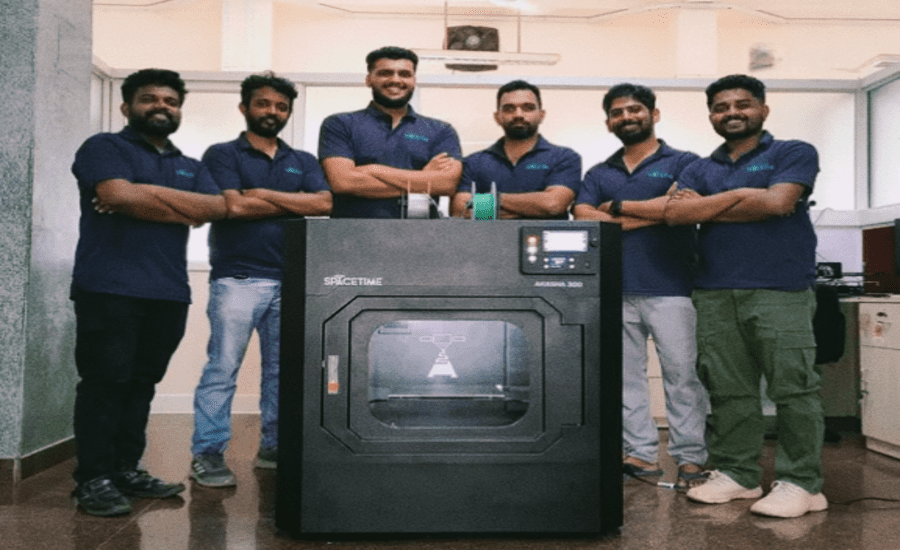
A Kerala-based startup, Spacetime 4D Printing Solution, has delivered its flagship Akasha300 3D printer to ISRO’s Liquid Propulsion Systems Centre (LPSC) in Valiyamala.
Read also: Explained: How ISRO’s GISAT-1A Will Transform Real-Time Earth Observation for India
This marks a significant collaboration between a young Indian startup and one of the country’s top space research organisations.
The achievement shows how startups are now directly contributing to India’s strategic programmes like space exploration and defence manufacturing.
Why is Akasha300 3D Printer Important
The Akasha300 is not a regular 3D printer. It is designed for high-end industrial and research applications.
What are the Features of Akasha300 3D Printer
- High-temperature printing up to 350°C (upgradeable to 500°C)
- Dual-extrusion system for multi-material printing
- Can process advanced polymers and composite materials
- Heated bed up to 110–150°C
- Enclosed chamber up to 80°C for stability
- Modular design for future upgrades
These features allow the printer to manufacture strong, heat-resistant components, which are essential for aerospace and defence sectors.
Why This Matters for ISRO
ISRO’s Liquid Propulsion Systems Centre (LPSC) plays a key role in rocket engine and propulsion technology.
With the Akasha300, ISRO can:
- Develop advanced components faster
- Reduce dependency on imports
- Improve prototype testing and production speed
- Experiment with new materials for space missions
This makes research more efficient and cost-effective.
Boost to ‘Make in India’ and Self-Reliance
The startup aims to build indigenous additive manufacturing systems, reducing reliance on foreign technology.
India has been focusing on building a strong domestic defence and aerospace ecosystem.
Initiatives like defence corridors and startup collaboration are helping:
- Promote local manufacturing
- Encourage innovation
- Strengthen national security capabilities
Strong Support from Kerala’s Innovation Ecosystem
The startup was supported by:
- Space Technology Innovation and Incubation Centre (STIIC)
- Indian Institute of Space Science and Technology (IIST)
- Kerala Startup Mission
Kerala is rapidly emerging as a defence and aerospace innovation hub, thanks to its skilled workforce and strong R&D ecosystem.