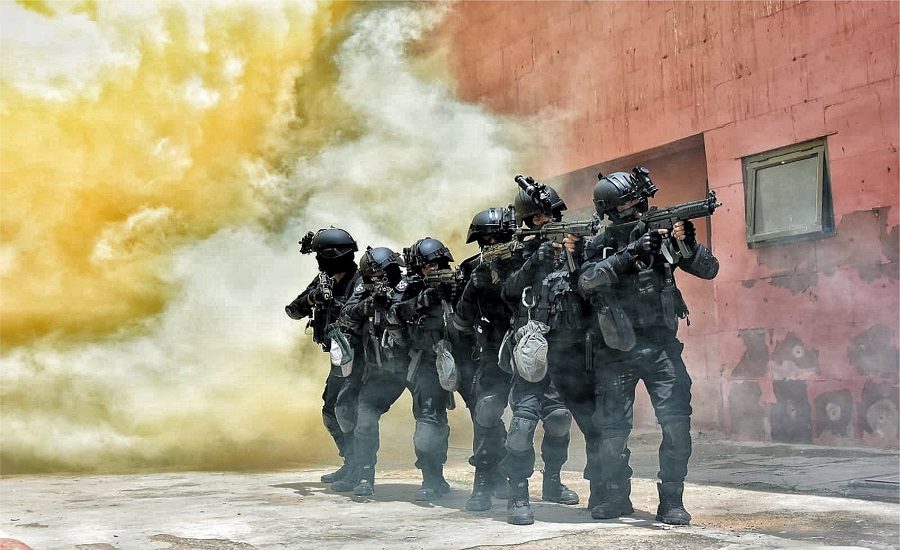
New Delhi: India’s elite anti-terror urban warfare force, the National Security Guard (NSG), participated in the four-day Dubai SWAT Challenge from 7–11 February 2026 but finished in a disappointing 62nd position out of 109 teams representing 48 countries.
The competition, organised by the Dubai Police, tested specialized urban warfare and counter-terror operations through realistic simulation exercises. Despite being the sole Indian unit at the event, the NSG team scored 236 points, significantly behind the winners from Kazakhstan, who scored 536 and 515 points, and other top-performing teams from China, Thailand, and Rwanda.
Top Performers and Comparative Rankings
Kazakhstan dominated the event, placing three teams in the top 10, while China and Thailand also secured top positions. Pakistan’s units—the Elite Punjab Police and Special Security Unit of Sindh Police—finished 68th and 90th, respectively.
A senior NSG official, requesting anonymity, emphasized:
“We participated in the competition for the first time, and it was just for familiarisation and exposure for our troops. Scores in the competition do not necessarily reflect the operational readiness and strength of any force.”
The official also expressed surprise at Kazakhstan’s performance, noting, “Based on these rankings and scores, one can assume Kazakhstan’s units are superior to Russians…is that even possible…?”
NSG’s Performance in Individual Stages
The Dubai SWAT Challenge involved five rigorous stages, each simulating real-world urban combat scenarios:
Assault Challenge – Teams competed in precision shooting exercises, testing speed and accuracy under simulated combat conditions.
Hostage Rescue – Teams of six breached structures, neutralized dummy targets, and rescued dummy hostages, while a sniper engaged long-range targets.
Officer Rescue – Four assault members and a sniper rescued a teammate acting as a casualty, navigating obstacles like large tyres within a stipulated time.
Tower Assault Challenge – Snipers climbed towers, rappelled down, cleared targets at close and long ranges, demonstrating precision firing under extreme conditions.
Obstacle Course Challenge – Fully geared in combat uniforms, team members completed 21 obstacles, including wall climbs, low-crawl sections, and other physical endurance tests.
NSG sources noted that the team excelled in the final stage, ranking third in the obstacle course challenge, highlighting their physical agility and coordination.
Purpose of Participation
The NSG’s involvement aimed at exposure and familiarisation with global counter-terror tactics rather than direct competition results. Participating alongside teams from the United States, Russia, China, and other nations provided the NSG with insights into international best practices and training methodologies.
The event saw multi-unit participation, including four units from the US, and six units each from China and Russia, including the Moscow Police.
About the Dubai SWAT Challenge
Organized annually, the Dubai SWAT Challenge tests urban warfare, hostage rescue, officer rescue, tower assaults, and obstacle navigation. Each team comprises five members, including snipers in four of the five stages, reflecting multi-dimensional tactical capabilities essential for elite law enforcement and counter-terror operations.
The NSG’s participation in the event marks a strategic move towards international exposure for India’s premier anti-terror force, even as it trails in global rankings.
About The NSG
The National Security Guard (NSG), commonly known as the Black Cats, is India’s premier federal contingency force established in 1984 to handle high-risk counter-terrorism and anti-hijacking operations. Operating under the Ministry of Home Affairs, the force is unique for its 100% deputation-based structure, drawing elite personnel from both the Indian Army (Special Action Group) and Central Armed Police Forces (Special Ranger Group). Renowned for their “Zero Error” philosophy and distinctive black tactical gear, the NSG has spearheaded critical missions like Operation Black Tornado during the 2008 Mumbai attacks and the 2016 Pathankot operation. To ensure a swift nationwide response, the force maintains regional hubs across India and operates the National Bomb Data Centre, cementing its role as the country’s ultimate strike force against unconventional threats.
Read also: India Approves 114 Rafale Jets, 6 P-8I Aircraft in ₹3.25 Lakh Crore Defence Deal