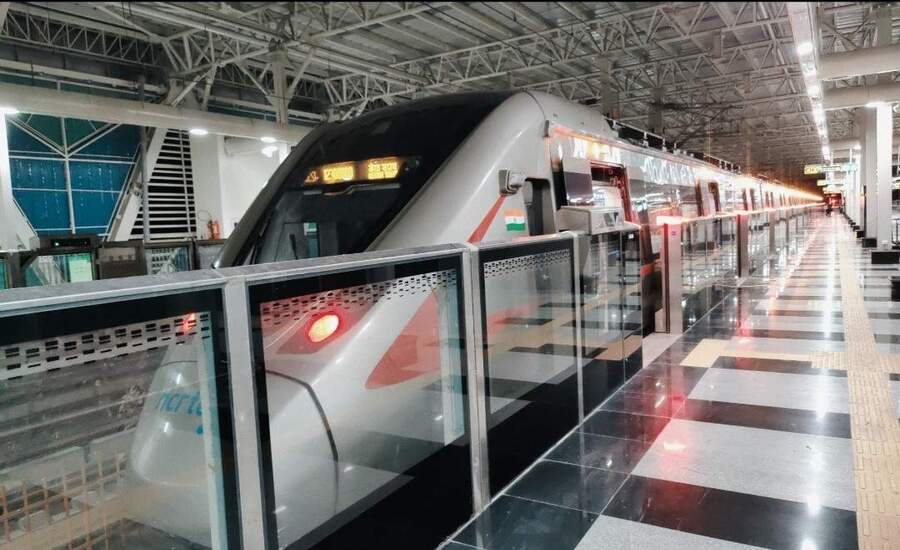
New Delhi: Prime Minister Narendra Modi flagged off the Meerut Metro and the Namo Bharat Train, marking a major milestone in India’s urban and regional transit expansion. The Meerut Metro and Namo Bharat train launch comes as part of the Delhi–Meerut Regional Rapid Transit System (RRTS) corridor, making travel between Delhi and Meerut faster and more efficient.
This initiative aims to revolutionize connectivity in the National Capital Region (NCR) by drastically cutting travel times and improving commuter experience.
Key Details
- Prime Minister Modi inaugurated both the Meerut Metro and Namo Bharat train services from the Shatabdi Nagar Namo Bharat Station in Meerut, Uttar Pradesh.
- Mr. Modi also took a metro ride to Meerut South Station, interacting with passengers including students.
- The event saw the presence of key dignitaries, including Uttar Pradesh Chief Minister Yogi Adityanath and other officials.
Importance of Delhi–Meerut Regional Rapid Transit System
- The Namo Bharat train operates under the Delhi–Meerut RRTS corridor, a semi-high-speed regional transit system designed for rapid travel between Delhi, Ghaziabad, and Meerut.
- The train service is expected to connect major urban hubs like Sarai Kale Khan, Sahibabad, Modinagar, and Meerut, significantly reducing travel time between the national capital and Meerut to under an hour.
- Meerut Metro now serves local connectivity between key locations within the city, blending into the larger RRTS infrastructure.
Faster Travel with Seamless Connectivity
- The combined system anticipates reducing travel time from Delhi to Meerut from several hours to around 55–60 minutes, a major improvement over road travel.
- This integration of metro and regional rail services on shared infrastructure is the first of its kind in India.
Boost to Infrastructure and Economy
- Alongside the transport services, the Prime Minister inaugurated and dedicated various development projects worth around ₹12,930 crore to the nation.
- These investments are expected to catalyse economic growth, improve urban mobility, and spur development across western Uttar Pradesh.
Major Impact of Delhi–Meerut Regional Rapid Transit System
- Residents and daily commuters between Delhi and Meerut can now expect faster, comfortable and efficient travel.
- The services are also expected to decongest road traffic, reduce environmental impact, and open up new opportunities for jobs and education.
Significance for Urban Mobility
- India’s metro network is now one of the largest in the world, with this expansion marking yet another leap forward.
- The integrated RRTS system reflects India’s focus on sustainable and modern urban transit solutions.