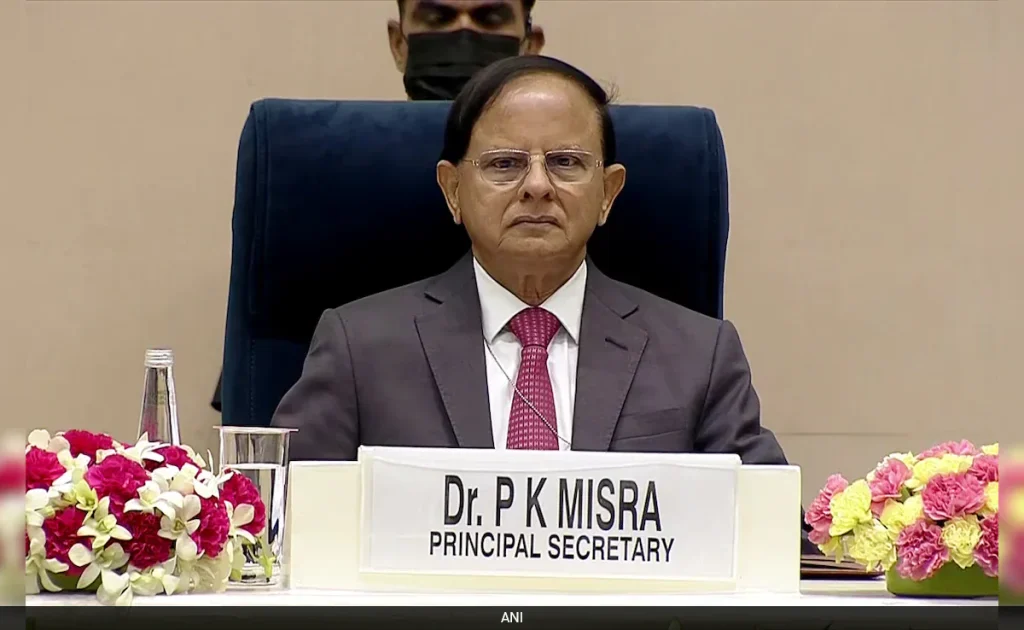
New Delhi: Public Sector Undertakings (PSUs) in India must not only excel domestically but also be prepared to compete internationally, Dr P.K. Mishra, a retired 1972 batch IAS officer of the Gujarat cadre and Principal Secretary to the Prime Minister, said on Friday. Speaking at the inaugural session of the second batch of DAKSH, a flagship leadership development programme for senior executives of Central Public Sector Enterprises (CPSEs), Mishra emphasized that global integration, technological change, and economic reforms have reshaped the domestic and international business landscape.
“In this changing context, expectations from PSUs have evolved,” Mr Mishra said. “They need to operate with greater agility while continuing to serve national priorities.”
He added that debates about public versus private sector dominance have gradually given way to a more integrated approach, where competitiveness, efficiency, and innovation are central to the performance of public sector enterprises.
Historical and Strategic Role of PSUs
Dr Mishra recalled that PSUs were pivotal in building India’s industrial and infrastructure base post-independence, laying the foundation for economic growth, financial stability, and national self-reliance. For decades, public enterprises formed the backbone of India’s development strategy, and they continue to play a strategic role in energy, defence, infrastructure, and finance, sectors critical for national stability and long-term growth.
Referring to the Public Sector Enterprise Policy of 2021, he highlighted the classification of CPSEs into strategic and non-strategic sectors. While private enterprises are expanding, public sector units remain essential in areas where market mechanisms alone cannot ensure national security or public welfare.
“PSUs also balance markets that are imperfect or where public goods and national interests are involved,” he noted.
Technology, Innovation, and Digital Public Infrastructure
Dr Mishra emphasized that CPSEs must adopt a technology-oriented and innovation-driven approach to maintain global competitiveness. He cited India’s digital public infrastructure (DPI), including the Unified Payments Interface (UPI) and advances in public sector banking, clean energy, and cybersecurity, as examples of how PSUs can lead in cutting-edge sectors while maintaining long-term trust and commitment.
“Public enterprises are uniquely positioned to lead in emerging domains like energy transition, data governance, and cybersecurity, where continuity and national trust are critical,” Mr Mishra said.
Leadership and Human Capital Development
Highlighting the importance of leadership, Mishra said that the quality of human capital is the ultimate driver of institutional success. He urged PSU executives to embrace continuous learning, adaptability, and strategic thinking, especially in an era of rapid technological change.
DAKSH Programme: Building Future Leaders
The DAKSH programme, jointly organised by the Capacity Building Commission (CBC) and the Standing Conference of Public Enterprises (SCOPE) under the Mission Karmayogi framework, aims to prepare senior CPSE executives for higher leadership roles while enabling them to address national priorities and global challenges.
Atul Sobti, Director General of SCOPE, said the programme would provide participants an opportunity for strategic development, leadership emergence, and international exposure.
Alka Mittal, Member, Capacity Building Commission, outlined the programme’s design, which combines:
- Digital learning modules
- Classroom engagement at leading institutions
- Executive coaching
- Live action learning projects
- International exposure
The first batch of DAKSH trained 73 senior CPSE officials, while the second batch, launched on Friday, comprises 72 participants from sectors including energy, space, defence, transport and logistics, mining, manufacturing, and construction.
Building Globally Competitive PSUs
Concluding his address, Dr Mishra said that as India deepens its global integration through free trade agreements and strategic partnerships, PSUs must embrace international standards of efficiency, innovation, and governance. By combining strategic vision with technology adoption and strong leadership, public sector enterprises can continue to drive national growth while competing on a global stage.