Chandigarh: Punjab has emerged as the country’s best-performing state under the Agriculture Infrastructure Fund (AIF), recording the highest number of sanctioned projects nationwide and maintaining its leadership position consistently since 2024–25. With 32,823 projects approved and more than ₹7,050 crore disbursed, the state has surpassed larger agricultural states such as Madhya Pradesh, Maharashtra, Uttar Pradesh and Haryana in both project approvals and fund utilisation.
The achievement is being seen as a major example of effective implementation of a central agricultural scheme by a non-NDA-ruled state, especially at a time when opposition-ruled states often raise concerns over alleged bias in fund allocation and policy support from the Centre.
Punjab Leads National Rankings in Sanctioned Projects Under AIF
According to official data available till February 28, 2026, Punjab recorded 32,823 sanctioned projects under the AIF scheme since its launch, ahead of Madhya Pradesh with 27,514 projects, Maharashtra with 16,015, Uttar Pradesh with 14,678 and Haryana with 10,064.
The AIF scheme, launched by the Government of India in July 2020, was designed to strengthen post-harvest agricultural infrastructure and create efficient supply chains across agriculture and horticulture sectors. It offers interest subvention and credit guarantee support to farmers, agri-entrepreneurs, farmer producer organisations, cooperative societies, start-ups, public-private partnerships and state agencies.
Punjab’s strong showing is not limited to approvals alone; the state has also demonstrated the highest execution efficiency in the country.
Highest Disbursal Rate in the Country at 96 Per Cent
Officials associated with the scheme’s implementation said Punjab has achieved nearly 96 per cent disbursal against sanctioned applications — the highest disbursal rate in India under the scheme.
Out of loans worth ₹7,597 crore sanctioned so far, ₹7,132 crore has already been disbursed, showing strong financial absorption and project execution capability. This has also translated into over ₹11,000 crore of total investment mobilised through AIF-backed agricultural infrastructure projects across the state.
The strong performance is also reflected in stakeholder participation, with Punjab recording the highest number of applications uploaded on the AIF portal nationally.
State Exceeds Financial Targets Multiple Times
Punjab has repeatedly crossed its sanctioned financial targets under the scheme.
The state first achieved its original allocation target of ₹4,713 crore in January 2025. It then surpassed an additional allocation of ₹2,337 crore by November 2025, taking the total approved amount to ₹7,050 crore.
According to the Punjab Horticulture Department, which serves as the nodal agency for implementation, the state is now working towards a fresh enhanced target of ₹2,000 crore, which would raise the total allocation under the scheme to ₹9,050 crore.
This consistent overachievement has made Punjab one of the most closely watched states in the national agricultural financing framework.
Eight Punjab Districts Among Top 10 Performing Districts in India
District-wise performance further highlights Punjab’s dominance under the scheme.
Out of 734 participating districts across the country, eight districts from Punjab are ranked among India’s top 10 districts in terms of highest sanctioned applications.
Ludhiana district ranks first nationally with 3,650 sanctioned projects.
Other Punjab districts in the top rankings include:
• Sangrur district – 3,155 projects
• Bathinda district – 3,049 projects
• Patiala district – 2,970 projects
• Fazilka district – 2,844 projects
• Sri Muktsar Sahib district – 2,246 projects
• Moga district – 1,758 projects
• Ferozepur district – 1,680 projects
In terms of loan sanction value, Ludhiana again leads with ₹928.48 crore, followed by Sangrur with ₹781.46 crore, Patiala with ₹777.09 crore, Bathinda with ₹529.65 crore and Ferozepur with ₹529.54 crore.
Infrastructure Created Across Punjab Under the Scheme
The AIF-supported projects in Punjab have significantly expanded agricultural infrastructure across districts.
These projects include:
• Cold storage units
• Warehouses
• Primary processing centres
• Sorting and grading units
• Custom hiring centres
• Solar installations linked to agricultural infrastructure
Officials noted that over 65 per cent of sanctioned projects fall within the ₹25 lakh range, indicating strong participation by micro and small rural entrepreneurs.
This pattern suggests that the scheme has not remained limited to large investors but has penetrated deeply into grassroots agricultural economies.
Punjab Wins National Awards Twice for Best Performance
Punjab’s performance has also earned repeated national recognition.
The state received the Best Performing State award under the Agriculture Infrastructure Fund in September 2024 and again in January 2026.
It was also honoured with the Best State Project Monitoring Unit (SPMU) award by the Union Agriculture Ministry in January 2026.
Punjab’s State Project Monitoring Unit is being managed with technical support from KPMG, whose contribution was acknowledged by Punjab Horticulture Minister Mohinder Bhagat during a recent state-level review.
The minister said the coordinated work of the monitoring team and field departments helped Punjab secure top rankings and national accolades.
SBI Emerges as Top Lending Institution Under AIF in Punjab
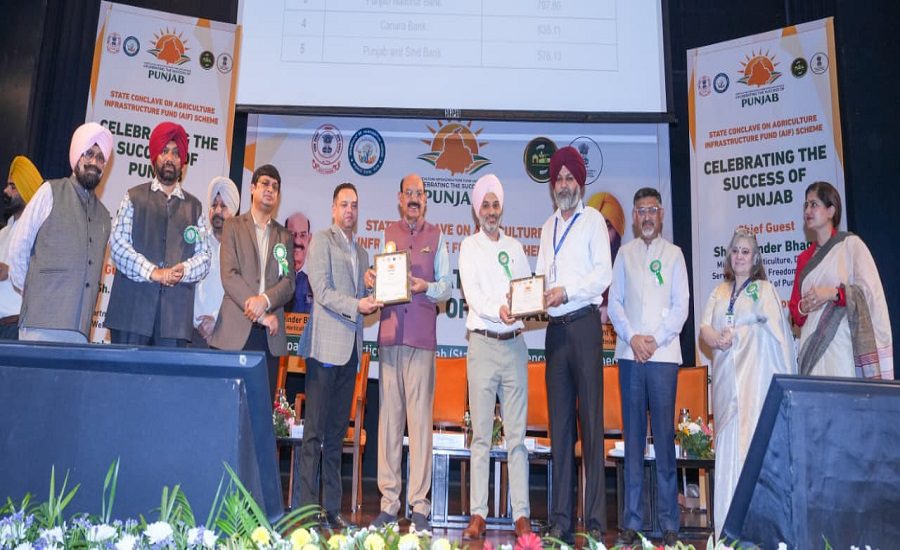
A conclave organised by the Punjab Department of Horticulture at Mahatma Gandhi State Institute of Public Administration reviewed progress under the scheme and honoured top-performing districts, banks and officials.
State Bank of India emerged as the leading institution with the highest number of sanctioned and disbursed projects under AIF in Punjab.
Representatives from banks, senior state officials, central government representatives and implementation agencies attended the conclave.
Crop Diversification Linked to Future Infrastructure Push
During the conclave, Mohinder Bhagat highlighted Punjab’s larger strategy of linking agricultural infrastructure to crop diversification.
He announced that a ₹1,300 crore project titled “Promoting Sustainable Horticulture in Punjab”, supported by Japan International Cooperation Agency, has been approved for implementation over the next eight to ten years.
The project aims to:
• Expand horticulture area
• Develop crop clusters
• Strengthen horticulture value chains
• Build access to high-value agricultural markets
The minister also said Punjab’s first biofertiliser laboratory has been established in Hoshiarpur to encourage organic farming and reduce chemical dependence.
Interest Subsidy and Credit Guarantee Make Scheme Attractive
According to Ravdeep Kaur from the KPMG implementation team, the scheme offers 3 per cent interest subvention on eligible loans.
Loans up to ₹2 crore are eligible for interest support, with the effective maximum interest rate capped at 9 per cent for seven years.
Additional protection comes through credit guarantee support under:
• Credit Guarantee Fund Trust for Micro and Small Enterprises
• National Bank for Agriculture and Rural Development through NABSanrakshan
Beneficiaries can also combine AIF benefits with other central and state subsidy schemes.
A Model of Cooperative Federalism in Agriculture
Punjab’s continued leadership under a centrally funded agricultural scheme is increasingly being cited as a model of cooperative federalism, where state-level implementation strength determines outcomes more than political alignment.
As one of India’s largest agricultural economies, Punjab’s performance under AIF is likely to influence future policy design for infrastructure-led agricultural reforms.
Read also: Punjab CM Bhagwant Singh Mann Launches 300 km New Roads and 350 km Renovation in Jalalabad