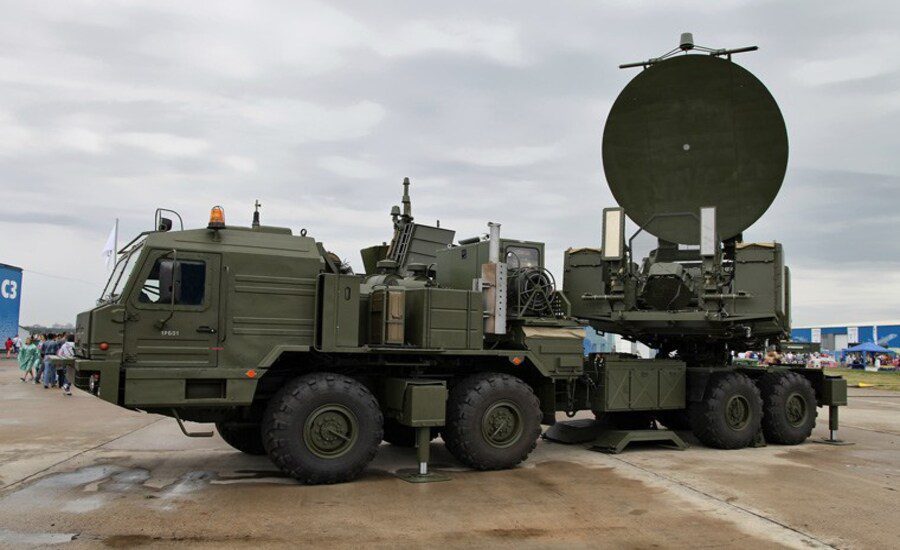
New Delhi: In a strategic move that could reshape electronic warfare capabilities in South Asia, Russia has reportedly offered the Indian Armed Forces the Krasukha-2 Electronic Warfare (EW) System, a ground-based countermeasures platform designed to blind hostile radar systems, including airborne early warning and control (AWACS) aircraft, and protect high-value defence assets such as the S-400 Triumf long-range air defence system.
What Is the Krasukha-2 EW System?
The Krasukha family is a Russian-built, ground-based EW system developed by the state-owned KRET corporation.
Read also: What Is the Pralay Missile? Everything You Need to Know About India’s Most Advanced Tactical Missile
Among its variants, the Krasukha-2 (designated 1L269) is engineered specifically to jam and deny the radar capabilities of airborne sensors.
Primary Function: Disrupt S-band radar systems used by AWACS and surveillance aircraft.
Krasukha-2 EW System Operational Range: Up to approximately 250 km, depending on terrain and atmospheric conditions.
Platform: Mobile 8×8 truck chassis enabling rapid deployment and repositioning.
Rather than destroying enemy radars with kinetic force, Krasukha-2 employs electronic countermeasures to jam, spoof, and confuse radar operators, effectively creating an electronic “black hole” that conceals friendly assets and distorts adversary situational awareness.
How the Krasukha-2 EW System Works
At its core, the Krasukha-2 EW system is designed to interfere with radar emissions used by airborne sensors. This includes:
Jamming AWACS Radar
AWACS aircraft such as Boeing E-3 Sentry platforms provide battlefield surveillance and command-and-control functions by broadcasting and receiving S-band radar reflections. Krasukha-2 disrupts these signals, degrading the sensor picture that commanders rely on to coordinate air operations.
Spoofing and False Targets
In addition to jamming, the system can introduce deceptive signals into enemy radar displays, creating “phantom aircraft” or false formations that confuse and mislead operators.
Soft-Kill Against Missiles
Beyond radar suppression, Krasukha-2’s jamming capability has the potential to misdirect radar-guided missile seekers, reducing the effectiveness of precision attacks and further protecting defended zones.
What is the Implications of Krasukha-2 EW System
India’s S-400 Triumf long-range air defence batteries represent one of the most advanced anti-aircraft networks in the region. However, systems like AWACS play a pivotal role in planning and executing strikes by relaying target data and aerial pictures.
Krasukha-2 aims to disrupt enemy radar coordination well before kinetic threats reach Indian airspace.
India’s security doctrine increasingly recognizes non-kinetic warfare as a vital part of integrated air defence, where EW works in synergy with interceptor missiles, fighters, and ground radars to create a layered defence shield.
Complementing Indigenous Radar and EW Initiatives
India is also advancing its own radar and AEW platforms. The DRDO AWACS & AEW&C programmes and the upcoming Netra Mk2 radar fleet demonstrate New Delhi’s intent to strengthen aerial surveillance and early warning capabilities.
Integrating internationally sourced EW like Krasukha-2 with indigenous detection systems could enhance overall response depth.
Read also: Indian Navy MQ-9 Drones Set to Transform Maritime Surveillance Across the Indian Ocean Region