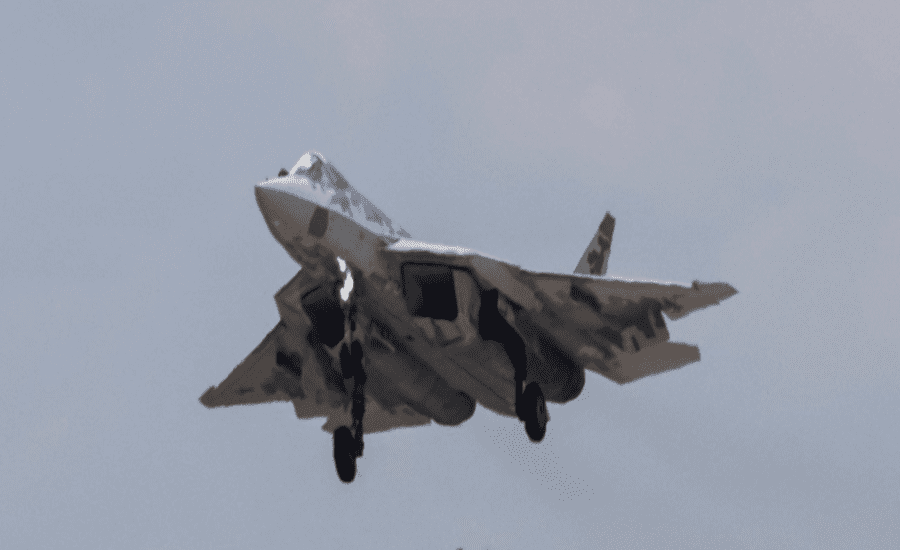
New Delhi: In a major development in Indo-Russian defence cooperation, Russia has reportedly offered India the opportunity not just to procure, but to locally produce its fifth-generation stealth fighter jets, along with high-end drones.
The offer — if accepted — would mark a dramatic shift from conventional procurement to a deep technology transfer and co-production model, aligning with India’s push for defense self-reliance under initiatives like “Make in India” and “Atmanirbhar Bharat.”
Beyond hardware supply, the offer includes access to critical technologies: stealth-material know-how, avionics, source code, and next-generation radar systems. If actualised, this could reshape India’s air combat capabilities — as well as its domestic defence-industrial ecosystem.
Background of Su-57E Stealth Jets
The Sukhoi Su-57 is Russia’s most advanced fifth-generation multi-role stealth fighter, designed to deliver air superiority, precision strike, and multi-domain operations. It features low-observable airframe design, advanced composite materials, stealth coatings, and a modern avionics suite including AESA radar, infrared search and track (IRST), distributed sensors, and a weapons bay for long-range missiles. The export variant offered to India is designated Su-57E.
India had earlier engaged with Russia on a derivative of the Su-57 under the now-defunct FGFA (Fifth Generation Fighter Aircraft) programme, which was cancelled after India concluded the stealth, avionics and sensor suite did not meet its requirements.
In 2019, high-level Indian Air Force leadership had publicly stated that India would not import stealth fighters like the Su-57, choosing instead to focus on indigenous development (notably the Advanced Medium Combat Aircraft or AMCA).
However — with growing pressure to modernize and expand the fleet quickly — Kremlin-linked bodies recently resurrected and significantly sweetened the offer, making it more palatable for Indian decision-makers.
Why Indian Wants Su-57E Stealth Jets
Fleet Deficits & Urgent Requirements: The Indian Air Force (IAF) currently faces a fighter-squadron shortfall and needs to induct large numbers of combat jets over the next two decades. The urgency to bolster air capabilities — especially in the face of evolving threats — has increased.
“Make in India” / Indigenous Production Push: The Indian government has prioritized localized manufacturing and defence self-reliance. The offer to locally produced Su-57E — rather than just import — fits neatly within this ambition.
Continuity with Existing Infrastructure: Russia claims that existing Indian facilities — specifically the facility of Hindustan Aeronautics Limited (HAL) at Nashik, currently used for assembling older Russian jets like the Sukhoi Su-30MKI — could be repurposed with minimal retooling (less than 30%) to build Su-57E.
Access to High-End Technologies: The offer includes technology transfer: source code access, advanced stealth material technology, avionics, radar systems — giving India not just finished jets, but the knowledge to build and maintain them independently.
Support to Indigenous AMCA Programme: Experts believe that working on Su-57 production could accelerate India’s indigenous AMCA programme, offering real-world experience in stealth aircraft manufacturing, radar, avionics — all vital for next-generation aircraft.
What Exactly Has Russia Offered
According to recent reports; Russia’s state-owned defense conglomerate ROSTEC has proposed establishing a production line for Su-57 jets in India.
The plan envisages an initial batch of jets delivered from Russia, followed by local assembly/production in India. Estimates suggest around 20–30 jets within 3–4 years, scaling eventually to 70–100 aircraft by early 2030s.
The localisation target is ambitious: 40–60% of components and systems to be manufactured in India. This includes covert technologies: stealth coatings, avionics, radar systems, and even source code for avionics/mission software.
The proposal also includes joint production of unmanned aerial systems — drones — including engines, sensors and low-signature materials. In effect, this would create a comprehensive fighter jet + drone manufacturing ecosystem inside India.
The suggested manufacturing hub inside India is HAL’s Nashik facility — already experienced in assembling Russian jets like Su-30MKI. Given shared production workflows, retooling efforts are estimated to be modest (less than 30%).
Moreover, Russian officials have described the proposal as encompassing full technology transfer, including engines, radar & optics, stealth materials, and weapons integration — a broad, unrestricted package.
They have also signaled readiness to entertain an Indian demand for a two-seat Su-57 variant — which could ease pilot training and transition.
Key Strategic and Industrial Significance for India
Boosting Defence-Industrial Base: If implemented, this deal would mark one of the most significant technology transfers India has ever received in the defence sector.
The localized production of a fifth-generation stealth jet would elevate India from being a buyer to a manufacturer — a major shift that could have long-term benefits:
- Development of a domestic supply chain in stealth materials, avionics, radar systems, mission computing — capabilities that could feed into future indigenous designs (e.g., AMCA).
- Skill building in composite airframe construction, stealth coating application, radar integration, systems engineering — areas where India currently lacks experience.
- Creation of high-value jobs and strengthening of aerospace industrial infrastructure.
Strengthening Air Power & Strategic Autonomy
Induction of Su-57E would significantly enhance the strike, reconnaissance, and air-superiority capabilities of the IAF — offering stealth, long-range engagement, advanced sensors — features critical in contested airspaces.
Given India’s strategic challenges across its borders and evolving security landscape in the Indo-Pacific, having a domestically co-produced stealth jet will offer long-term strategic autonomy and reduce dependence on foreign supply chains.
The drone component of the deal could give India access to advanced UAV strike and reconnaissance technologies — critical in modern warfare paradigms.
Complementing Indigenous Ambitions
The deal could act as a bridge — while indigenous programmes like AMCA mature. The experience gained from building Su-57E could feed into better design, testing, and production of next-gen domestic jets.
This approach aligns with India’s long-term vision of self-reliant defence manufacturing under “Atmanirbhar Bharat.”
Key Challenges, Risks & Reservations
Despite the promise, there are significant factors that India must weigh carefully.
Past concerns over stealth, avionics, and sensors: The earlier FGFA project was cancelled partly because the Russian design was considered inadequate in stealth and sensor sophistication compared to Indian expectations.
Accepting a Russian offer again would require thorough evaluation; Indian experts may still have reservations.
Sanctions risk and supply-chain reliability: The ongoing sanctions on Russia, and potential future restrictions, may impact supply of critical components, materials, or maintenance support — especially for complex stealth coatings, sensors, and avionics. Historical issues with servicing older Russian aircraft have been cited before.
Integration with existing IAF inventory and doctrinal fit: The IAF operates a mixed fleet (Rafale, Su-30MKI, Tejas, etc.). Integrating Su-57E + drones + new logistics/support chain may be challenging. Also, indigenous programmes like AMCA may be deprioritized — or complicated — if Su-57E becomes a major focus.
Cost, resource commitment, and long-term timeline: Setting up local production, technology transfer, dual-use supply chains, and maintenance infrastructure will demand substantial investments — not only money but also time, manpower, policy continuity.
Geopolitical backlash / strategic balancing: Closer defence cooperation with Russia, especially in stealth jets and drones, may draw renewed scrutiny from Western powers, potentially impacting India’s other partnerships.
What Next? Likely Scenarios & What to Watch
Several paths lie ahead depending on political, strategic and technical decisions by India’s leadership:
1. Full local production deal accepted — India signs formal agreement, sets up production line at HAL Nashik, begins building Su-57E and drones, and receives the first batch within 3–4 years. Over time, it scales up to 70–100 jets by the early 2030s. This would be a game-changer for Indian defense manufacturing and air capabilities.
2. Selective purchase + partial localisation — Accept some units directly from Russia, with partial local assembly and limited tech transfer — a more cautious approach balancing capability needs with risk mitigation.
3. Use as a technology/learning bridge — feed into AMCA — India could treat the deal as a way to acquire know-how and industrial expertise, without committing to massive Su-57 induction.
The goal is to boost indigenous programmes with “on-the-job” experience.
4. Reject or postpone — due to risks/concerns — Given past concerns, sanctions complications, and long-term costs, India may decide to rely on indigenous projects (AMCA, Tejas Mk2) and other foreign or domestic alternatives rather than commit to full-scale Su-57 production.