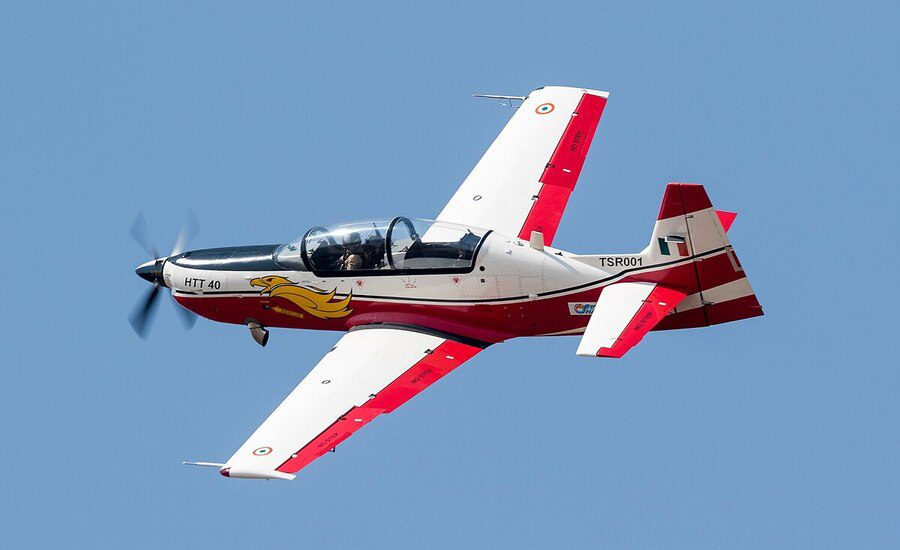
New Delhi/ Nashik: On December 6, 2025, the second production-series HAL HTT-40 basic trainer aircraft — designated TH-4002 — successfully completed its maiden flight from the newly commissioned production facility at Hindustan Aeronautics Limited (HAL) in Nashik. This marks a significant milestone not only for HAL but also for the wider ambitions of the Indian Air Force (IAF), as the HTT-40 is set to replace older trainers and become the backbone of the future ab-initio pilot training pipeline.
Background of HAL HTT-40
The HTT-40 was conceived by HAL to replace the aging fleet of HAL HPT-32 Deepak trainers, which were retired from service in 2009.
Designed as a tandem-seat, fully aerobatic turboprop trainer, the HTT-40 is intended for basic flight training, aerobatics, instrument flying, navigation, night flying, and close-formation flights — essentially preparing novice pilots for advanced jet training.
The aircraft is powered by a single 1100 hp turboprop engine (specifically the Honeywell TPE331-12B), offering a mix of manageable low-speed handling and sufficient performance to safely train rookie pilots while exposing them to realistic flight dynamics.
Under a contract signed recently, HAL is expected to deliver 70 HTT-40 trainers to the IAF (with option for more), a program valued at around ₹6,838 crore.
Given the IAF’s longstanding shortage of basic trainers — exacerbated by retiring older aircraft and growth in pilot induction — HTT-40 represents a critical investment in future manpower and training infrastructure.
What the Maiden Flight at Nashik Signifies
The maiden flight of TH-4002 carries multiple layers of significance:
Operationalisation of the Nashik Production Line: This is the first HTT-40 produced at HAL’s Nashik facility — earlier prototypes and the first serial production aircraft (TH-4001) were assembled at Bengaluru.
The shift represents part of HAL’s strategic decentralisation plan: by adding Nashik as a parallel production hub, HAL can spread out workload, avoid bottlenecks at Bengaluru, and accelerate output to meet IAF demand.
Validation of Series-Production Standards: Flying a “second-series production aircraft” instead of a prototype is important: it demonstrates that HAL has successfully transitioned from developmental/trial stages to standardised, repeatable serial production. This builds confidence in the ability to deliver reliable trainers to IAF on schedule.
It also underscores that all manufacturing, assembly, systems integration, and quality control — at least for this airframe — meet required standards, and the new facility is operationally ready.
Boost to IAF’s Pilot Training Pipeline & Indigenous Production: The induction of HTT-40 from Nashik will help bridge the IAF’s training shortfall; according to current plans, deliveries to the IAF should begin by early 2026.
More broadly, this milestone aligns with the national push for defence self-reliance (Atmanirbhar Bharat): a homegrown basic trainer built, assembled, and delivered from Indian soil, reducing dependence on foreign imports.
Technical Snapshot of HAL HTT-40
The HTT-40 is a tandem-seat basic turboprop trainer designed to support the Indian Air Force’s foundational pilot training syllabus. Powered by the Honeywell TPE331-12B turboprop engine generating approximately 1100 horsepower, the aircraft offers reliable performance for a wide range of training missions. With a maximum take-off weight of around 2,800 kg and a top speed nearing 450 km/h, the HTT-40 provides the ideal balance between stability for beginners and agility for advanced manoeuvres.
Operationally, the aircraft is certified to operate up to an altitude of roughly 6,000 metres, aligning with the standard mission profile for basic trainer platforms. Its training envelope covers core flight skills such as basic flying, aerobatics, instrument procedures, navigation, night operations, and close-formation flying. In addition, the design includes provisions for potential conversion into a light-attack or weapons-training variant, offering future scalability.
The HTT-40 currently incorporates approximately 56 percent indigenous content, with an ongoing effort to raise this figure beyond 60 percent. This growing localisation underscores India’s commitment to strengthening its defence manufacturing ecosystem and reducing dependency on foreign platforms.
Strategic Importance — Beyond the Flight Deck
Addressing the Training Shortage: For years, the IAF has relied heavily on foreign or older vintage trainers — which are expensive, harder to maintain, and sometimes insufficient to meet training demand. The HTT-40 helps close that gap, offering a modern, domestically produced solution tailored for India’s needs.
Building India’s Aerospace-Industrial Ecosystem: The successful inception of serial production at Nashik means more than one aircraft type — it means sustained manufacturing capacity, supply-chain activation, job creation, technology transfer through engine production collaboration (with Honeywell), and potential future expansion (e.g. export variants, light-attack trainer derivatives).
Enhancing Self-Reliance & Reducing Dependence on Imports: In an era where supply-chain disruptions and geopolitical uncertainties can impact procurement, having a homegrown, fully indigenous basic trainer strengthens national security and ensures that pilot training remains uninterrupted. HTT-40 is a proof-point for “defence manufacturing at home.”
Key Challenges & What Lies Ahead
Engine Supply Delays: There have been reports of delays in delivery of new TPE331-12B engines by Honeywell, which forced HAL to plan first deliveries with a reused “Category B” engine from prototypes.
Scaling Up Production: While two production lines (Bengaluru + Nashik) are now active, HAL needs to ramp up to produce “around 20 aircraft a year” (and possibly more) to meet IAF’s requirements — requiring robust supply chain, vendor readiness, and logistical coordination.
Future Variants & Long-Term Planning: There is discussion about light-attack or export variants of HTT-40; if pursued, they will need additional certification, integration of weapons systems, and perhaps structural or avionics upgrades.
What This Means for the Indian Air Force & National Defence
The IAF stands to receive a steady influx of modern basic trainers starting 2026 — which will accelerate pilot training, shorten waiting times for cadets, and free up higher-end trainers/fighters for advanced roles.
HAL’s ability to manage serial production of HTT-40 from Nashik signals maturity in India’s aerospace manufacturing — a positive sign for upcoming indigenous projects.
Over time, reliance on foreign trainers will reduce, bringing savings, logistical ease, easier maintenance, and stronger long-term control over pilot training infrastructure.
The HTT-40 program could act as a foundation for future domestic trainer/light-attack aircraft development, potentially opening doors for exports — boosting India’s defence-industrial stature globally.
About Hindustan Aeronautics Ltd
Hindustan Aeronautics Limited (HAL) is India’s premier state-owned aerospace and defence company, responsible for designing, manufacturing, and maintaining military and civilian aircraft for the nation.
With a legacy spanning over eight decades, HAL has played a central role in developing indigenous aviation capabilities, from trainers and helicopters to fighter aircraft and advanced avionics.
The organisation operates multiple production facilities across India and remains a cornerstone of the country’s self-reliance initiatives in defence manufacturing.