New Delhi: Indian defence research ecosystem has taken another step toward modern warfare readiness with the delivery of the Sigma 4.0 camouflage system developed by the Defence Laboratory Jodhpur (DLJ) under the Defence Research and Development Organisation (DRDO).
The advanced system is designed to help the Indian Armed Forces hide military vehicles and equipment from enemy detection systems. The Sigma 4.0 camouflage system uses digital tools and multispectral technology to generate effective camouflage patterns for different terrains and environments. This development strengthens India’s ability to counter modern surveillance technologies such as thermal imaging, infrared sensors, drones, and radar systems, which are increasingly used in modern battlefields.
What Is the Sigma 4.0 Camouflage System?
Sigma 4.0 is officially known as Camouflage Pattern Generation Software (CPGS 4.0). It is an advanced software platform developed by DRDO scientists to create effective camouflage patterns for military equipment and installations.
Read also: When Algorithms Enter the Kill Chain: How AI Is Reshaping Decision-Making in Modern Warfare
The software can design camouflage patterns for different terrains such as:
- Desert regions
- Forest areas
- Urban battle zones
- Mountain environments
Unlike traditional camouflage that mainly hides objects visually, Sigma 4.0 focuses on multispectral camouflage, which protects military assets from detection across several wavelengths of the electromagnetic spectrum. These include:
- Visible light
- Infrared (IR)
- Thermal sensors
- Radar signals
This makes it significantly harder for enemy surveillance systems to detect vehicles, weapons systems, or military bases.
About Defence Laboratory Jodhpur
The technology has been developed by the Defence Laboratory, Jodhpur (DLJ), one of DRDO’s key research laboratories.
DLJ was established in 1959 and focuses on technologies related to:
- Camouflage and concealment
- Electronic warfare materials
- Desert warfare research
- Signature management systems
Over the years, the laboratory has developed several important defence technologies including radar-absorbing materials, chaff systems, and camouflage solutions for the Indian Armed Forces.
Multispectral Tank Mock-up for Realistic Training
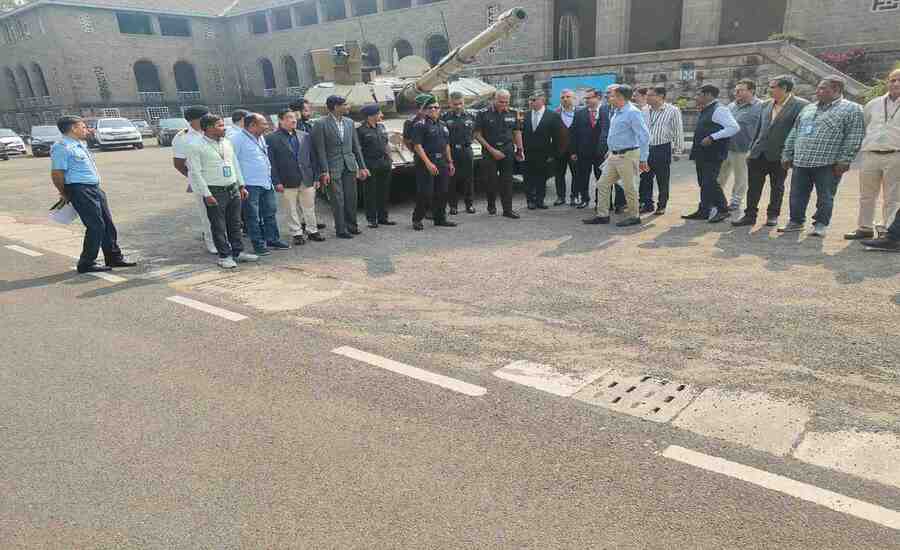
Along with the Sigma 4.0 software, DRDO has also provided a full-scale multispectral signature tank mock-up.
This mock-up is a life-size training model of a battle tank that can replicate the visual, thermal, infrared, and radar signatures of real combat vehicles.
This allows soldiers and engineers to:
- Test camouflage materials and patterns
- Study how tanks appear to enemy sensors
- Improve concealment strategies
- Practice deception techniques on realistic targets
The system will be used by the College of Military Engineering (CME) in Pune for training military personnel in camouflage and deception technologies.
Why Modern Camouflage Is Important in Warfare
Modern warfare relies heavily on advanced surveillance technologies, including:
- Military drones
- Satellite imagery
- Thermal imaging cameras
- Radar detection systems
These tools can easily detect conventional camouflage methods.
Multispectral camouflage like Sigma 4.0 helps overcome this challenge by ensuring that military equipment blends into its surroundings across multiple detection systems, making it far more difficult for enemies to locate strategic assets.
Strengthening India’s Indigenous Defence Ecosystem
The Sigma 4.0 system is also a major step toward self-reliance in defence technology under the “Make in India” initiative.
Key benefits include:
- Reduced dependence on foreign defence technology
- Improved survivability of Indian military assets
- Better training capabilities for armed forces
- Faster adaptation to different battle environments
The collaboration between DRDO and the Indian Army also highlights how India’s defence research ecosystem is working closely with operational forces to develop practical battlefield solutions.
Future Developments in Camouflage Technology
DRDO researchers are expected to further improve the Sigma series of camouflage technologies. Future upgrades may include:
- Artificial Intelligence-based adaptive camouflage
- Real-time environmental pattern adjustment
- Integration with advanced sensor-countering materials
Such innovations could allow military vehicles to automatically adjust camouflage patterns based on terrain and threat environment, giving India a strategic advantage in future conflicts.