“In war, everything is simple but the simplest thing is difficult.”
Clausewitz could have never imagined artificial intelligence, yet his premonition applies perfectly to it.
Modern warfare is not being transformed by men and machines on their own by sighting targets and pulling the trigger. Instead, it is being reshaped(replaced) by machines that help humans think, see, and decide faster than ever before. The real transformation is not autonomous lethality, but decision superiority.
Conventional warfare decisions were sequential as information arrived from echelons, intelligence fragmented constrained by human limits and time measured in hours allowing deliberation before decision was arrived at by commanders. Today, that time has collapsed into minutes, sometimes seconds.
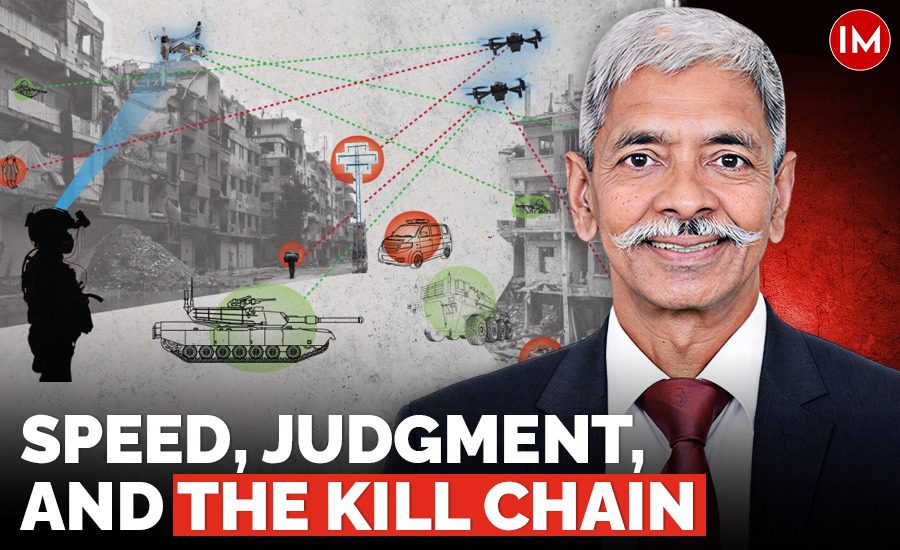
Artificial Intelligence has entered the kill chain as a force multiplier for judgment by accelerating the OODA loop (Observe- Orient- Decide- Act) outpacing human speed.
Contrary to popular imagination, AI’s primary role in contemporary warfare is not to replace commanders or automate killing. Its value lies in processing, synthesising, and interpreting vast volumes of data generated from space and cyber domains. AI enables commanders to see patterns that would otherwise would have been lost in the digital noise.
Projects such as the United States Project Maven, illustrates how AI actually functions in war. Machine-learning models analyze drone footage and sensor feeds to identify potential targets and anomalies. Importantly, AI does not authorize strikes. Humans remain firmly “in the loop,” evaluating AI-generated insights before decisions are made. Accountability is preserved, escalation is controlled, and judgment remain the sole preserve of humans.
The ongoing Russia–Ukraine war offers a live demonstration of this reality. Ukraine’s ability to fuse intelligence from commercial satellites, drones, cyber domain and battlefield reports (often assisted by AI-driven analytics) has allowed it to conduct precise strikes against high-value Russian targets. Ammunition depots, command centres, bridges, and logistics nodes have been targeted not by massed fire, but by rapid, informed decisions.
Russia meanwhile has struggled, by contrast, revealing the cost of delayed decision-making, centralised control and blunted effectiveness owing to slower intelligence processing and rigid command structures. AI does not win battles on its own, instead transforms decision loops for shorter outcomes.
Israel’s operations against Hamas highlight another dimension where AI-enabled systems helped processing immense intelligence flows in dense urban terrain.
As targeting cycles shorten, its speed intensifies moral and strategic pressure as faster decisions leave less room for error. Precision demands discipline.
“Speed saves lives but will fail if judgment lags behind it.”
Today, USA remains the most doctrinally mature actor in AI-enabled warfare. Its emphasis on network-centric operations, multi-domain integration and decision dominance reflects decades of investment in doctrine, not just technology. Precision strikes against Iranian-linked nuclear and strategic facilities exemplified an intelligence-led, calibrated and a politically conscious decision wherein AI supported analysis and humans controlled the escalation.
The central lesson which emerges therefore is that AI enhances decision-making, but doctrine governs its use.
For India to successfully navigate its geo- strategic ecosystem this presents a significant learning on decision superiority with algorithms entering the “kill chain”.
Operating in one of the world’s most complex security environments with a technologically superior China, an unstable Pakistan with a sub-conventional playbook, political turmoil in Nepal and Bangladesh, turbulence in Myanmar and instability in Iran all creating a compressed and unpredictable strategic theatre. Given this prevailing reality, any delayed decision will not only be cost prohibitive but also spiral escalation thus necessitating automated decisions and a calibrated response.
India has today begun integrating AI across surveillance, intelligence analysis, logistics and command-support functions. The emphasis, notably, is on decision support rather than autonomous weapons. India’s approach of strategic prudence witnessed in Operation Sindoor aligns with the ‘human-in-the-loop model’ that preserves accountability and escalation control.
Intelligence-driven targeting, rapid analysis and controlled execution showcased how technology can compress decision cycles leading to its precise, restrained execution and reflecting ethics and discipline matter while doing so. This is decision superiority in its most practical form.
On one hand if algorithms provide the strategic shield and situational awareness, they also on the other hand expose new vulnerabilities. Algorithms learn from data. If data is biased, incomplete or manipulated, decision making will suffer. Adversaries will decode predictability, attempt deceiving of sensors and saturate decision-support systems.
Remember every system eventually meets its counter.
Doctrine must therefore emphasise adaptability and keep embracing change and not remain blinded on ‘tried and tested’ models.
Next is the leadership challenge. AI compresses time. Junior commanders will increasingly receive algorithm-assisted inputs and required to act within seconds. Mission command with clear intent, decentralised execution and trust becomes therefore indispensable. Without it, speed may result in chaos.
Here history offers a sobering reminder for all of us to reflect upon. In 1940, French forces possessed superior tanks. German forces possessed superior doctrine and faster decision-making. Technology did not decide the campaign, decision superiority famously known as the “Blitzkrieg” and the “Fall Gelb” strategies did
AI amplifies this timeless truth.
For India’s aspiration to be a regional player and a credible global power, integrating AI into the kill chain must be deliberate, ethical, and doctrinally grounded. Precision warfare demands speed but democracy demands accountability. Balancing the two is the defining leadership challenge of this era.
“The first advantage is gained by the side which figures out how to combine traditional systems with new technologies in creative ways.”
This combination and not autonomous machine will shape modern warfare. When algorithms enter the kill chain, they do not replace commanders. They expose them. Decisions become faster, consequences clearer, and responsibility therefore unavoidable.
In future conflicts, victory will belong to those whose doctrine, leadership, judgment are prepared, coherent and calibrated for decision superiority way beyond human speeds but without surrendering human control.
This is the true essence of decision superiority in the age of Artificial Intelligence.