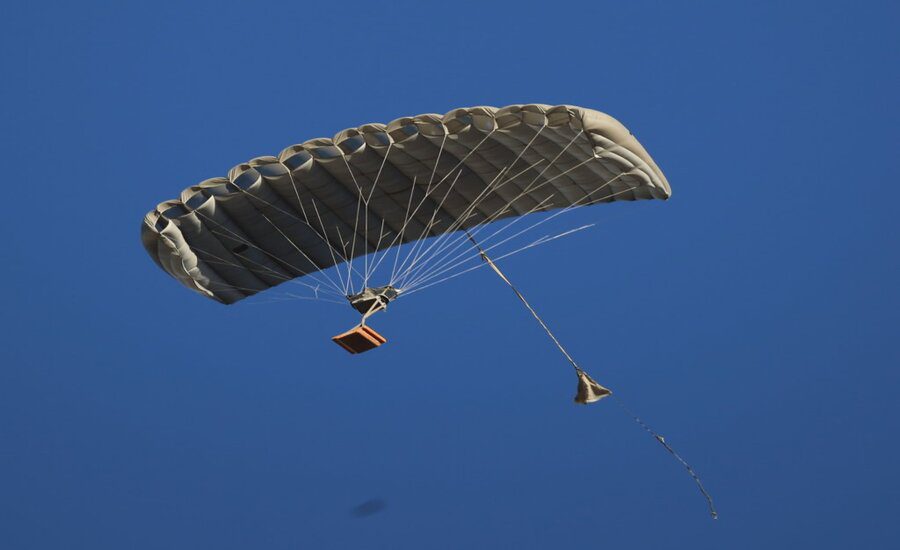
New Delhi: India’s push for indigenous defence innovation has received a major boost with the development of the SMVEC Precision Aerial Delivery System (PADS). Researchers from Sri Manakula Vinayagar Engineering College (SMVEC) in Puducherry have unveiled a system capable of delivering payloads of up to 4 tons with high precision through aerial drops. The SMVEC Precision Aerial Delivery System is designed to autonomously guide supplies such as ammunition, medical kits, and equipment to specific ground locations.
This innovation could significantly strengthen logistics capabilities for the Indian Armed Forces, especially in remote or conflict-prone regions where traditional supply routes are difficult to maintain.
What Is the SMVEC Precision Aerial Delivery System (PADS)
The Precision Aerial Delivery System (PADS) is an advanced aerial logistics technology developed by the R&D cell of SMVEC.
It allows aircraft to drop heavy payloads from the air while ensuring they land accurately at a predefined location.
Key highlights include:
- Payload capacity of up to 4 tons
- Autonomous navigation and guidance technology
- Ability to deliver supplies with minimal deviation from the target zone
- Designed for rapid and precise aerial supply missions
Unlike traditional parachute drops, which often scatter supplies over a large area, the PADS system guides the payload to a specific landing zone using advanced sensors and onboard computing.
How the SMVEC Precision Aerial Delivery System Works
The SMVEC system uses a combination of modern navigation technologies to ensure accurate delivery.
Main technologies involved:
- GPS navigation – Determines the exact location and guides the payload to the target zone.
- Inertial navigation system (INS) – Helps maintain trajectory and stability during descent.
- Onboard sensors and computing – Adjust flight path according to wind, terrain, and environmental conditions.
These technologies allow the payload to automatically correct its path during descent, ensuring a precise landing even in challenging environments.
What are the Importance of SMVEC Precision Aerial Delivery System
Precision airdrop systems are extremely important for modern warfare and emergency operations.
Possible uses include:
- Supplying troops stationed in remote areas
- Delivering ammunition or equipment during combat operations
- Providing medical supplies during disasters or humanitarian missions
- Supporting special forces operations in difficult terrain
In areas such as mountains, islands, or border regions where ground logistics are difficult, such systems can save time and reduce operational risks.
The development of indigenous defence technologies supports India’s broader Atmanirbhar Bharat (self-reliance) mission in defence manufacturing.
Key strategic benefits include:
- Reduced reliance on foreign technology
- Lower defence procurement costs
- Strengthening India’s domestic aerospace and defence ecosystem
- Improved logistics capability for military operations
If successfully tested and integrated into service, the SMVEC PADS could complement existing systems used by the Indian armed forces.
Comparison With Existing Indian Defence Systems
India already has similar technologies developed by the Defence Research and Development Organisation (DRDO).
Examples include:
- Controlled Aerial Delivery System (CADS) – Handles payloads ranging from 3 to 16 tons
- P-7 Heavy Drop System – Designed for payloads around 9.5 tons
However, the SMVEC system offers a mid-range solution with a 4-ton payload capacity, demonstrating how academic institutions can contribute to defence innovation.
Role of Academic Institutions in Defence Innovation
The development of the PADS system shows how engineering colleges and research institutions can support defence technology development.
Universities can contribute by:
- Developing new prototypes and experimental technologies
- Training engineers and scientists for defence R&D
- Collaborating with defence organisations and private industry
SMVEC’s work reflects the growing ecosystem of academia-driven defence research in India.