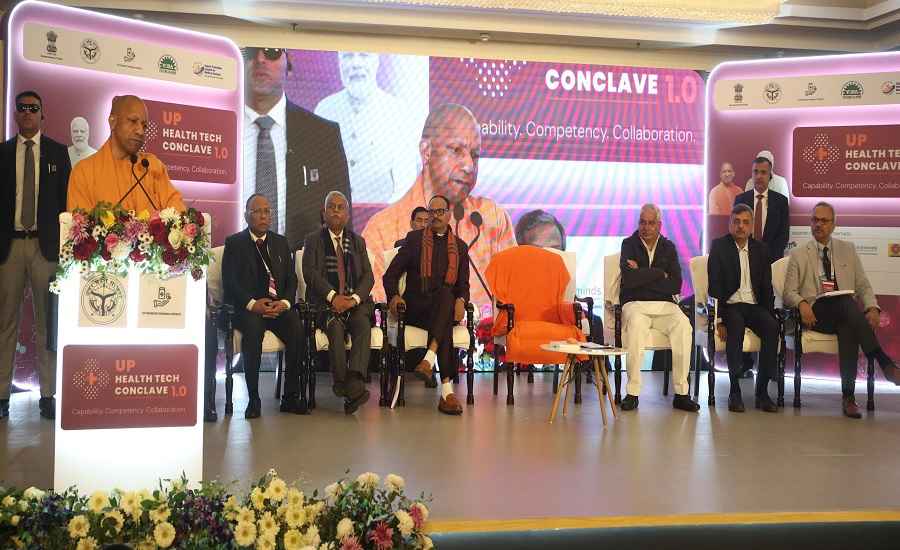
Lucknow: Uttar Pradesh Chief Minister Yogi Adityanath on Sunday asserted that the state is on course to emerge as India’s largest healthcare and medical technology hub, with the capacity to serve not only its own population but also the healthcare needs of neighboring states and the nation at large. He made these remarks while inaugurating the UP HealthTech Conclave 1.0 in the state capital, Lucknow.
Addressing policymakers, healthcare leaders, industry representatives, innovators, and investors, the Chief Minister said Uttar Pradesh today bears the responsibility of healthcare for over 35 crore people, far beyond its resident population of nearly 25 crore, making it the country’s largest healthcare consumer market.
Historic Transformation of Healthcare in Last Eight and a Half Years
Chief Minister Yogi Adityanath stated that Uttar Pradesh’s healthcare sector has undergone a historic transformation over the past eight and a half years, guided by the vision of Prime Minister Narendra Modi. He emphasized that changes which once seemed unimaginable are now visible on the ground.
“Earlier, Uttar Pradesh had only 40 medical colleges, including government and private institutions. Today, the state has 81 fully functional medical colleges, including two AIIMS,” he said. In addition, more than 100 district hospitals, hundreds of Community Health Centers (CHCs) and Primary Health Centers (PHCs), and a widespread network of Health and Wellness Centers have been established.
Focus on Dignified and Quality Healthcare for the Last Person
The Chief Minister stressed that the government’s priority is not merely infrastructure creation but ensuring dignified, accessible, and quality healthcare for the person standing at the last rung of society.
He said free and accessible healthcare services are now reaching even the most remote rural areas. “Our efforts are centered on creating a healthcare system that respects human dignity and ensures timely treatment without discrimination,” he added.
Ayushman Bharat Brings Financial Security to Millions
Highlighting the impact of the Pradhan Mantri Jan Arogya Yojana, Chief Minister Yogi Adityanath recalled that earlier, serious illness in poor families often resulted in fear, debt, and abandonment of treatment due to lack of funds.
Today, Ayushman Golden Cards have been issued to 5.5 crore families in Uttar Pradesh, enabling cashless treatment up to ₹5 lakh per family. Families not covered under the central scheme are being supported through the Mukhyamantri Jan Arogya Yojana.
The Chief Minister described the Ayushman Card as a powerful shield, ensuring free, non-discriminatory treatment across medical colleges, district hospitals, CHCs, PHCs, and Health and Wellness Centers throughout the state.
Major Gains in Maternal, Infant Health and Disease Control
Sustained healthcare reforms have led to significant improvements in maternal and infant mortality rates, with institutional deliveries now on par with the national average, the Chief Minister noted. Several districts in the state have achieved complete control over tuberculosis.
Uttar Pradesh, once severely affected by vector-borne diseases, has also made remarkable progress in disease control. Diseases such as encephalitis, dengue, malaria, chikungunya, and kala-azar, which earlier spread rapidly during monsoons, are now effectively contained.
Encephalitis Control Campaign: A Turning Point
Chief Minister Yogi Adityanath highlighted encephalitis as one of the most devastating diseases the state faced. “Over four decades, encephalitis claimed nearly 50,000 innocent lives,” he said.
In 2017, the government launched a focused, time-bound campaign based on early identification, localized treatment, and strict accountability. Within two years, encephalitis was brought under control, and today Uttar Pradesh is recording zero deaths from the disease. Effective control has also been achieved over dengue, malaria, kala-azar, and chikungunya.
Technology-Driven Healthcare for ‘Ease of Living’
Outlining the roadmap ahead, the Chief Minister said the next objective is to realize Prime Minister Narendra Modi’s vision of ‘ease of living’, which requires extensive integration of technology into healthcare delivery.
He emphasized that health screening must begin at the village level, so patients do not have to travel 40–50 kilometers unnecessarily. Health and Wellness Centers should be empowered through teleconsultation, telemedicine, and AI-based screening to assess patients and refer them appropriately for advanced care.
Medical Device and Pharma Parks to Boost Self-Reliance
Chief Minister Yogi Adityanath said the Medical Device Park in the Yamuna Authority region and the Bulk Drug Pharma Park in Lalitpur are being developed on a war footing.
The goal, he said, is not just self-reliance for India but a transition from ‘Make in India’ to ‘Make for the World’. He noted that lessons from the COVID-19 pandemic revealed how global crises expose monopolistic tendencies, reinforcing the need for domestic strength in healthcare and medical technology.
Ancient Knowledge and Modern Innovation Go Hand in Hand
Referring to India’s ancient knowledge traditions, the Chief Minister cited Takshashila University and the legacy of Vaidya Jivaka, emphasizing the belief that “Naasti Moolamanoushadham” (there is no plant without medicinal value) and “Ayogya: Purusho Naasti” (no individual is incapable).
He said the government is playing the role of a facilitator by creating opportunities for youth, startups, innovators, and entrepreneurs, enabling them to contribute to healthcare innovation and nation-building.
Invitation to Global Investors
Inviting investors and industrialists from India and abroad, Chief Minister Yogi Adityanath said Uttar Pradesh offers world-class infrastructure, a secure and investor-friendly environment, and a robust single-window clearance system.
He assured time-bound approvals and government support at every stage, expressing confidence that Uttar Pradesh has the potential to become a leading national and global hub for medical technology, healthcare services, and pharmaceutical manufacturing.
Launch of UP-IMRAS Digital Platform
During the programme, the Chief Minister inaugurated the UP-IMRAS (Integrated Medical Research Application System) software by pressing a remote button. This advanced digital platform has been developed to simplify, streamline, and bring transparency to research related to clinical trials, pharmaceuticals, and medical devices.
UP-IMRAS enables researchers to submit proposals, applications, and permissions online, while the entire review, approval, and monitoring process by the Institutional Ethics Committee (IEC) will be conducted digitally. The system is expected to significantly reduce timelines while enhancing transparency and accountability.
SOP Book for Institutional Ethics Committees Released
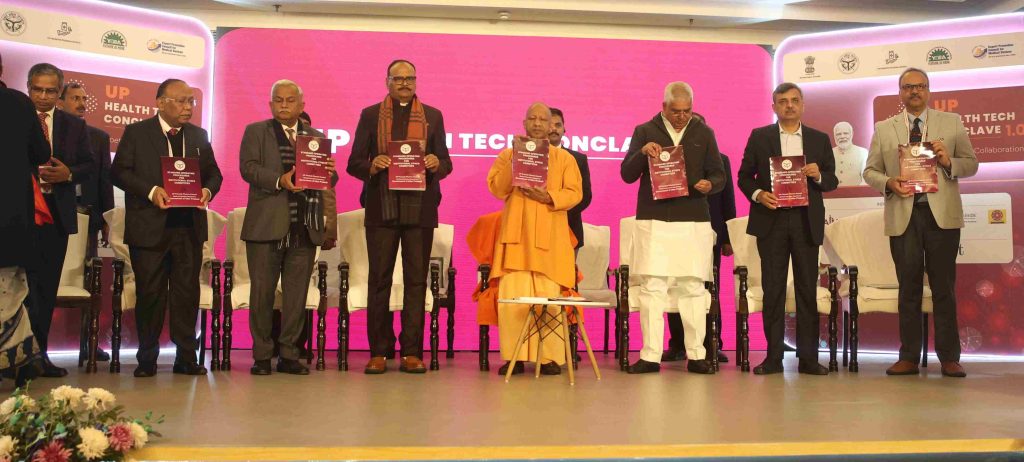
On the occasion, Chief Minister Yogi Adityanath also released a book containing Standard Operating Procedures (SOPs) for the Institutional Ethics Committee. The publication includes detailed SOPs for 22 distinct procedures, ensuring uniformity, ethical compliance, and quality across clinical trials and related research.
Officials stated that this initiative represents the first organized effort of its kind not only in Uttar Pradesh but globally, strengthening the state’s international standing in medical research and health technology.
Dignitaries Present at the Conclave
Deputy Chief Minister Brajesh Pathak, Minister of State for Health Mayankeshwar Singh, Secretary to the Government of India Manoj Joshi, Additional Chief Secretary (Health and Medical) Amit Ghosh, Drug Controller General of India Rajiv Raghuvanshi, and several senior officials were present at the event.