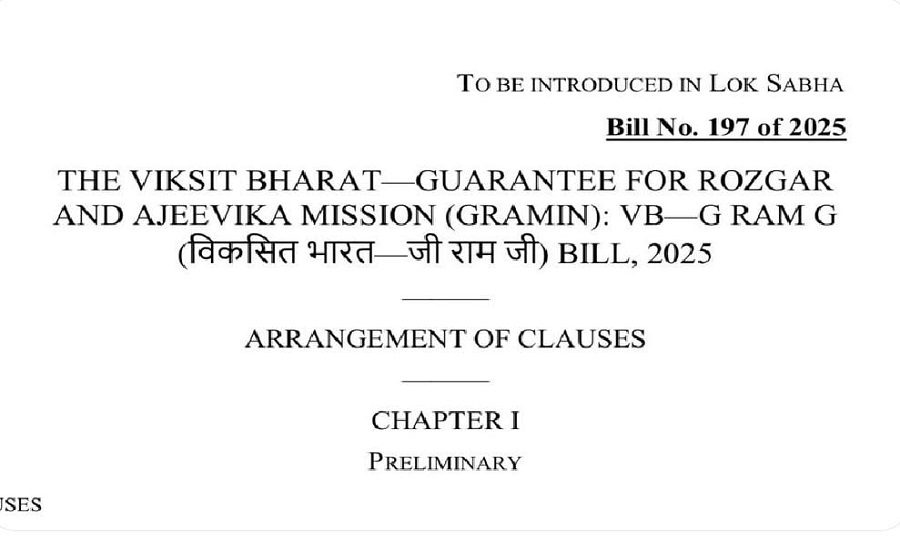
New Delhi: The central government has proposed a major overhaul of India’s rural employment framework by introducing the Viksit Bharat-Guarantee for Employment and Livelihood Mission (Rural), 2025, popularly called the VB-G RAM Ji Bill. This bill aims to replace the Mahatma Gandhi National Rural Employment Guarantee Act (MGNREGA), which has been in effect since 2005.
The new framework proposes statutory guarantees of 125 days of wage employment per rural household per year, up from the current 100 days, while integrating rural development initiatives under a unified and digitally monitored structure.
Key Changes in Central-State Funding
A major change under the VB-G RAM Ji Bill is the revised funding pattern.
Current MGNREGA: Central government covers 100% of wages and 75% of material costs.
VB-G RAM Ji Bill: Expenditure will now be shared between the central and state governments in a 60:40 ratio for most states. North-Eastern and Himalayan states will follow a 90:10 ratio, while Union Territories will continue to receive full central assistance.
This change is expected to increase the financial responsibility of states, sparking potential debates on fiscal sustainability.
Read also: Uttar Pradesh Launches Automatic Old Age Pension Scheme: No Application Needed for Seniors Above 60
Legal Employment Guarantee and Payment Provisions
The bill ensures –
- 125 days of guaranteed employment per household.
- Weekly or bi-weekly wage payments.
- Unemployment allowance if work is not provided within 15 days of application.
Exemptions during peak agricultural seasons (up to 60 days) with provisions for natural calamities.
Structured Planning and Implementation
The scheme divides works into four major areas –
- Water security
- Core rural infrastructure
- Livelihood-related infrastructure
- Disaster-resilient structures
Works will be planned at the village panchayat level and integrated through block, district, and state structures. Digital tools like the Viksit Bharat National Rural Infrastructure Stack will ensure monitoring, geospatial planning, and coordination with PM Gati Shakti.
Institutional and Accountability Framework
The bill proposes:
- Rural Employment Guarantee Councils at central and state levels.
- National and state steering committees for convergence and policy formulation.
- Panchayats as central implementers; District Programme Coordinators and Programme Officers to monitor daily operations.
Digital monitoring, biometric authentication, geo-tagging, and social audits to ensure transparency.
District-level Ombudsman for grievance redressal.
Estimated Expenditure
The total annual estimated expenditure is ₹1.51 lakh crore, with the central government contributing approximately ₹95,692 crore. This funding aims to strengthen livelihood security, create durable rural assets, and promote climate-resilient development.
Objective: Towards a ‘Developed India’ by 2047
The VB-G RAM Ji Bill aligns with the national vision of “Viksit Bharat 2047”, aiming to:
- Enhance rural livelihood security.
- Promote participatory planning.
- Ensure sustainable development and climate resilience.
Pending works and liabilities under MGNREGA will be transitioned under the new framework, ensuring continuity for ongoing projects.