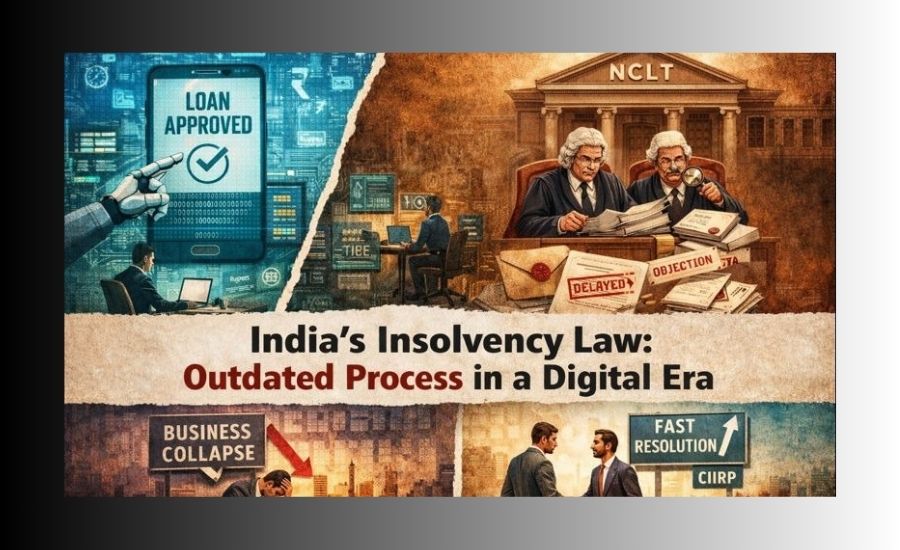
India’s rapid growth of artificial intelligence-powered digital lending has opened new frontiers in financial inclusion and credit access. Fintech platforms now use algorithms to evaluate creditworthiness, approve loans and disburse funds with minimal or no human intervention. But as this model scales, a critical question looms: what happens when these borrowers default?
This is no longer a marginal issue. Industry estimates suggest that India’s digital lending ecosystem now serves more than 25 million borrowers, with annual loan disbursements running into several trillion rupees. Much of this growth has been driven by AI-first lenders offering small-ticket, short-tenure loans—often approved within minutes—using alternative data instead of conventional income verification or credit scores. These models have been particularly effective in Tier-2 and Tier-3 cities, where access to formal credit was historically limited.
Legal experts and insolvency professionals, however, warn that India’s insolvency framework—particularly the Insolvency and Bankruptcy Code (IBC)—is not equipped to deal with defaults arising from loans originated entirely by AI systems. These lenders rely on machine-learning models that assess behavioural and transactional signals, rather than traditional underwriting norms. While this has widened the credit net, it has also introduced serious challenges around accountability, contract enforceability and legal recognition.
“AI-first lending is expanding rapidly, especially outside metro markets. But there is no clarity on how these algorithmic debts will be treated in court if they go unpaid,” said a senior partner at a Mumbai-based law firm specialising in insolvency. “Many of these loans are issued without conventional paperwork or physical signatures. They exist entirely as digital agreements embedded in code.”
In traditional lending, the creditor is clearly identifiable, underwriting decisions are traceable, and established principles of Indian contract law govern the transaction. In AI-driven models, however, the lender may be a platform that outsources underwriting to third-party algorithms, with risk decisions made by systems that are neither transparent nor easily explainable.
This raises fundamental questions that insolvency forums are increasingly likely to confront. Who is liable if an algorithm misjudges risk? Can a borrower challenge loan terms determined by a black-box model? And under the IBC, can such loans be admitted as “financial debt” when documentation is digital-only and underwriting logic is opaque?
These concerns are amplified by emerging stress signals. Industry disclosures indicate that delinquency rates in certain short-tenure digital loan segments remain materially higher than those of traditional retail credit, particularly where loans are issued without income verification. As volumes grow, even modest default rates translate into large numbers of contested claims—placing pressure on recovery mechanisms and adjudicatory forums.
Globally, regulators are already grappling with similar challenges. The European Union’s proposed AI Act classifies credit scoring as a high-risk activity, imposing requirements around transparency and explainability. In the United States, regulators have initiated scrutiny of AI-driven consumer lending models, particularly in the Buy Now Pay Later segment, over concerns of opaque decision-making and potential consumer harm.
India’s regulatory response has so far focused on the front end of digital lending. The Reserve Bank of India’s digital lending guidelines—introduced in 2022 and strengthened in subsequent revisions—mandate disclosures, data protection safeguards and grievance redress mechanisms. These measures are important, but they stop short of addressing what happens after default. There is currently no explicit provision under the IBC, nor any guidance from the Insolvency and Bankruptcy Board of India (IBBI), that deals with AI-originated loans or algorithmic underwriting.
“There is a regulatory gap,” said a former member of the Bankruptcy Law Reform Committee. “Not all financial creditors today are banks or NBFCs. The law must evolve to reflect the reality that algorithms, not individuals, are increasingly triggering credit decisions and defaults.”
Fintech companies acknowledge the issue but point to the absence of legal clarity. Some industry participants have proposed regulatory sandboxes to test how algorithm-driven credit claims should be examined in insolvency proceedings. Others have argued for targeted amendments to the IBC to explicitly recognise digital contracts and algorithmic credit as enforceable debt instruments.
The implications extend beyond lenders and borrowers. Insolvency professionals and benches of the National Company Law Tribunal are increasingly expected to assess claims rooted in automated underwriting, smart contracts and platform-based lending structures—often without technical tools or statutory guidance. Without clarity, there is a real risk of inconsistent interpretations that undermine both creditor confidence and borrower protection.
As artificial intelligence continues to reshape India’s credit landscape, the mismatch between innovation and legal infrastructure is becoming harder to ignore. Without timely reform, defaults arising from AI-driven credit could grow not only in number but also in opacity—making recovery, resolution and accountability significantly more difficult.
“The innovation is outpacing the law,” said a fintech general counsel, requesting anonymity. “If the insolvency framework does not adapt soon, we will be in uncharted territory when algorithmic credit defaults hit the system at scale.”
( About Author : Dr Sumit Suri holds a PhD and is currently a doctoral scholar at the Indian Institute of Management. He is trained in law (LLB, LLM) and researches insolvency, financial regulation and technology-led business models)