On October 1, 2025, the Union Public Service Commission (UPSC) marked a landmark moment in India’s administrative history by unveiling a new logo to commemorate its centenary. Released by UPSC Chairman Dr. Ajay Kumar, the centenary logo is not a cosmetic redesign but a carefully layered visual narrative that reflects the institution’s evolution, values, and enduring role in India’s governance framework.
Designed to coincide with 100 years of the Commission’s existence, the logo draws from India’s constitutional, cultural, and administrative traditions while visually tracing the journey of civil services from colonial structures to a modern merit-based system.
DECODING THE UPSC CENTENARY LOGO
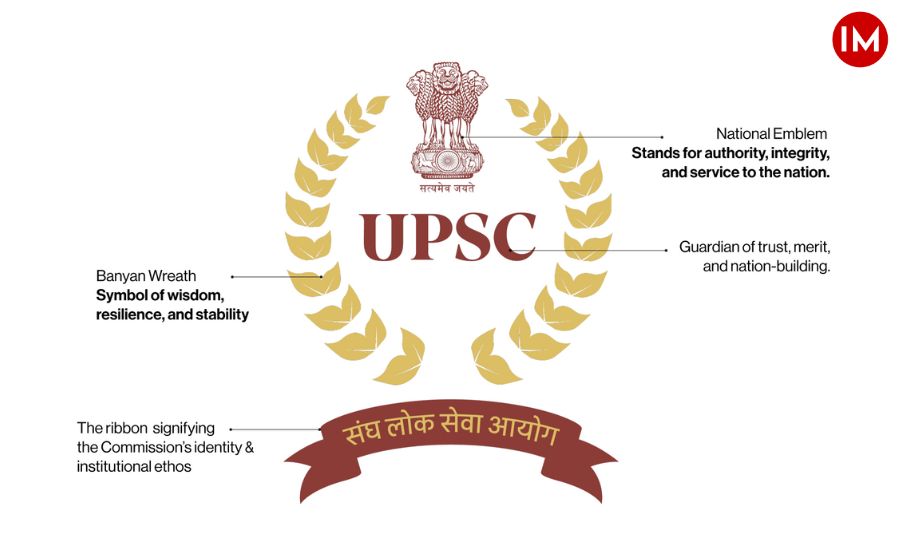
The centenary logo adopts a circular form, a shape historically associated with continuity and wholeness. In the context of UPSC, the circle conveys the uninterrupted cycle of public service, symbolising the Commission’s sustained role in recruiting administrators for a changing nation over the past century.
Prominently placed within the design is the National Emblem, derived from Emperor Ashoka’s Lion Capital at Sarnath. This element represents authority rooted in responsibility and public duty, values that define constitutional governance in India. Beneath the emblem appears the Ashoka Chakra, its 24 spokes signifying ethical governance, motion, and adherence to constitutional principles.
Encircling these core elements is a wreath composed of banyan leaves. The banyan, known for its longevity and expansive canopy, represents wisdom, institutional stability, and continuity across generations. In administrative symbolism, it reflects the obligation of civil servants to protect and sustain democratic structures.
A flowing ribbon bearing the Devanagari inscription “संघ लोक सेवा आयोग” anchors the design in linguistic and institutional identity. The ribbon reinforces the Commission’s role as an impartial constitutional body committed to recruitment based on merit rather than influence.
Completing the visual narrative is a wave motif integrated into the numeral ‘100’. This wave traces the transformation of civil services across a century, representing gradual change, adaptation, and progression. The final ‘0’ symbolically highlights UPSC’s central position in shaping India’s administrative systems over time.
ORIGINS OF THE CIVL SERVICES IN INDIA
The roots of India’s civil services lie in the early 19th century, during the rule of the East India Company. At that time, senior officials were nominated directly by the Company’s Directors and trained at Haileybury College in London before being posted to India. This system functioned through patronage rather than competence.
A significant shift occurred in 1854 following Lord Macaulay’s Report to the British Parliament. The report recommended replacing the nomination-based structure with a permanent civil service recruited through open competitive examinations. As a result, a Civil Service Commission was established in London, and the first competitive Indian Civil Services (ICS) examination was conducted in 1855.
However, structural barriers remained. The examination was held exclusively in London, with age limits set between 18 and 23 years. The syllabus heavily favoured European classics, making it inaccessible to most Indian candidates. Despite these constraints, Satyendranath Tagore became the first Indian to clear the ICS examination in 1864. Over the next three years, four more Indians succeeded.
DEMAND FOR EXAMINATIONS IN INDIA
For nearly five decades, Indian leaders repeatedly demanded that civil services examinations be conducted simultaneously in India. These demands were consistently resisted, as British authorities sought to limit Indian representation within administrative services.
The situation changed after the First World War and the Montagu–Chelmsford Reforms. From 1922 onwards, the ICS examination began to be held in India, initially in Allahabad and later in Delhi, while examinations in London continued in parallel.
During this period, other services also began formalising recruitment processes. The Imperial Police introduced open competitive examinations in England in 1893, though Indian candidates were allowed entry only after 1920. Even then, Indian appointments progressed slowly, with Indians occupying only 20 percent of Superintendent of Police posts until 1931. Larger Indian participation occurred only after 1939 due to a shortage of European candidates.
Similarly, the Imperial Forest Department, established in 1864, formalised the Imperial Forest Service in 1867. Officers were trained in Europe until the early 20th century. By 1920, recruitment was conducted both in England and India. Post-independence, the Indian Forest Service was formally created in 1966 under the All India Services Act, 1951.
BIRTH OF THE PUBLIC SERVICE COMMISSION
The idea of a permanent, independent recruitment body gained legislative recognition in the Government of India Act, 1919. Section 96(C) of the Act provided for the establishment of a Public Service Commission to regulate recruitment and service conditions.
Despite this provision, administrative delays postponed its creation. The matter was later referred to the Royal Commission on the Superior Civil Services in India, also known as the Lee Commission. In its 1924 report, the Commission strongly recommended the immediate establishment of a statutory Public Service Commission.
Acting on these recommendations, the Public Service Commission was formally established on October 1, 1926. It comprised a Chairman and four Members, with Sir Ross Barker serving as its first Chairman. The Commission’s functions were governed by the Public Service Commission (Functions) Rules, 1926.
Under the Government of India Act, 1935, the body was reconstituted as the Federal Public Service Commission, which came into effect on April 1, 1937. Provincial Public Service Commissions were also envisaged under the same Act.
UPSC IN INDEPENDENT INDIA
With the adoption of the Constitution of India on January 26, 1950, the Federal Public Service Commission was renamed the Union Public Service Commission. Article 378 of the Constitution ensured continuity by transferring the Chairman and Members of the Federal Commission to the newly constituted UPSC.
Since then, UPSC has functioned as a constitutional authority responsible for conducting examinations and advising the government on recruitment to All India Services, Central Services, and other posts. The Civil Services Examination has evolved into a multi-stage process and is regarded as one of the most competitive examinations in the country, attracting lakhs of candidates annually.
THE UPSC VIRTUAL MUSEUM
As part of its centenary initiatives, UPSC has also introduced a Virtual Museum Tour, offering a digital exploration of its 100-plus years of institutional history. The museum presents rare exhibits related to examinations, administrative reforms, and recruitment processes, tracing the transformation of civil services from colonial administration to democratic governance.
Accessible globally, the virtual tour allows visitors to engage with historical documents and narratives without physical entry, making institutional history available to a wider audience.
The centenary logo unveiled in 2025 encapsulates this long journey through visual symbolism. From the introduction of competitive examinations in 1855 to the constitutional mandate of UPSC in independent India, the Commission’s evolution reflects broader changes in governance, representation, and administrative accountability.