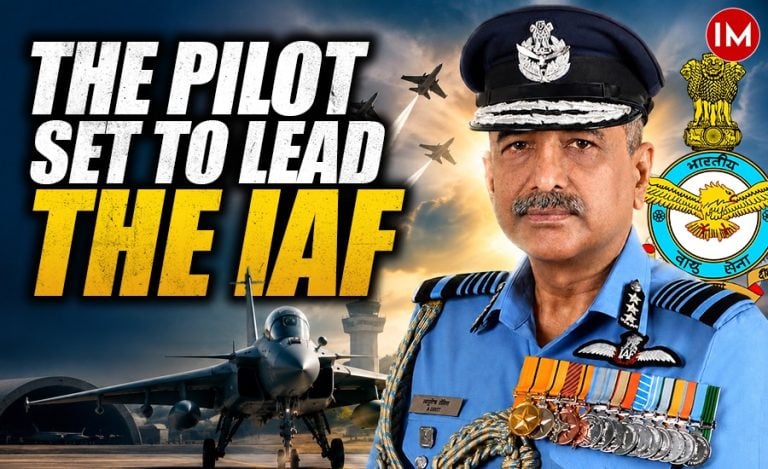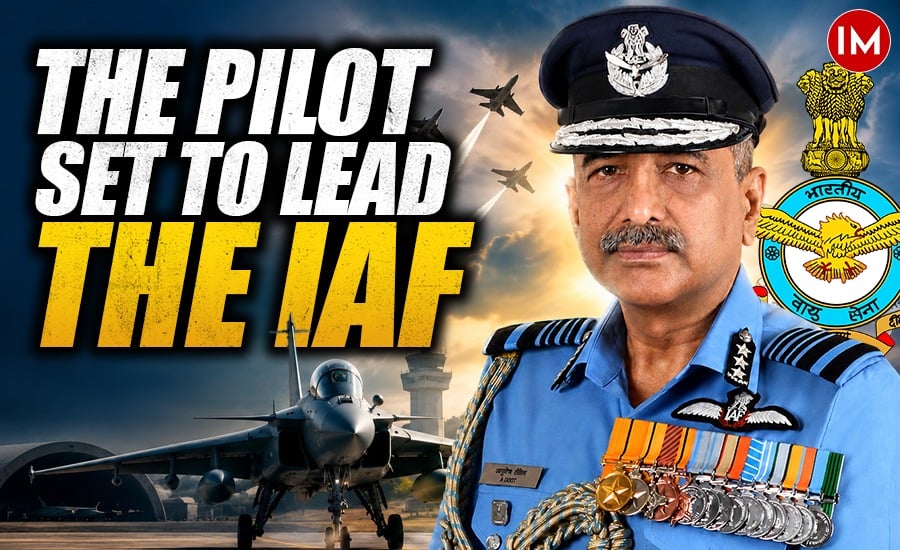
On December 6, 1986, Ashutosh Dixit was commissioned into the fighter stream of the Indian Air Force. Nearly four decades later, that journey has brought him to the threshold of its highest office.
Born on December 9, 1966, Dixit is scheduled to take over as the 29th Chief of the Air Staff on October 31, 2026, succeeding Air Chief Marshal Amar Preet Singh. By then, his career will have spanned fighter operations, experimental test flying, aircraft modernisation, operational command and the coordination of India’s three armed services.
His journey has not been confined to the cockpit. It has taken him through the technical establishments where aircraft are tested, the headquarters where operational requirements are shaped, and the commands responsible for maintaining the Air Force’s fighting capability.
Also read: Amar Preet Singh: The Fighter Pilot Who Rose from Tejas Trials to Lead the Indian Air Force
A Fighter Pilot with More Than 3,500 Flying Hours
An alumnus of the National Defence Academy at Khadakwasla, the Defence Services Command and Staff College in Bangladesh, and the National Defence College in New Delhi, Dixit has accumulated more than 3,500 hours of flying experience.
His aircraft experience includes the Mirage-2000, variants of the MiG family, Kiran, Jaguar, IL-78, Hawk and Tejas. He is both an Experimental Test Pilot and a Qualified Flying Instructor.
These qualifications reflect two distinct strands of military aviation: evaluating aircraft and their systems, and training pilots to operate them. During his service, Dixit participated in operations including Safed Sagar, Rakshak, Operation Sindoor and exercises such as Cope India.
Testing Aircraft, Shaping Modernisation
One of the most distinctive chapters of Dixit’s career unfolded at the Aircraft and Systems Testing Establishment in Bengaluru. As a test pilot and later Commanding Officer of its Flight Test Squadron, he was involved in indigenous upgrade and development programmes, including avionics upgrades for the Jaguar and MiG-27.
The work placed him within a critical part of military aviation: evaluating and improving aircraft systems so that existing platforms could continue to meet operational requirements.
His technical experience extended into capability planning. As Principal Director of Air Staff Requirements at Air Headquarters, he played a key role in planning and conducting trials for the Medium Multi-Role Combat Aircraft programme.
The assignment connected his experience as a pilot with the larger process of assessing the aircraft the Air Force would need. Dixit also served as directing staff at the Air Force Test Pilots School, adding an instructional role to his operational and technical experience.
From Squadron Command to Central Air Command
As Commanding Officer, Dixit re-equipped No. 9 Squadron with Mirage-2000 aircraft. He subsequently commanded a frontline fighter air base in the Western Sector and a premier fighter training base in the Southern Sector.
Under his command, the training base was adjudged the best in its command, according to the Ministry of Defence.
His subsequent appointments broadened his responsibilities. He served as Air Defence Commander of Southern Air Command and held the posts of Assistant Chief of the Air Staff (Projects) and Assistant Chief of the Air Staff (Plans) at Air Headquarters. sHe later became Senior Air Staff Officer at South Western Air Command and Deputy Chief of the Air Staff.
On September 1, 2024, he took over as Air Officer Commanding-in-Chief of Central Air Command. The appointment placed him in charge of an operational command after years of experience spanning flying, planning, technical evaluation and staff responsibilities.
A Tri-Service Role Beyond the Air Force
On May 1, 2025, Dixit assumed charge as Chief of Integrated Defence Staff to the Chairman, Chiefs of Staff Committee.
The appointment brought him into a role focused on coordination and integration among the Army, Navy and Air Force. During his tenure, joint doctrines and orders were released, while initiatives were developed to strengthen the armed forces across domains.
This experience added a tri-service dimension to a career that had largely been built within the Air Force.
On July 1, 2026, he took over as Vice Chief of the Air Staff, succeeding Air Marshal Nagesh Kapoor. The appointment placed him immediately below the service chief before the government announced his elevation to the top post.
Four Decorations Across Four Decades
Dixit’s distinguished service has been recognised through four decorations: the Vayu Sena Medal in 2006, the Vishisht Seva Medal in 2011, the Ati Vishisht Seva Medal in 2023 and the Param Vishisht Seva Medal in 2026.
Together with his operational, instructional, technical and command appointments, these awards form part of the official record of his career.
The Next Chapter
When Dixit assumes office on October 31, 2026, he will bring experience from several layers of military aviation: flying fighter aircraft, evaluating their systems, planning future requirements, commanding operational formations and working across the three services.
His career has moved from the fighter stream to aircraft testing, from squadron leadership to air command, and from Air Headquarters to tri-service planning.
The next chapter will begin at the head of the Indian Air Force, with a career spanning almost four decades behind him.
Also read: Brighu Srinivasan: The IPS Officer Leading India’s Elite NSG Force