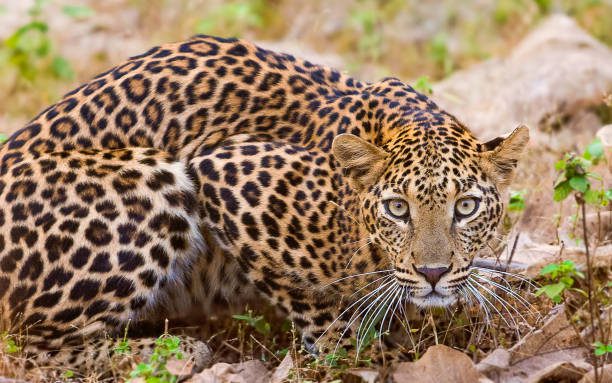
If a unique proposal of the Junnar Forest department gets approval from the Ministry of Environment, Forests and Climate Change, it would be for the first time in India that a sterilization programme could be launched for leopards. The country is no stranger to spaying and neutering of street dogs and cats. Animal caregivers and feeders carry out such drives routinely in their respective areas to control the stray population.
However, mass neutering or sterilization as a population control measure has never been carried out on wild animals so far. This unique proposal from the Junnar forest division in Maharashtra’s Pune district is the fallout of frequent attacks on humans by leopards of the area. These attacks are not new; the area is known as a hotspot for leopard attack for decades now. However, what sparked this rather unique proposal for sterilization was the rising frequency of such attacks and the resultant casualties. In a span of two weeks in May, three humans were mauled by the big cats, resulting in their death, including a child.
Indian Masterminds got in touch with Junnar division’s Deputy Conservator of Forest, Mr. Amol Satpute, IFS, to know about the leopard sterilization proposal and its larger implications.
IS NEUTERING THE SOLUTION?
Human-leopard conflict is common in Junnar. There are many hotspots where these conflicts occur on a regular basis. With time, the villagers have learned to live with leopards in their yards, exercising greater caution with their movements outside.
The big cats hide in the agricultural fields during the day and come out to prowl in the night. Usually they pounce on the unsuspecting cattle, goat, and even dog, and drag it away for its next meal. However, the occasional human, too, have fallen prey to a very hungry cat on the prowl, giving rise to unrest and resentment in village after village.
But, this year, such human-leopard encounters have been uncharacteristically relentless. With conflicts and resulting attacks on humans on the rise, anger among the villagers is palpable and so is consternation within the forest department. Besieged with calls for action, they are under high pressure to ‘act’. But, how? Already much of the preventive measures are in place, like capture, rehabilitation and relocation of the animal, and reuniting lost cubs with their mother so that the latter does not turn aggressive towards humans.
The only step left to consider was neutering and spaying, a system very much in place as a street dog population control measure. The dogs are captured in a very humane way, taken to an animal clinic for surgery, then allowed to heal in an animal shelter or foster home, and, finally, released back in its home street. There is a strict rule against relocation of such dogs. Hence, they have to be released in the same location from where they had been picked up from.
But, in the case of a wild animal like leopard, the logistics would be more complex. And how feasible would it be? DCF Satpute said, “If permitted, this will be a pilot project. We plan to capture only male leopards from 5-6 hotspots, where attack on humans are frequent, take these cats to an animal hospital, and then carry out the surgical procedure of neutering under general anaesthesia. After surgery, they will be kept under observation till the wound heals, and, then, we will undertake a control release. We are also studying chemical castration as an option.”
Even as he spoke, leopards were being captured in Junnar and, after a health overhaul, being released back in different locations. This relocation, Mr. Satpute pointed out, is part of a safety procedure. The spotted cats are picked up from highly populated areas and released in lesser populated ones to prevent human-leopard conflict.
THE IDENTIFICATION PROCESS
At least 20 camera traps and 40 cage traps have been set up in 10 villages around the Yedgaon dam, known as a hotspot. Between May 10 to May 15, the department managed to capture six leopards after conducting thermal drone surveys in these areas.
After capture, the big cats were sent to the Manikdoh Leopard Rescue Centre, where health check-ups were conducted, and blood samples taken and sent to Hyderabad for further scrutiny and study.
“By verifying their genes and behaviour patterns, we will be able to identify the ones who have attacked people fatally. If identified, we will keep them in lifetime captivity in a rescue facility while the others will be set free,” Mr. Satpute said.
CALL FOR ‘DISASTER AREA’ DECLARATION
Meanwhile three human deaths in quick succession this month and the resultant anger among villagers have led the Junnar forest division to propose declaring this Maharashtra taluka as a ‘disaster area’. The reasons behind this sudden spurt in attack have been attributed to the drought conditions, the lack of prey base, and an ‘exceeding carrying capacity’.
Mr. Satpute said, “We wrote to the Pune District Collectorate asking for the region to be declared as a ‘disaster area’. We also demanded additional workforce and equipment to deal with the crisis.”
In the latest attacks, 45-year-old Nanubai Sitaram Kadale and Ashwini Manoj Hulawade were attacked fatally while they were working in agricultural fields. In another attack, 8-year-old Mahesh Fapale was killed. All three attacks took place early in the morning or in the late evening across different villages located within a 5 sq km zone.
What has made the leopards in Junnar, which have been known to co-exist with humans for decades, suddenly turn against the latter? An ongoing drought has forced these animals to migrate from neighbouring areas to Junnar, resulting in high leopard density and shortage of prey base. “Due to drought conditions, farmers have grown less crops. As a result, the crop density that leopards use as shelter and cover has reduced, and the water scarcity has pushed the cats to venture into areas where water is available,” Mr. Satpute explained.
The result is conflicts, encounters, attacks, and tragic deaths. With emotions running high in the area, and left with hardly any more options, a besieged forest department now moots mass sterilization of the spotted cats that have turned the spotlight back on Junnar, but for all the wrong reasons.