India might not have crude producing oil wells. But, it has more than compensated by procuring tremendous refining capacities making it a Global Oil Hub…
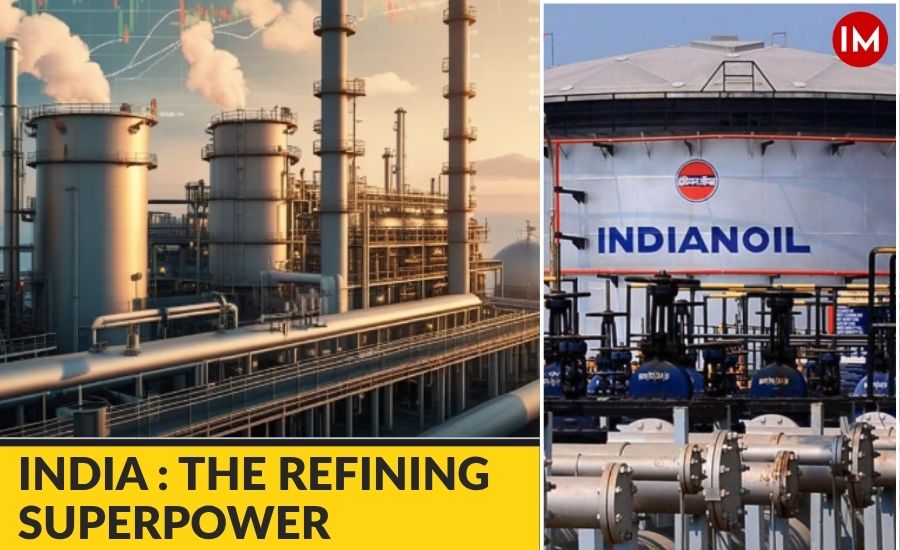
India’s hydrocarbon story is no longer just about importing crude oil—it is about refining it efficiently, exporting value-added fuels, and shaping global energy markets. With world-class refineries, advanced processing technologies, and strategic export networks, India has emerged as one of the world’s major refining powers.
The Big Picture
India’s refining capacity has grown from about 215 million metric tonnes per annum (MMTPA) in 2014 to about 256–258 MMTPA in 2024–25, making it world’s largest refining nations. In barrel terms, India’s refining capacity is about 5–5.2 million barrels per day, second only to China in Asia. India has more than 23 operational refineries, including public-sector units, private giants, and joint ventures.
The Crown Jewel
The refining complex at Jamnagar in Gujarat, owned by Reliance Industries, is the largest refining complex in the world, with capacity exceeding 1.2–1.4 million barrels per day. This mega-complex is known for Very high Nelson Complexity Index, ability to process heavy, sour, and discounted crude (the Venezuelan type), Integrated petrochemical units
How India Compares Globally
Among major refining countries USA has a capacity of 18-19 million barrels per day (mb/d) while China is a shade less at 17 mb/d, Russia at 6-7 mb/d, India at 5 mb/d, Japan at 3, mb/d and South Korea at 3 mb/day. India’s strength is not just capacity—but complexity.
Types of Crude
Crude oil varies widely. Refineries must be designed to process different types. Light Sweet Crude: Crude like US shale oil and Brent crude have low sulphur and are easy to refine. Refineries in Japan and Europe prefer this. Heavy Sour Crude: like Venezuelan, Russian Urals, Middle East grades have high sulphur and requires advanced refining. India’s most advanced refineries—especially Jamnagar—can process heavy sour crude efficiently.
Venezuelan Crude Beneficial?
Russian Crude’s typical delivered price to India was $55–70 per barrel while Venezuelan Crude’s landing cost in India is expected to be around $60 per barrel delivered to India in recent assessments. Heavy crude trades cheaper at wellhead but costs more to refine and ship.
Export Markets
India exports diesel, petrol, jet fuel, and petrochemicals. During the Ukraine war, Indian refiners processed discounted Russian crude and exported refined fuel globally, strengthening India’s position in global markets. Private refiners especially dominate exports.
Green Refinery Technologies
India’s refineries are also moving toward cleaner operations by producing Hydrogen, Biofuel blending, Carbon capture pilots and Energy efficiency upgrades. Refineries like Jamnagar integrate petrochemicals to reduce emissions per unit output. Oil PSUs are also investing in green hydrogen and renewable energy.
A Refining Superpower?
Its strategically placed between Middle East suppliers and Asian markets. Can process cheaper heavy crude and is designed to serve global markets. Has tax incentives, SEZs, and infrastructure besides skilled engineers, planners, and global negotiators.
Future Challenges
For a country of 1.4 billion people, refining is not just an industry. It is energy security, economic growth, diplomatic leverage, and technological excellence—rolled into one.