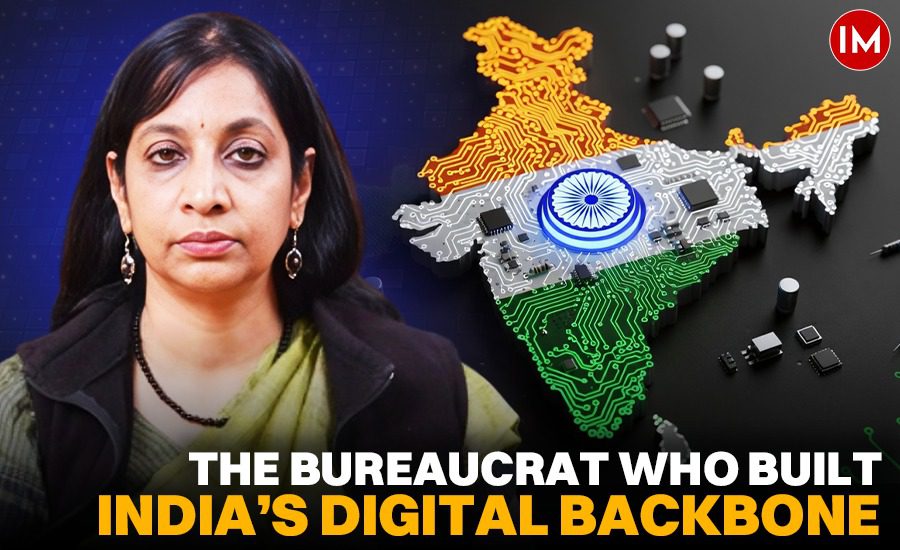
In the annals of India’s administrative history, some officers manage systems — and a rare few build them. Aruna Sundararajan belongs to the latter category. Trained in philosophy and public administration, she did not enter the civil services as a technologist. Yet she emerged as one of the principal architects of India’s digital governance framework — proving that foresight, not formal training, defines transformation.
“Her training in philosophy meant she asked not just what technology could do, but what it should do for society.”
Born on 12 July 1959 in Kerala, Sundararajan grew up close to nature in the Nilgiri region. Trekking through the Western Ghats became a lifelong passion, one she often described as essential for balance in a high-pressure service. That ability to combine perspective with purpose would later define her leadership style.
She joined the Indian Administrative Service (IAS) in 1982, Kerala cadre, beginning a career that spanned nearly four decades across economic administration, investment promotion, IT, and telecommunications. With a Master’s degree in Philosophy and a Diploma in Public Administration from France’s École nationale d’administration, her academic grounding sharpened her ethical lens. She was not trained in coding or engineering — but she possessed something more enduring: the ability to anticipate how technology would reshape governance long before it became a policy buzzword.
1998: Kerala’s Digital Foundation
The turning point came in 1998, when Sundararajan convinced Chief Minister E.K. Nayanar that the IT revolution was inevitable and Kerala needed a dedicated Department of Information Technology. She went on to establish the state’s first-ever IT department — a structural reform that fundamentally altered Kerala’s development trajectory.
“Kerala’s early leadership in digital governance was not accidental. It was architected.”
In 2002, she conceived and spearheaded the Akshaya Project, one of the largest digital literacy missions in the world. Over one million people were trained in basic computer skills in campaign mode. At a time when the digital divide was wide and rural connectivity limited, Akshaya democratized access to technology and earned domestic and international acclaim.
Her contributions also included helping establish InfoPark Kochi and the Indian Institute of Information Technology and Management–Kerala (IIITM-K) — institutions that strengthened the state’s IT ecosystem and employment landscape. These initiatives ensured that technology was embedded within governance architecture, not treated as an auxiliary function.
From State Innovation to National Transformation
After decades of service in Kerala, Sundararajan moved to national leadership roles. She served as:
- CEO, Common Services Centre (CSC) Project under the National e-Governance Plan
- Country Head, Global E-Schools Initiative (United Nations)
- Senior positions overseeing telecom and broadband expansion
In July 2016, she was appointed Secretary, Ministry of Electronics and Information Technology (MeitY). India’s digital push was accelerating — digital payments were expanding, service delivery was going online, cybersecurity concerns were rising. As MeitY Secretary, she spearheaded critical components of the Digital India programme, focusing on inclusion, scale, and sustainability. Her emphasis was clear: technology must empower citizens, not merely modernize files.
Steering Telecom Through Disruption
In June 2017, she became Telecom Secretary of India, inheriting a sector in turmoil after the entry of Reliance Jio. Revenues were collapsing, consolidation was intense, and industry-government tensions were high.
Her leadership during this period was marked by clarity and composure. She maintained that while companies compete in markets, government must safeguard public policy and national interest.
Under her stewardship, the government rolled out the National Digital Communications Policy (NDCP) 2018 — an ambitious blueprint targeting:
- $100 billion in investments
- Creation of 4 million jobs
- Broadband for all citizens
She also chaired the high-level forum preparing India’s 5G roadmap, positioning the country for next-generation connectivity.
When she retired on 31 July 2019, she left behind frameworks that continue to shape India’s digital infrastructure landscape.
Why She Belongs in “Legends of Bureaucracy”
Aruna Sundararajan is a legend because she anticipated the digital state before it fully emerged.
- She institutionalised IT governance in Kerala in 1998.
- She democratised digital literacy in 2002.
- She scaled Digital India during its formative years.
- She stabilised telecom policy during its most disruptive phase.
- She built policies that continue to guide India’s communications future.
“Her imprint is not just indelible — it is infrastructural. Every time a citizen logs into a digital service, pays online, or connects to broadband, they are walking through systems she helped architect.”
Most importantly, she demonstrated that one does not need to be an engineer to shape technological transformation. What is required is vision, institutional courage, and unwavering public purpose.
Her journey reflects the evolution of Indian bureaucracy itself — from managing scarcity to designing systems, from administrative control to digital empowerment. And in the story of India’s digital century, Aruna Sundararajan’s legacy remains foundational.