It is a truth universally acknowledged, that a single woman in possession of a keen wit and excellent prose, must be in want of a publisher. But even if her various novels do not find commensurate financial appreciation from said publisher(s), her legacy may in some cases eclipse her own expectations.
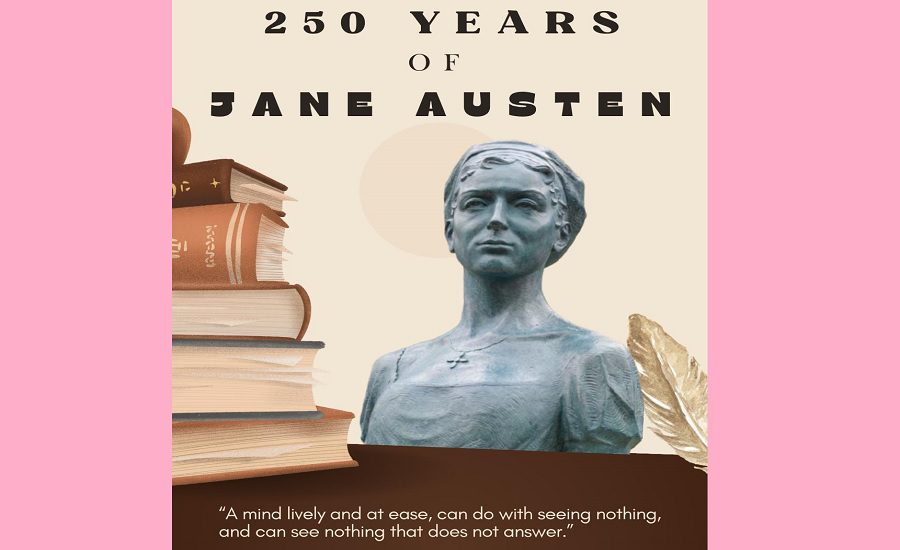
In another December, 250 years ago, Jane Austen was born. Over the course of her relatively short life – she died at the age of 41 – she would write stories whose premises have since become extraordinarily recognizable in being adapted to a dizzying range of popular culture around the world. In India, her renown is enduring. She has a connection to the subcontinent through an aunt who married an East India Company surgeon and an association with Warren Hastings; her books however rarely touch upon colonization or other politics. They focus on family and finance, but do not particularly engage with any extractive logic behind the acquisition of the latter. Nonetheless, Austen is familiar to Indians across generations. Her novels have been prescribed in middle school syllabi and undergraduate college courses. Those who may not have read her work are likely to have encountered variations of it in films like Rajiv Menon’s Kandukondain Kandukondain (2000), Gurinder Chadha’s Bride and Prejudice (2004) and Rajshree Ojha’s Aisha (2010).
Beloved to both the general reader and the academic, Austen’s novels are humorous in gentle and wry ways, critical of social hypocrisies, and culminating towards domestic happiness. In each, the transformation of character by overcoming flaws of dishonesty or greed or obstinacy or arrogance leads to a healthier sense of self within society. These books are infused with a certain piety, but without any overt self-righteousness aside from their contextual location within particular time and place.
“Let other pens dwell on guilt and misery,” she writes in the concluding chapter of Mansfield Park. “I quit such odious subjects as soon as I can, impatient to restore everybody, not greatly in fault themselves, to tolerable comfort, and to have done with all the rest.” But character is consequence, and flawed figures do suffer in the exposition which follows. The patriarch of Mansfield, Sir Thomas Bertram (whose fortune comes from a sugar plantation in Antigua which we are informed about in a short reference to the slave trade), realises in anguish after a terrible scandal that he has not been able to provide a wholesome upbringing for his daughters.
He feared that principle, active principle, had been wanting; that they had never been properly taught to govern their inclinations and tempers by that sense of duty which can alone suffice. They had been instructed theoretically in their religion, but never required to bring it into daily practice. To be distinguished for elegance and accomplishments, the authorised object of their youth, could have had no useful influence that way, no moral effect on the mind.
His younger daughter, Julia Bertram, described earlier in the novel as having been raised to perform genteel politeness without “that higher species of self-command, that just consideration of others, that knowledge of her own heart, that principle of right, which had not formed any essential part of her education” is pardoned in the final pages because “her feelings, though quick, were more controllable, and education had not given her so very hurtful a degree of self-consequence.” Not so for the vain Mary Crawford, romantic rival to our virtuous protagonist Fanny Price: “Miss Crawford, in spite of some amiable sensations, and much personal kindness, had still been Miss Crawford; still shown a mind led astray and bewildered, and without any suspicion of being so; darkened, yet fancying itself light,” and thus it is unsurprising that Mary is destined to wait longer than she would like, in the last lines, to find a suitable partner for herself.
Fanny Price is an ideal of sorts – affectionately referred to as “My Fanny” by her author – and she is not actually as insipid as the novel’s characters and readers could presume. She is more like Sense and Sensibility’sdiscreet Elinor Dashwood or Pride and Prejudice’s gentle Jane Bennet or Persuasion’s reserved Anne Elliot: women who may not be outwardly expressive but who have rich inner lives. They differ from their feistier counterparts in Marianne Dashwood, Elizabeth Bennet, or Emma’s Emma in that they are resolute in reform as habit. A strong sense of personal ethics defines them – and they are rewarded in these books which are not so much about marriage as they are about manners. Austen herself never married but by all accounts was conscientious in her commitment to being a steady daughter, sister, friend, and author. Scenes and dialogues of the landed gentry which she laughingly satirised two hundred years ago reflect in the anxieties of middle-class India today; the earnestness of her faith and lightness of her judgement echo in the hollowness of what we have inherited.
Is there an Indian Austen? It is a disservice to compare. Perhaps the scope of interiority she captures into the character – and countenance – of people could be said to align with the styles of Ismat Chughtai or Qurratulain Hyder: authors who began publishing their works after early foundations of writing for and around their large families, who have the same observational knack for conversational tones as an extension of begumati zubaan. There are comparisons and equivalents to Austen in more contemporary works too like Vikram Seth’s A Suitable Boy;or Anuja Chauhan’s Those Pricey Thakur Girls and Mahesh Rao’s Polite Society. The impact of her writing style on English literature in general, and Indian English literature as part of that global fabric, is immense.
“I came upon Jane Austen when I was very young. In a sense, it seems to me that I have accompanied her on her journey from relative obscurity to this great splash of fame,” writes Shashi Deshpande in a recent essay: “She was a pioneer, an originator, an influence on other writers. She turned her back on the novels of her time and gave the novel a different face. The novel today is still tethered to Austen’s novel… Understating was her way. Perhaps it is because of this that it took us two centuries to recognise her greatness.”
However little known the feelings or views of such an author may have been on her journey into publishing – never completely validated in her own time – the truth of Jane Austen’s brilliance is so well fixed in the minds of her diverse readers since, that she continues to be considered in well-deserved favour as one of the greatest authors of the modern world.
(This article is written by Yauvanika Chopra, it’s on the 250th Aniversary of Jane Austen.)