In many government schools across rural Punjab, science education often stops at textbooks. Laboratories are limited, advanced equipment is scarce, and exposure to emerging technologies is rare.
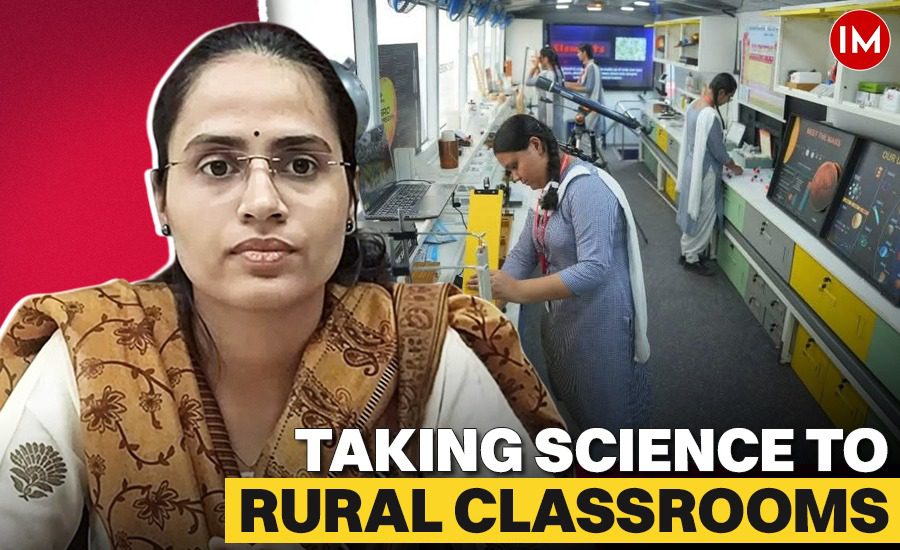
When Dr. Preeti Yadav, a 2014-batch IAS officer of the Punjab cadre, was serving as Deputy Commissioner of Rupnagar in 2023, she decided to change that reality. The result was Skill on Wheels — a fully equipped Mobile STEM Lab, designed to bring practical science education directly to students’ doorsteps.
Funded through the State Collaborative Initiatives of the Government of India, the project was conceived to bridge the urban–rural gap in access to quality STEM learning.
“Science becomes meaningful only when students can see, touch and experiment. The idea was simple: if schools cannot reach advanced laboratories, the laboratory should reach the schools,” she shared in an exclusive conversation with Indian Masterminds.
ADDRESSING A SILENT EDUCATION GAP
Education data in Punjab has been pointing to worrying patterns. Reports from UDISE+ and state education assessments show declining enrolment in government schools and fewer students choosing science in senior secondary classes.
One major reason is the lack of exposure to real laboratories and emerging technologies in rural schools.
Recognizing this challenge, Dr. Yadav brought together an unusual team to design the initiative. Experts from NIELIT Ropar, IIT Ropar, the District Education Office, ITI principals, science teachers, and the district’s Good Governance Fellow collaborated to create a sustainable model.
The team also studied mobile science lab models from countries such as the United States, Finland, Israel and Singapore, adapting their ideas to local needs while keeping the project economically viable.
A LABORATORY INSIDE A BUS
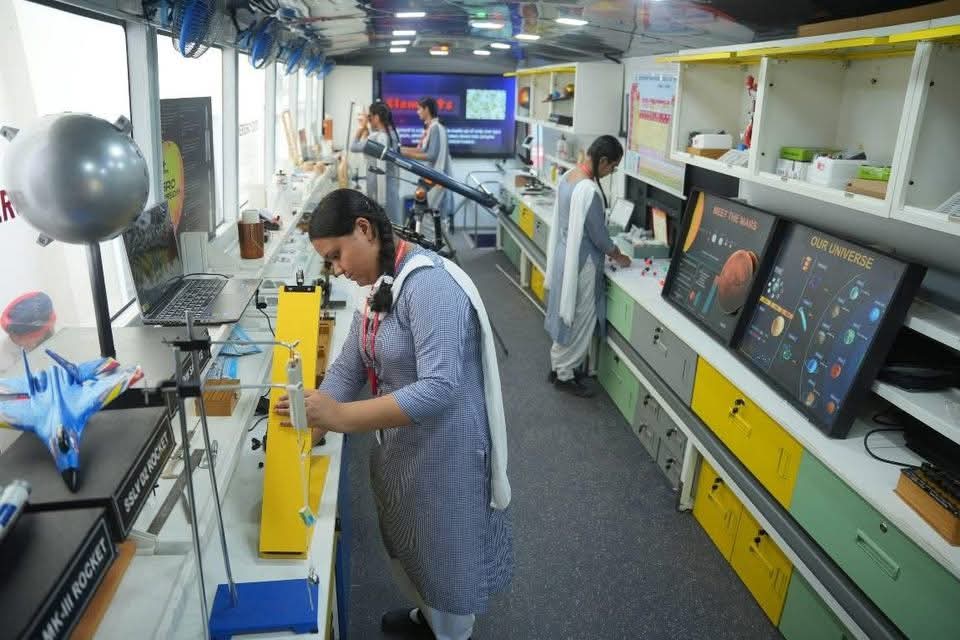
The result is a state-of-the-art laboratory housed inside a bus, carrying more than 300 pieces of laboratory equipment. It supports practical learning for students from Classes 5 to 12 and beyond, covering physics, chemistry, and biology experiments aligned with school curricula.
But the lab goes far beyond traditional science tools.
Students can work with robotics kits and programmable microcontrollers, explore coding through advanced laptops, experiment with 3D printing, and learn concepts of Artificial Intelligence and the Internet of Things.
The bus also carries rocket models and space science demonstration kits, telescopes for astronomical observation, GIS-based learning tools, digital microscopes, sensor-based experiment modules, and mathematics innovation models.
“This lab is not only about completing experiments from textbooks,” Dr. Yadav explains. “It is about giving students the confidence to innovate, design and imagine careers in science and technology.”
DESIGNED WITH IIT EXPERTISE
The bus itself was technically designed with support from experts at IIT Ropar.
Its interior layout can comfortably accommodate 35–40 students at a time, with modular workstations and adjustable stools allowing the space to shift between practical sessions and demonstrations.
A smart board enables interactive teaching and workshops, while an LED screen mounted outside the bus allows educational film screenings and community awareness programmes. A foldable shed provides shade for outdoor learning sessions.
The vehicle is fully air-conditioned and fitted with air purifiers, ensuring a safe and comfortable learning environment even during extreme weather conditions.
LEARNING THAT INCLUDES EVERYONE
Inclusivity has been a central design principle of the Mobile STEM Lab.
The bus includes a special ramp for students with disabilities, allowing safe and easy access. The interior layout also enables smooth movement and participation for differently-abled students.
“Every child should feel that science belongs to them,” Dr. Yadav says. “Accessibility was not an optional feature; it was part of the core design.”
A LAB THAT TRAVELS WITHOUT LIMITS
The lab is built to function anywhere. It can operate through direct electricity supply or an onboard generator, allowing uninterrupted sessions even in remote villages.
Whether stationed at a rural school or a semi-urban campus, the bus eliminates infrastructure barriers and brings advanced learning facilities directly to students.
Its purpose is clear: introduce unique and emerging courses to students who otherwise have no access to advanced laboratories.
LEARNING BEYOND THE CLASSROOM
The initiative also promotes field-based learning.
Students can participate in nature trails, biodiversity mapping, zoology-based habitat studies, insect diversity observations, bird-watching modules, soil testing and environmental science experiments.
In collaboration with the Forest Department, the programme plans biodiversity awareness sessions, helping students understand the ecological richness of Rupnagar and the importance of conservation.
Partnerships with national institutions are also envisioned. These include ISRO for space science modules, the National Council of Science Museums for demonstrations, IIT Ropar for technical mentoring, and NIELIT Ropar for digital skill certification programmes.
BUILDING THE FUTURE OF SCIENCE EDUCATION
For Dr. Preeti Yadav, the Mobile STEM Lab represents a shift in how government schools approach learning.
“It is not enough to teach science,” she says. “Students must experience it, question it, and experiment with it. That is when curiosity turns into innovation.”
To monitor its outreach, a digital dashboard is being proposed to track school visits, student participation, courses delivered and learning outcomes in real time.
Future plans also include structured certification courses and an online booking system, potentially supported by nominal user contributions to sustain operational costs.
What began as a bus is gradually becoming a moving ecosystem of science education—taking robotics, coding, space science and environmental learning to the last mile.