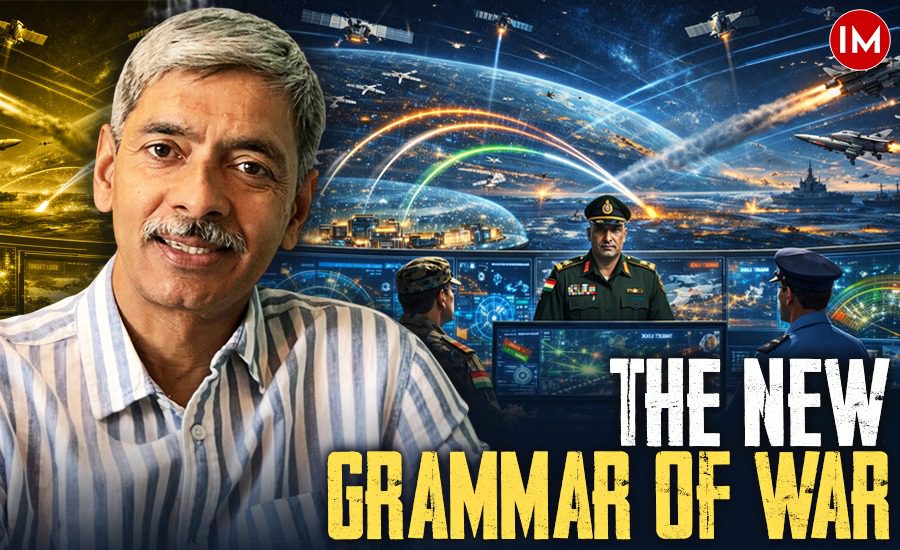
I grew up professionally in an era where military strength was measured in numbers guns deployed, troops mobilised, frontage held. The belief was straightforward- mass creates shock, shock creates collapse.
As a Gunner everything I learnt was in mass. Massed guns. Massed formations. Massed firepower. The logic was simple and for its time, overwhelm the enemy, break his will, and dominate ground through volume. Fire assaults and degradation were thunderous affairs, designed to crush resistance before manoeuvre followed. Yet, as any soldier who has served long enough will tell you that war has an unforgiving habit of changing its rules quietly and then punishing those who fail to notice.
Today, the world has crossed such a moment.
The next war will not look like the last one because power itself has become precise, measured, targeted and unforgiving. India’s own experience in recent years including Operation Sindoor offers a clear window into this transformation. It was not about spectacle or saturation instead it showcased use of calibrated force, intelligence-led action in an integrated operational ecosystem and controlled escalation.
Sending a signal without lighting a fuse. That, in essence is “precision dominance”.
Operation Sindoor demonstrated that modern military action is as much about “what you choose not to do as much as what you want to execute.” The operation was defined by restraint backed by readiness, by clarity of objectives rather than spectacular displays. It reflected a mature strategic culture one that understands that in a hyper-connected world, every strike is watched, recorded, interpreted, and judged within minutes.
This is why mass firepower is giving way to precision. Visibility has killed anonymity. Satellites, drones, cyber tools, and open-source intelligence mean that nothing large stays hidden for long.
“Factum apparens erat omnibus.”
Concentration attracts attention and attention attracts targeting. In such an environment, mass becomes a liability. Ukraine’s battlefields have shown this starkly. Large armoured formations, once symbols of dominance, have become high-value targets for precision-guided munitions and drones costing a fraction of a tank’s price. In Nagorno-Karabakh, entrenched positions collapsed not under sustained barrages, but under persistent, precise strikes that dismantled command, sensors, and morale. Gaza, for all its complexity, underscores how intelligence-led targeting shapes not just military outcomes but global political narratives. India is absorbing these lessons not as an observer, but as a practitioner and a keen student of this art.
As an emerging world power and the de facto voice of the Global South, India matters today in every serious strategic conversation involving the United States, Russia, and China. This is not accidental. It is the outcome of sustained strategic autonomy, economic resilience, and an increasingly credible military posture. Interestingly, this shift towards precision is visible even outside the military domain.
Look at how social media has reshaped human communication. A decade ago, messages were verbose, explanatory, often redundant. Today, communication is compressed into acronyms, emojis, and shorthand “BRB,” “ICYMI,” “TL; DR.” Fewer words, sharper meaning. Precision has replaced volume. The same message, delivered faster, clearer and with minimal noise.
Warfare is undergoing a similar compression. Long fire plans are giving way to short kill chains and decision cycles. Hours of deliberation replaced by seconds of decision-making. The objective is not to say more, but to say exactly that is enough. Decision de-centralized and execution with intent, clarity, and purpose.
First, technology has democratised lethality. Drones, loitering munitions, and guided rockets are no longer the preserve of superpowers. State and non-state actors alike can now access precision effects once unimaginable and even small units can deliver strategic impact.
Second, data has become the new battlespace. Intelligence, Surveillance, and Reconnaissance are no longer episodic. They are 24×7 and seamless. Satellites, UAVs, cyber intrusions, and open-source intelligence create battlefield transparency that punishes static thinking. Hiding mass concentrations is next to impossible today.
Last, dynamics of geo-politics has tightened the margins of error in a nuclearized, interconnected world. Escalation control through precision strikes offers political utility.
Our armed forces are large, professional, and experienced. But size alone will not guarantee success in future conflicts. Precision demands integration across services, domains, and ministries. It demands jointness as an operating principle. Force re-structuring and integrated theatres commands will soon become a reality.
Precision warfare places leadership under a harsher spotlight. When every action is visible, leaders are judged not only by outcomes but also by judgment. There is no hiding behind fog or friction. This is where India’s civilisational ethos, restraint, proportionality, responsibility become a strategic asset.
As leader of the Global South, India is expected to demonstrate that power can be exercised without recklessness. Precision warfare naturally aligns with India’s strategic temperament. It shows that strength and stability are not opposites, but partners.
The next war will not be about who brings more to the battlefield. It will be about who understands the battlefield better.And in that context, precision is not just an advantage. It is the price of relevance.
“The supreme art of war is to subdue the enemy without fighting.” Sun Tzu