“Failure is not the end of effort; often, it is the phase where character is quietly being built for a larger victory.”
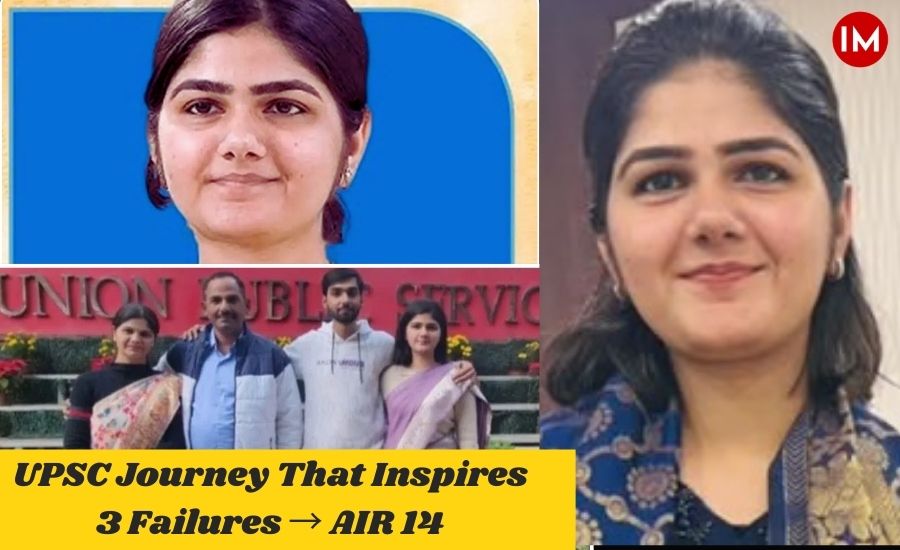
For thousands of UPSC aspirants, the journey often becomes a test not just of knowledge, but of emotional endurance, patience, and the ability to continue despite uncertainty. Very few stories capture that reality as powerfully as that of Surbhi Yadav, a young woman from a small district, who secured All India Rank 14 in the UPSC Civil Services Examination-2025 after a long and demanding journey marked by near misses, repeated setbacks, and relentless self-correction.
The daughter of a police inspector, Surabhi did not clear the examination in one dramatic attempt. Her success came only after four attempts, each teaching her something new, each forcing her to refine her strategy, and each strengthening her resolve. What makes her achievement even more remarkable is that she accomplished it without formal coaching, relying instead on disciplined self-study, careful analysis of mistakes, and unwavering support from her family.
Today, her success has brought pride not only to her family but also to her village, where celebrations continue as people see in her journey the triumph of perseverance over uncertainty.
In an exclusive conversation with Indian Masterminds, Surbhi shared her journey, preparation strategy, and a strong message for aspirants.
A Village Celebrates: Pride for Amroha and Naseer Nangla
Surabhi belongs to Naseer Nangla village in Uttar Pradesh’s Amroha district. Her father, Inspector Rakesh Singh Yadav, is currently posted in the Economic Offences Wing (EOW) of the police department.
Read Also: How Pratibha Setu Became the Turning Point in Geetika Arora’s UPSC AIR 22 Success | Exclusive
As soon as the UPSC result was declared and Surbhi’s name appeared among the top rankers with AIR 14, joy spread rapidly through the village and district. For her family, this was not merely a result – it was the culmination of years of silent effort, emotional pressure, and sustained determination.
Her family had witnessed every difficult phase: the disappointment after missed cut-offs, the uncertainty after failed prelims, and the emotional burden that naturally grows when attempts begin to accumulate.
She openly credits her family for standing by her throughout.
“It was quite a long journey. It required very consistent efforts throughout. There were many difficulties, but my family and friends helped me immensely in overcoming those hurdles and finally reaching a successful milestone.”
Her Academic Background: Excellence Built Long Before UPSC
Surabhi’s academic journey reflects excellence from the very beginning.
She completed her education till Class 10 from SR International Inter College, Bareilly. Later, she studied at Army Public School, Bareilly, where she passed Class 12 with exceptional distinction.
Her Class 12 performance was extraordinary: she scored 96 percent and topped the entire Bareilly division.
This early academic discipline laid a strong foundation for the demanding UPSC journey that would follow.
She then pursued B.A. (Honours) from Lady Shri Ram College for Women, Delhi University, one of India’s most prestigious colleges. Later, she completed her M.A. in History from Jamia Millia Islamia, Delhi.
History eventually became one of her strongest areas in UPSC preparation.
The UPSC Journey So Far: Four Attempts, Four Different Lessons
Unlike many success stories that seem linear in hindsight, Surabhi’s UPSC path was full of fluctuations.
She made her first UPSC attempt in 2022.
First Attempt: In her very first attempt, she could not clear the Preliminary Examination.
Second Attempt: Her second attempt showed major improvement. She cleared Prelims, Mains, and Interview, but missed the final list by a narrow margin.
According to family accounts, she fell short by around ten marks. This was perhaps one of the toughest phases because she had come extremely close.
She said, “In the second attempt, after clearing Prelims, Mains and Interview, I missed the final cut-off.”
Third Attempt: The third attempt brought another painful setback. She missed clearing Prelims by only 0.6 marks. A margin this narrow often becomes emotionally difficult because success feels within touching distance.
“In the third attempt, I missed Prelims by just 0.6 marks.”
Fourth Attempt: The fourth attempt became the defining one. This time, every previous lesson translated into rank. And not just selection—she entered the top ranks nationally with AIR 14.
The Biggest Struggle: When Attempts Begin to Feel Heavy
She spoke candidly about the emotional pressure that grows as years pass.
For UPSC aspirants, the exam is not only academically demanding—it often creates psychological pressure linked to age, career uncertainty, and fear of lost time.
She described this honestly –
“The biggest struggle was that attempts were piling up one after another. I was getting older, and there was constant pressure that career-wise I should be settled somewhere.”
She added, “The UPSC journey is inherently very uncertain. You are either at the very pinnacle, or you are right at the bottom – starting from zero.”
This uncertainty pushed her to think seriously about alternatives.
Plan B: Why She Did Not Leave Her Future to Chance
Unlike many aspirants who rely solely on UPSC, Surabhi consciously built a backup plan.
She qualified NET-JRF in December 2024, ensuring academic opportunities remained open.
She also explored doctoral opportunities and had applied for PhD admission through the JRF route.
“After 23, when I didn’t clear, I began to feel perhaps it was time for a Plan B.”
This practical thinking gave her emotional stability.
Pratibha Setu Became a Turning Point
An important development in her journey came through the Pratibha Setu portal, an initiative that helps non-recommended UPSC candidates access opportunities.
Through this route, Surbhi secured a government position.
She is currently serving as: Assistant Director at My Bharat, under the Ministry of Youth Affairs and Sports
She joined in January. “That position too came through UPSC CSE – through the Pratibha Setu portal.”
This job reduced uncertainty and gave her professional grounding even before final UPSC success.
Her Preparation Strategy for Prelims: No Subject Left Behind
One of Surabhi’s most important lessons is that selective study can be risky.
She deliberately avoided skipping subjects.
“People often say skip Science and Tech or skip Environment. I made sure I covered every single topic.”
Her strategy included –
- Complete subject coverage
- Strong focus on mapping
- PYQ-based trend analysis
- History strengthening
- Ancient History emphasis
She noticed that mapping questions consistently appeared in UPSC papers.
So she studied –
- Important locations
- International geography relevance
- Repeated map-based themes
Why She Preferred Concept-Based Mock Tests Over Full-Length Tests
Instead of repeatedly attempting full mock papers, Surabhi chose targeted concept tests.
“I did not focus heavily on full-length tests for prelims. I attempted basic concept tests to identify exactly where my concepts were weak.”
This helped her isolate weaknesses topic by topic.
Mains Strategy: Content Over Excessive Answer Writing
Her Mains preparation was highly analytical.
Since she had already cleared Mains earlier, she used previous marks intelligently.
She conducted –
- Subject-wise score analysis
- Weak-area identification
- Essay improvement
- Content enrichment
Her essay score improved significantly.
Essay Marks Improved to 121
“This time I scored 121 in Essay, which was a major improvement.”
She emphasized that rich content matters more than mechanical answer writing.
“If you possess content, writing becomes easy. Difficulty arises only when content is missing,” she added.
How She Used Toppers’ Copies Smartly
Rather than blindly copying toppers, she used answer sheets only to observe structure.
“I looked at toppers’ answer sheets to understand what they wrote and how they structured answers.”
But she focused more on improving her own notes.
Final Mains Phase: No Full-Length Tests
Interestingly, during the last stage she stopped writing full papers.
Instead:
- She read questions
- Mentally framed answers
- Made brief outlines
This sharpened thinking speed without causing burnout.
Interview Experience: History Dominated the Board Discussion
Surabhi’s interview was comfortable and academic.
Most questions came from:
- History
- International Relations
She did not face unusual or highly unexpected questions.
“My interview went quite well. Most questions were history-related and from International Relations.”
Why History Became Her Strength
With an academic background in History, she leveraged it strategically.
Her special focus areas included:
- Ancient History
- PYQs in History
- Deep factual clarity
This gave her an edge in both Prelims and Interview.
Message for UPSC Aspirants: Self-Analysis Is Non-Negotiable
Surabhi’s strongest advice is not simply hard work – but corrective hard work.
“You must continue to work consistently and keep striving for improvement.”
She adds –
“If you fail, identify exactly what you failed at, what mistakes you made, and what weaknesses exist. Then consciously rectify them.”
And most importantly:
“Learn from others. Observe what others are doing differently that you can incorporate into your own strategy.”
The Real Lesson from Surbhi Yadav’s Story
Her story teaches a lesson many aspirants overlook:
Success in UPSC is often not about brilliance in one year—it is about improving after each setback.
She failed prelims.
She missed final selection.
She lost by 0.6 marks.
She built a Plan B.
She took a job.
She kept improving.
And finally, she reached AIR 14.
That is why her story resonates so deeply.
Because it is not a story of sudden success.
It is a story of staying steady when success delays itself.
“Consistency and self-analysis changed everything.”