Before the UPSC turned them into household names, it was never a badge of honor. It was a weight on their shoulders – an exam that haunted their thoughts, invaded their sleep, and quietly reshaped every corner of their daily lives.
They worried – about money, about time slipping away, about letting down those who believed in them. They missed family moments, questioned their choices, and carried the silent, gnawing fear every aspirant knows too well: What if this doesn’t work out? At that stage, UPSC was not a dream; it was a risk, a test of patience, perseverance, and resilience.
This series takes you back to those unpolished years – before confidence hardened into conviction, before effort was rewarded with rank. It reveals the ordinary, fragile beginnings that slowly forged the extraordinary individuals the nation would one day call icons.
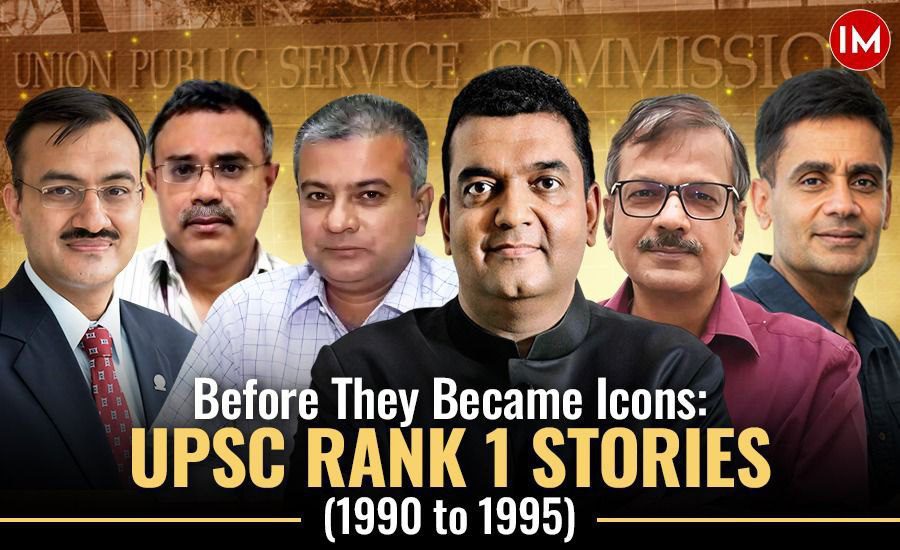
Indian Masterminds presents an exclusive series on UPSC Rank 1 Toppers from 1990 onwards, tracing their journeys from uncertain beginnings, through the crucible of the examination, to the remarkable roles they occupy today. In this first installment, we spotlight the pioneers: the UPSC CSE toppers from 1990 to 1995, exploring their struggles, their triumphs, and where their relentless pursuit of excellence has taken them.
- UPSC – 1990 Topper – Raju Narayana Swamy, Kerala Cadre
- UPSC – 1991 Topper – Anurag Srivastava, Uttar Pradesh Cadre
- UPSC – 1992 Topper Aniruddhe Mukherjee, MP Cadre
- UPSC – 1993 Topper Srivatsa Krishna, Karnataka Cadre
- UPSC – 1994 Topper Asutosh Jindal, Delhi Cadre
- UPSC – 1995 Topper Iqbal Dhaliwal, Tamil Nadu Cadre
Raju Narayana Swamy
Early Life, Education, and Academic Excellence
Mr Swamy was born on 24 May 1968 in Changanassery, Kottayam district, Kerala, into a Brahmin, middle-class academic family, with both parents serving as college professors. He grew up in an intellectually stimulating environment and consistently excelled in academics. He completed his schooling at Sacred Heart High School, Changanacherry, securing first rank in the SSLC examination (1983). He continued his academic success at St. Berchmans College, Changanassery, where he secured first rank in the Pre-Degree examination.
He went on to complete a B.Tech. in Computer Science from IIT Madras (1989), ranking first, and declined a full scholarship from MIT to pursue a career in civil services. Choosing mathematics and physics as optional subjects, he topped the UPSC Civil Services Examination in 1991 and again secured first rank at LBSNAA, Mussoorie, in 1993. He holds two Ph.D.s—one in Political Science from Amrita University (2011) and another in Law from Gujarat National Law University (2022). Known as a lifelong topper, he emphasized passion for learning and effective time management as the key to success.
Administrative Career, Anti-Corruption Work, and Public Service
A 1991-batch IAS officer from the Kerala cadre, Mr Swamy is widely recognized as a staunch anti-corruption crusader and whistleblower, often compared to IAS officer Ashok Khemka. His uncompromising stand against corruption led to repeated conflicts with political and bureaucratic authorities, resulting in over 32 transfers in about 34 years (including 31 transfers in 33 years and 22 transfers within 27 years of service).
Key career highlights and actions include –
- Served as District Collector/Magistrate of five Kerala districts, including Thrissur and Idukki
- As Thrissur Collector, widened five major roads (including Pattalom Road and Inner Ring Road), transforming the town’s infrastructure
- Handpicked by Chief Minister V. S. Achuthanandan to remove encroachments in Munnar, despite objections from CPM leaders
- Served in key roles such as Agriculture Production Commissioner, Principal Secretary (Agriculture), Director of Fisheries, Director of Collegiate Education, Managing Director of MarketFed, and Commissioner, Civil Supplies
- Appointed Chairman of the Coconut Development Board (2018), where he exposed corruption leading to the suspension of senior officials
- Frequently engaged by the Election Commission of India, serving in 37 election assignments across 17 states, including as Roll Observer in Uttar Pradesh (2012)
Despite political controversies and being sidelined at times, he has received immense public support and remains committed to integrity, stating that public trust and applause motivate honest officers.
Literary Contributions, Research, and Awards
Alongside his administrative career, Mr Swamy has made remarkable contributions to literature, research, and academia. He is a Sahitya Akademi Award-winning writer and has authored 34 books, including the popular science work Nano Muthal Nakshatram Vare. He received the 2003 Kerala Sahitya Akademi Award (Travelogue) for Santhimantram Muzhangunna Thazvarayil.
He has authored over 300 research papers and is a recognized research guide in multiple disciplines, including technology, cyber law, intellectual property rights, and maritime law. His major honors include the Satyendra K. Dubey Memorial Award (2018) from IIT Kanpur for professional integrity, the Homi Bhabha Fellowship, and the Leonardo da Vinci Fellowship (2021) from George Mason University, focusing on corruption prevention using AI and blockchain. He also served as an international observer for the 2018 Zimbabwean general election.
Currently, he serves as Principal Secretary to the Government of Kerala, continuing his lifelong mission of ethical governance, academic excellence, and public service.
Anurag Srivastava
Early Life and Education
Mr Srivastava was born on 30 June 1967 (or 30 April 1968, as both dates appear in sources) in Barabanki, Uttar Pradesh. He pursued his early education with a focus on engineering and graduated with a B.Tech in Civil Engineering from IIT Kanpur.
He further enhanced his academic credentials by earning –
- A postgraduate diploma in Diplomatic Studies from the University of Oxford, UK
- An MBA from the Faculty of Management Studies (FMS), Delhi in 1996
Civil Services Career and Key Positions
IAS Srivastava joined the Indian Administrative Service (IAS) in 1992, topping the Civil Services Examination (All India Rank 1) in his first attempt. He is a Uttar Pradesh cadre officer and has served in multiple senior administrative roles.
Notable career highlights include –
- Principal Secretary, Namami Gange & Rural Water Resources Department, State Water and Sanitation Mission, Lucknow
- District Magistrate (DM) of Kanpur
- Commissioner of the Basti Division
- Joint Secretary, Ministry of AYUSH
- Joint Secretary, Ministry of Information and Broadcasting
Mr Srivastava has demonstrated expertise in public administration and governance across water resources, rural development, health, and media sectors.
Professional Achievements and Skills
- Recognized for his dedication and competence in administrative roles
- Skilled in policy implementation, governance, and inter-departmental coordination
- Combines technical knowledge from engineering with management and diplomatic skills for effective administration
- Has contributed significantly to rural water management, sanitation projects, and development initiatives in Uttar Pradesh
Aniruddhe Mukherjee
Early Life and Education
Mr Mukherjee was born on 24 December 1968 in Uttar Pradesh. He cleared the UPSC Civil Services Examination in 1992, securing All India Rank 1, and joined the IAS 1993 batch, Madhya Pradesh cadre. He is married to Deepti Gaur Mukherjee, who is also a senior IAS officer of the same batch and cadre.
IAS Career and Key Postings
Mr Mukherjee has had a distinguished administrative career spanning district, state, and central government roles. He has served in both leadership and technical advisory positions, contributing to urban development, environmental governance, and district administration.
Notable roles and responsibilities include –
- Chairman, Board of Revenue, Gwalior (since Feb 2025)
- Resident Commissioner, Madhya Pradesh Bhawan, New Delhi (Nov 2024)
Principal Secretary for multiple departments –
- AYUSH Department
- Public Asset Management Department
- Environment Department (also Environment Commissioner and Director General, EPCO)
- Youth Affairs & Sports
- Finance
- District In-charge Secretary, Ratlam (2025)
- Collector and District Magistrate of Khargone (2003–2004) and Tikamgarh (2002–2003)
- Director, Ministry of Environment & Forests (2011–2013)
- Deputy Director General, UIDAI (2013–2015)
- Chief Technical Adviser, UN-HABITAT, Nairobi (2005–2007)
- Managing Director for state bodies including Pension & Provident Fund, State Road Transport Corporation, and MP State Public Assets Management Company
- Director for Bhopal Smart City, contributing to urban development initiatives
Recognition and Notable Events
Mr Mukherjee is recognized for his expertise in urban governance, environmental planning, and district administration. In early 2023, the Madhya Pradesh Lokayukta examined a reply he filed in the High Court regarding the Datana-Matana airstrip maintenance case, and his submission was found to be adverse to the state government’s stance. Over his career, he has consistently held senior leadership positions in Madhya Pradesh and central government, as well as international advisory roles, demonstrating his wide-ranging impact on administration and governance.
Srivatsa Krishna
Early Life and Education
Mr Krishna was born on 24 September 1968 in Delhi. From a young age, he dreamed of becoming both an IAS officer and a Bollywood singer. Despite financial struggles following his father’s death, he excelled academically. He studied at Shri Ram College of Commerce (SRCC) and received full scholarships to study computer technology at Yale and Stanford, which he declined to honor his father’s wish of joining the IAS. He further studied at Oxford University and Jawaharlal Nehru University (JNU), and later completed an MBA from Harvard Business School, becoming the first IAS officer in India to achieve this. He is currently pursuing a dual PhD at IIT Madras and IIM Bangalore. In addition, he displayed remarkable musical talent, mastering the full harmonium scale by age 19.
IAS Career and Achievements
Mr Krishna joined the IAS in 1993, Karnataka cadre, after three attempts, securing All India Rank 1 and becoming a Gold Medallist. He began his career in Delhi, serving as Sub-Divisional Magistrate in Outer Delhi and Central Delhi, tackling challenges such as land-grabbers and political pressures. He also managed the Centralized Accident and Trauma Services (ambulance network). Later, he moved to the Andhra Pradesh cadre during the IT boom under Chandrababu Naidu. He has held senior positions including Secretary of Karnataka’s Department of Information Technology, Biotechnology, and Science & Technology, and managed Hyderabad, the 15th largest city in the world.
Recognition and Personal Life
- Global Leader for Tomorrow, World Economic Forum, Davos (2003)
- Featured on IMDB and auditioned by A.R. Rahman for a musical production
- Married to Gunjan Krishna IAS, Maharashtra cadre (2004), currently Director of Industries & Commerce and Commissioner of Industrial Development, Bengaluru
- Known for combining academic brilliance, administrative excellence, and musical talent
Ashutosh Jindal
Early Life and Education
Mr Jindal was born on 11 December 1971 in Punjab. He completed his Bachelor’s degree in Electronics Engineering from Thapar Institute of Engineering & Technology (1992) and a Master’s degree in Economics from Punjabi University (2000). He also earned a Postgraduate Diploma in Intellectual Property Rights from IGNOU, reflecting his interest in both technical and legal aspects of governance. He joined the IAS at the age of 24 after clearing the 1995 UPSC Civil Services Examination, and was allotted the Tripura cadre.
IAS Career and Key Positions
Mr Jindal has decades of administrative experience in both state and central government roles. He is currently serving as Minister (Economic) at the Embassy of India, Washington DC, USA, and has held several important positions throughout his career.
Notable postings and responsibilities include –
- Additional Secretary and Joint Secretary, Cabinet Secretariat, New Delhi
- Joint Secretary, Petroleum & Natural Gas
- Secretary, Finance, Tourism, Urban Development Authority – Tripura
- Chief Electoral Officer, Law and Justice, Tripura
- Resident Commissioner, Tripura
- Director and Adviser, Indian Missions in Brussels; Commerce & Industry departments
- Private Secretary, Financial Services
- Deputy Secretary and Joint Director General, Foreign Trade, Commerce
- District Magistrate and Collector, West Tripura
- Secretary to Chief Minister, Tripura
- ADM and SDO, West Tripura
Recognition and Personal Life
Mr Jindal is recognized for his versatile administrative expertise, handling both technical and economic portfolios. Details about his family, including parents and spouse, are not publicly available. He is scheduled to retire on 31 December 2031, concluding a distinguished career spanning state and central governance as well as international postings.
Iqbal Singh Dhaliwal
Early Life and Education
Mr Dhaliwal was born in 1972 in Bengaluru to a father in the Border Security Force and a mother who ran a school. He spent 14 years at Mothers International School, Delhi, where he served as head boy of the 1989 batch. He completed his BA in Economics from the University of Delhi, an MA in Economics from the Delhi School of Economics, and an MPA in International Development from the Princeton School of Public and International Affairs. Prior to entering civil services, he worked as a teacher at Sant Memorial Public School in Gurgaon (1994–1996). He married to Gita Gopinath.
IAS Career and Administrative Work
Iqbal Dhaliwal first attempted the UPSC Civil Services Examination in 1994, securing AIR 229 and being allocated the Indian Civil Accounts Service. He reattempted in 1995, achieving AIR 1 and joining the IAS in the Tamil Nadu cadre.
During his years in the IAS, he served as –
- Deputy Secretary in a state government
- Director of a statewide welfare department
- CEO of a publicly owned company
- Head of an administrative sub-division
- Introduced innovations to improve public service delivery, closed polluting units, and freed bonded laborers
He received the Director’s Gold Medal at the National Academy of Administration (LBSNAA) for standing first in training. He later left the IAS and moved to the US to focus on research and policy work.
Post-IAS Career, Recognition, and Contributions
Ex-IAS Dhaliwal is currently the Global Executive Director of J-PAL (Latif Jameel Poverty Action Lab), MIT, overseeing global operations, research, and policy outreach.
His major contributions include –
- Co-directing J-PAL South Asia with Esther Duflo
- Co-chairing Project AI Evidence, applying AI to development and climate policy
- Serving on boards of Noora Health and Rocket Learning
- Member of Mission Karmayogi working group and Chief Minister of Punjab’s post-Covid economic strategy group
- Expanding J-PAL’s research and operations to new sectors, regions, and country offices
- Led the Innovation in Government Initiative (IGI) (2015–2024) with Abhijit Banerjee, funding 65 projects across 16 countries with a 17:1 ROI
- Founding co-chair of the Governance Initiative (2010–2014), supporting research on democracy and governance
- Co-authored large-scale evaluations on health and service delivery in rural India and co-edited the Handbook on Using Administrative Data
Awards and honors
- Guru Nanak Devji Achievers Award (2019), Government of Punjab
- Dean’s Fellowship, Princeton University
- Gold medal for academic excellence in undergraduate studies
Iqbal Dhaliwal combines public service experience, advanced academic training, and global policy leadership, making him a leading figure in evidence-based development and governance.
Read Also: Brains, Grit and Service: Inside the Lives of UPSC Rank 1 Toppers (2001–2005)