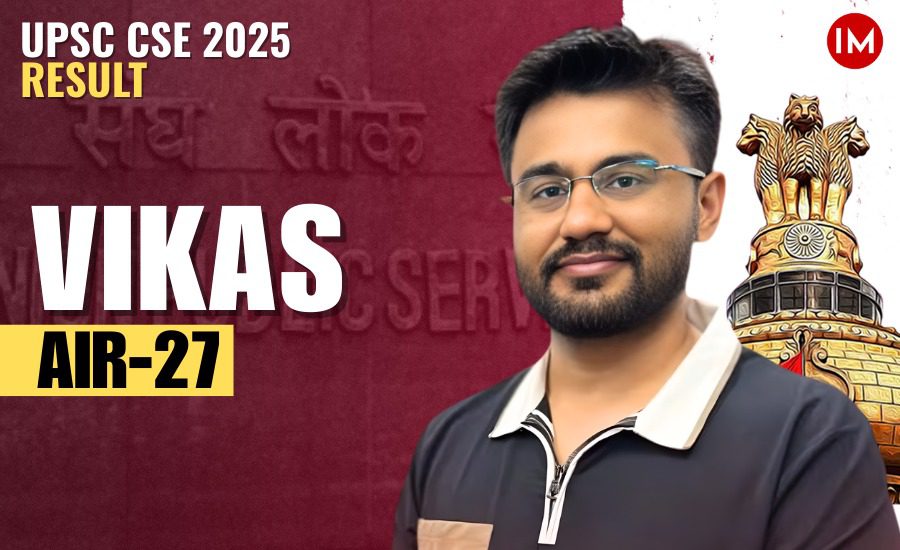
In the small village of Gillu Kheda in Jind district, Haryana, dreams often grow quietly alongside wheat fields and farm routines. For Vikas, the son of a farmer, the idea of joining India’s civil services was not something he had planned to do. It was a possibility that slowly took shape during his college years.
His parents, engaged in agriculture and with limited formal education, could not guide him through the maze of one of India’s toughest examinations. Yet their support formed the silent foundation of his journey.
Vikas completed his schooling at D.A.V. Public School in Jind before moving to Delhi for higher education. At Kirori Mal College, University of Delhi, where he pursued a B.Com degree, he first encountered a vibrant culture of civil services preparation.
It was here that the idea of becoming a civil servant truly took hold.
DISCOVERING THE CIVIL SERVICES DREAM IN COLLEGE
The environment at Kirori Mal College played a pivotal role in shaping his ambitions.
“I had heard about civil services earlier, but I didn’t have much clarity then. In college itself, I got the inspiration to start preparing for the civil services,” he shared in an exclusive conversation with Indian Masterminds.
What followed was a long and demanding journey through multiple attempts, self-learning, and constant reinvention of strategy.
SIX ATTEMPTS, MULTIPLE SETBACKS
Vikas’ journey to UPSC CSE 2025 AIR 27 was far from straightforward. His first two attempts ended at the preliminary stage, leaving him uncertain about whether he could even reach the next level.
Yet the real turning point came after his second failure.
“I still remember 2021 clearly,” he says. “After that, I changed my approach regarding how I should study for the examination. I tried to be brutally honest with myself about where I was going wrong.”
That honesty became the basis of his preparation. But the challenges didn’t stop there. In the third and fourth attempts, he reached the interview stage but failed to make the final list. Missing the final PDF twice after reaching the last stage was emotionally draining.
“It was a total debacle,” he admits. “For about a week or ten days, I did nothing. I was just lying on the bed thinking about what went wrong.”
Still, he chose to continue.
FROM IPS SELECTION TO AN EVEN BIGGER GOAL
Persistence finally paid off in one attempt when Vikas secured Rank 288 and was allotted the Indian Police Service. At the time of his latest result, he was already undergoing training as an IPS officer.
For many aspirants, that would have been the finish line. For Vikas, it became a platform for one final push toward the IAS.
“Basically, it is about what you truly want,” he explains. “I wanted this, so I worked for it.”
Interestingly, he chose not to tell his family that he was appearing for another attempt.
“They thought I would attempt the exam next year. When the result came, I told them I had a surprise. They were shocked and asked, ‘But you didn’t give the exam this year.’”
That surprise turned out to be All India Rank 27.
A PREPARATION BUILT ON SELF-LEARNING
Without formal guidance at home, Vikas built his strategy through peer discussions, test series, and self-evaluation.
“My strategy kept evolving,” he says. “If something wasn’t working, I changed it.”
His preparation rested on a few key pillars:
- Constant revision and mock tests
- Strong answer-writing practice
- Enriching answers with examples, data, and facts
- Playing to strengths while fixing weaknesses
Most of his preparation was self-study, though he relied on test series to evaluate his performance.
THE ART OF WRITING ‘ATTACKING ANSWERS’
One of Vikas’ strongest areas was answer writing in the UPSC Mains examination. Over successive attempts, his marks showed steady improvement — 425, 420, and 433 in different mains attempts.
His strategy was simple: start strong and stay direct.
“You have to captivate the examiner right from the introduction,” he explains.
He focused heavily on enrichment by adding examples, data, and structured points to stand out.
“A general answer will not take you anywhere in today’s GS papers.”
Instead of relying heavily on diagrams, he focused on writing a large number of well-structured points, sometimes writing 15 points for a 10-marker and more than 20 points for longer answers.
PREPARING FOR THE INTERVIEW
Interestingly, this was his first successful interview round, even though he had reached the stage earlier.
His preparation focused on two things:
- Deep understanding of his Detailed Application Form (DAF)
- Strong command over current affairs
He read newspapers daily and watched analytical discussions on global and national issues, especially in international relations.
During the interview, most questions revolved around police services. But one unexpected question stood out.
“The chairman asked me how I would rate this year’s interview compared to last year’s,” Vikas recalls.
WHAT VIKAS LEARNED ABOUT PRELIMS
After appearing in prelims multiple times, Vikas believes the exam is less about memory and more about mindset.
“The most important thing is to understand how the examiner is trying to trap you,” he says.
His advice is simple:
- Expect surprises in the paper.
- Stay calm if something unexpected appears.
- Avoid panic-driven guessing.
“If you panic, everything goes wrong. You attempt questions blindly and later realize many of them are wrong.”
He also stresses smart study over excessive reading, pointing out that some topics in standard books are more useful for mains than prelims.
A SIMPLE DAILY ROUTINE
During preparation, Vikas kept his routine flexible depending on the stage of the exam — prelims, mains, or interview.
But one habit remained constant. Every night, he planned the next day’s targets in advance. This helped him maintain clarity and direction in his preparation. Ultimately, he believes UPSC is less about the amount of knowledge and more about how effectively that knowledge is applied.
“It’s more of a game of skill—how effectively you can use your knowledge to solve questions,” he told Indian Masterminds.
THE FIRST FROM HIS VILLAGE
For Gillu Kheda village, Vikas’ success carries special meaning. He is the first person from his village to achieve this milestone in the civil services.
For his farming parents and the community that watched him grow up, the result brought both pride and disbelief.
A MESSAGE FOR ASPIRANTS
After six attempts, multiple setbacks, and finally securing a top-30 rank, Vikas offers a simple message to aspirants.
“Don’t just rely on hard work, do smart work. Keep yourself updated with trends and never lose hope.”
His journey shows that sometimes the final attempt can become the defining one.
And for Vikas, that last attempt turned years of effort into UPSC CSE 2025 AIR 27.