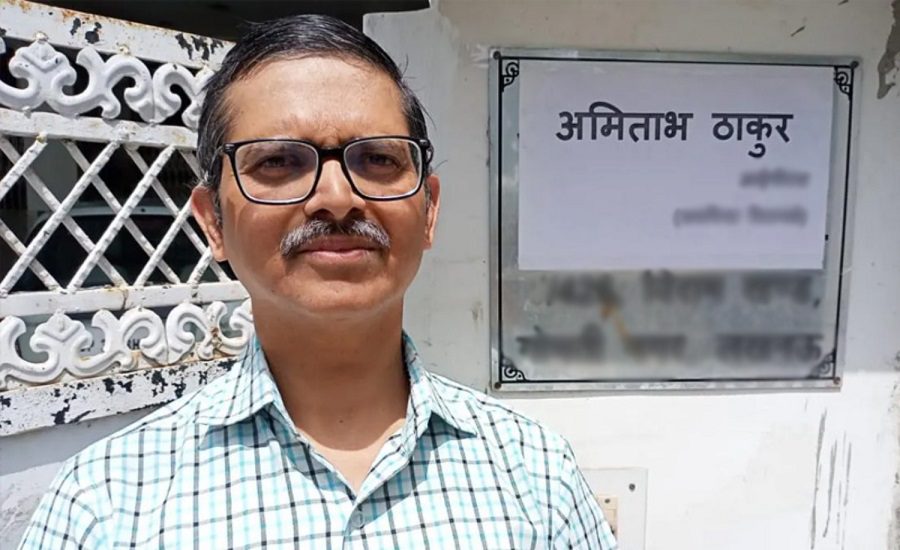
Deoria/Lucknow: In a major development from Deoria, Uttar Pradesh, a court has rejected the bail plea of retired Indian Police Service (IPS) officer Amitabh Thakur in connection with a decades-old land fraud case, remanding him to judicial custody. The former senior police officer, now political activist and head of the Azad Adhikar Sena, has maintained that the case is politically motivated and a misuse of legal processes, but the court declined his plea for bail amid ongoing criminal proceedings.
Background of 1999 Deoria Plot Scam
Amitabh Thakur is a 1992-batch retired IPS officer who served in various capacities across Uttar Pradesh before being compulsorily retired by the Union Home Ministry in 2021. Known for his strong stance on transparency, accountability and administrative reform, he also founded the Azad Adhikar Sena with his wife Dr. Nutan Thakur to promote civil rights and public accountability.
Since his retirement, Thakur has frequently clashed with governments and bureaucratic establishments, often attracting controversy due to his outspoken activism.
1999 Deoria Plot Scam: Old Allegations, New Arrest
The case in question dates back to 1999, when Thakur served as Superintendent of Police (SP) in Deoria district. According to the First Information Report (FIR) filed in 2025, Thakur — along with his wife Dr. Nutan Thakur — allegedly obtained an industrial plot (Plot B-2) in the Deoria Industrial Area using fraudulent information and forged documents during his tenure as SP.
The complaint, filed in September 2025 by a resident of Lucknow’s Talaktora Colony, alleges that the plot was acquired by misrepresenting identities and addresses in official documents and later sold, causing loss and misleading government departments and financial institutions.
Following investigation by a Special Investigation Team (SIT), police arrested Thakur from a train while he was travelling from Lucknow to Delhi. He was subsequently produced before the Chief Judicial Magistrate (CJM) Court in Deoria where he was remanded to 14 days of judicial custody.
Bail Hearing: Court’s Decision and Rationale
After his arrest, Thakur’s legal team filed an application for bail in the CJM court. However, during the hearing, the court rejected the bail plea on procedural and substantive considerations, declining to grant interim relief as the investigation and trial preparations are ongoing.
The rejection of the bail plea means that Thakur will continue to remain in judicial custody during the period of investigation and until the legal process advances further.
1999 Deoria Plot Scam: Allegations and Defence Claims
Allegations by Authorities
According to law enforcement sources:
- Thakur is accused of misusing his official position as SP in allotting the industrial plot.
- The FIR notes incorrect personal information in application forms — including altered names and addresses — allegedly designed to deceive government authorities during allotment.
- Police argue that the case implicates forgery, document fabrication and abuse of power, warranting a thorough criminal investigation.
Defense and Activist Claims
Thakur and his supporters have contended that:
- The case is an attempt at political retaliation and harassment, given his activism and public criticism of state policies.
- The dispute over land, according to supporters, could have been a civil matter rather than a criminal offence.
- Thakur has also voiced security concerns, alleging that wrongful imprisonment could endanger his safety — claims he made during court appearances.
His organisation, the Azad Adhikar Sena, has condemned the arrest and bail rejection as an injustice and pledged to challenge the matter through higher courts and human rights mechanisms.
Political and Public Reaction
The case has sparked reactions beyond the courtroom:
- Human rights groups and civil liberties activists have expressed concern over the timing and motivations behind the FIR.
- Supporters of Thakur have held that the legal action undermines dissent and accountability activism in Uttar Pradesh.
- Others emphasize the need for due legal process, asserting that all citizens — regardless of past service — are accountable under law.
These debates reflect broader tensions in Indian civil society regarding law enforcement, political activism and judicial outcomes.