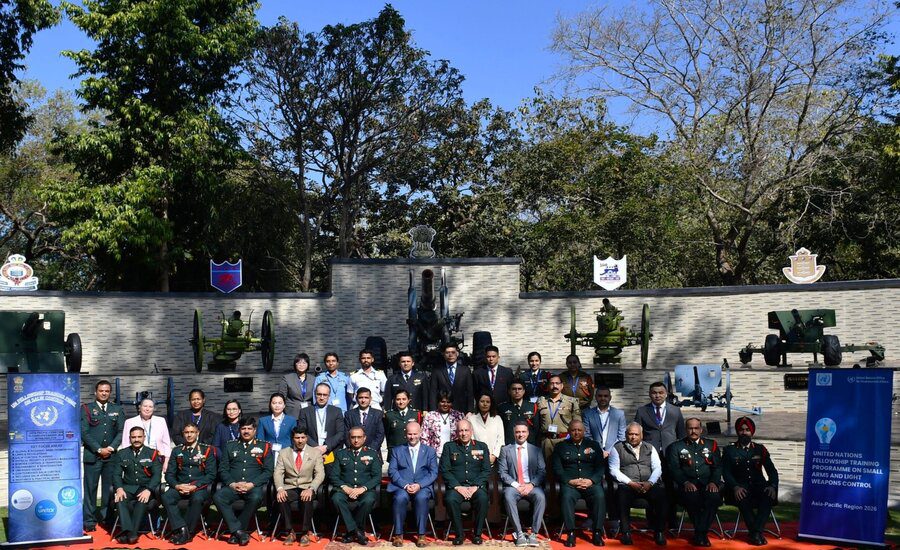
New Delhi: The United Nations Fellowship on Small Arms and Light Weapons (SALW) Control, organised by the United Nations Office for Disarmament Affairs (UNODA), is taking place in Jabalpur, Madhya Pradesh, India, from 16 February to 6 March 2026.
This landmark programme brings together delegates from 13 Asia-Pacific countries to strengthen regional cooperation, build technical expertise, and support implementation of global frameworks aimed at stopping the illicit trade of small arms and light weapons.
The three-week fellowship is being conducted under the Ministry of External Affairs and the Ministry of Defence, with the Indian Army hosting the event at the Military College of Materials Management (MCMM).
What Is the Asia-Pacific Small Arms and Light Weapons Control Fellowship
The SALW Fellowship Training Programme is a flagship initiative founded under United Nations General Assembly resolution A/RES/77/71 (2022).
It was established to enhance the technical knowledge and practical skills of government officials responsible for implementing the UN Programme of Action (PoA) and the International Tracing Instrument (ITI) — critical frameworks designed to prevent the illicit trade, diversion and misuse of small arms and light weapons worldwide.
This programme combines:
- Foundational online training on global and regional arms control frameworks.
- In-person training and workshops, exposing participants to best practices in stockpile management, weapons marking, tracing, border security, and legislative aspects of arms control.
It is delivered with support from regional partners like the UN Regional Centre for Peace and Disarmament in Asia and the Pacific (UNRCPD), headquartered in Nepal, which works to promote peace and arms control cooperation across the region.
Importance of Asia-Pacific Small Arms and Light Weapons Control Fellowship
Small arms and light weapons contribute significantly to conflict, terrorism, organised crime, and instability when they enter illicit markets. The SALW fellowship helps countries in the Asia-Pacific region build stronger national systems to:
- Improve weapons stockpile security and management.
- Strengthen weapon marking and tracing systems.
- Enhance border controls to prevent illegal transfer and circulation.
- Share regional best practices and insights.
By training officials from participating states, the programme supports the UN PoA’s mission to curb the global spread of small arms and protect civilian safety worldwide.
India’s Strategic Role in Global Disarmament
In his keynote address at the Jabalpur opening ceremony, Lieutenant General Sanjay Sethi highlighted how multilateral cooperation is essential to addressing emerging security challenges from illicit arms flows. He also reaffirmed India’s deep commitment to global peace, peacekeeping, and responsible arms governance under the United Nations framework.
The United Nations Office for Disarmament Affairs, in partnership with the Government of India, is conducting the Asia-Pacific Fellowship on Small Arms and Light Weapons, #SALW Control at #MCMM, Jabalpur.
— ADG PI – INDIAN ARMY (@adgpi) February 16, 2026
The programme brings together 13 nations to strengthen implementation of… pic.twitter.com/BQE1rt46qK
India hosting this first Asia-Pacific cohort reflects the country’s growing role in international peace and security initiatives and its willingness to partner with the United Nations and other nations for effective arms control solutions.
Who Is Participating in Asia-Pacific Small Arms and Light Weapons Control Fellowship
Officials from 13 Asia-Pacific countries, including Australia, Bangladesh, Bhutan, Cambodia, Fiji, Iran, Kiribati, Laos, Lebanon, Malaysia, Mongolia, Philippines, and Thailand, are part of this fellowship cohort. Participants represent national governments and agencies tasked with implementing SALW control policies in their home countries.
This diverse group exemplifies the region’s shared interest in harmonised arms control strategies and collective action against illegal weapons circulation.
Expected Outcomes and Long-Term Benefits
By the end of the programme on 6 March 2026, experts expect that participants will:
- Have a deeper understanding of international arms control frameworks.
- Connect with regional peers and international experts.
- Gain practical strategies to strengthen national implementation of PoA and ITI commitments.
- Enhance regional cooperation against weapons trafficking and misuse.
Strengthening these capacities will help reduce the loss of life and instability caused by illicit small arms, supporting peace, security, and development across the Asia-Pacific region.
Importance of Asia-Pacific Small Arms and Light Weapons Control Fellowship for Global Peace Efforts
This fellowship aligns with the UN’s broader goals of reducing violence and supporting sustainable development by encouraging inclusive and responsible arms control policies. Strengthened capacity among Asia-Pacific nations translates to more robust regional resilience, enhanced public safety, and forward progress in meeting the UN Sustainable Development Goals related to peace and justice.
Read also: From Drones to Rafales: How Operation Sindoor Changed Indian Defence Spending Pattern