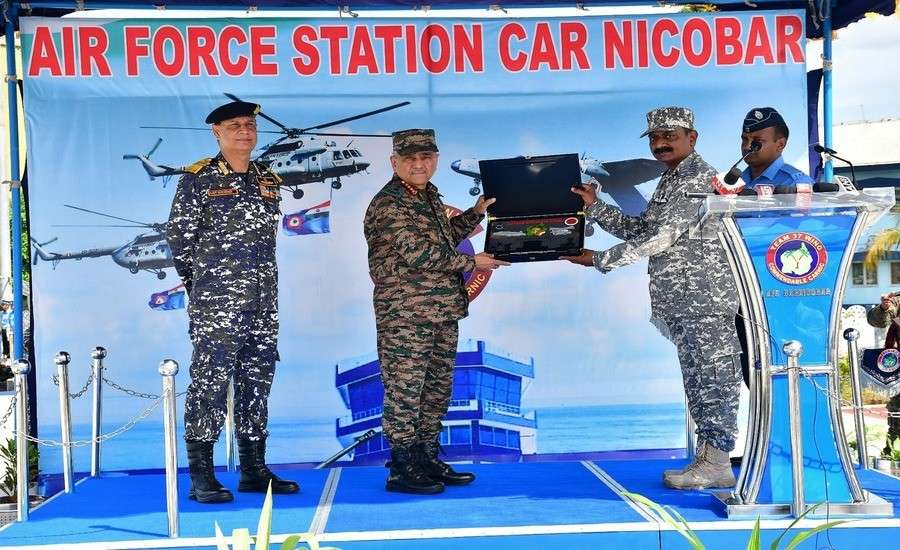
New Delhi: CDS General Anil Chauhan on 2 January 2026 inaugurated the newly resurfaced and upgraded runway at the Indian Air Force (IAF) base on Car Nicobar Island, marking a major stride in strengthening India’s defence infrastructure in the Andaman & Nicobar Islands.
The upgrade forms part of a broader initiative to bolster India’s eastern military readiness and enhance operational reach across the Indo-Pacific region.
Strategic Importance of Car Nicobar Air Base
Car Nicobar is located approximately 535 km south of Port Blair in the Nicobar district — India’s southernmost strategic region — and lies in proximity to the Malacca Strait, one of the world’s most critical maritime chokepoints through which a majority of global energy supplies and trade transit.
Read also: INS Arnala Commissioned: GRSE Delivers India’s First ASW Shallow Water Craft to Indian Navy
The air base has historical significance as a key forward outpost of the Indian Air Force and plays a pivotal role in maritime surveillance, rapid air response, and support for anti-submarine and coastal defence missions.
It also falls under the Andaman and Nicobar Command (ANC) — India’s only tri-service theatre command integrating the Army, Navy, and Air Force.
Upgraded Infrastructure: What’s New in Car Nicobar Air Base
The recently upgraded runway at Car Nicobar Air Base features:
- Resurfaced and strengthened pavement to support heavier military aircraft including fighter jets, transport planes, and surveillance platforms.
- Expanded apron areas for smoother aircraft movement and rapid turnaround during flight operations.
- Infrastructure improvements to facilitate long-range firing exercises and strategic drills without reliance on mainland facilities.
Officials have noted that these enhancements significantly reduce turnaround times and improve overall operational tempo, particularly for critical missions along the eastern seaboard.
What are the Strategic Operational Advantages of Car Nicobar Air Base
The upgraded runway will:
- Provide quicker air operations and deployment of advanced assets across the Indo-Pacific.
- Enhance India’s capacity for Humanitarian Assistance and Disaster Relief (HADR) in the tsunami-prone region.
- Strengthen monitoring of maritime traffic through the Malacca Strait, a route witnessing daily average crossings of major shipping vessels.
A Boost to Indo-Pacific Defence Posture
The runway upgrade is widely viewed by defence analysts as a tangible demonstration of India’s commitment to fortifying its eastern maritime frontier. Car Nicobar’s strategic location provides direct oversight of the southern approaches to the Malacca Strait — a conduit for energy and trade vital to global economies.
The development aligns with India’s long-term vision of strengthening deterrence and operational readiness amid evolving geopolitical competition in the Indo-Pacific region.
Leadership Presence: CDS and Senior Officials
General Anil Chauhan, who serves as the Chief of Defence Staff — the principal military advisor to India’s Ministry of Defence — arrived in Car Nicobar around 11:30 AM and was received by Vice Admiral Ajay Kochhar, Commander-in-Chief of the Andaman and Nicobar Command, along with senior military officials.
Chief of Defence Staff Gen Anil Chauhan visited Air Force Station Car Nicobar on 02 Jan during two-day visit to Andaman and Nicobar Command. Received by Vice Adm Ajay Kochhar, #CINCAN, #CDS inaugurated upgraded runway infrastructure and additional aviation fuel storage… pic.twitter.com/exHyXQ0nHT
— Andaman & Nicobar Command (@AN_Command) January 2, 2026
During the visit, the CDS emphasized the strategic importance of enhancing defence infrastructure in India’s island territories — a key pillar of the country’s ‘Act East’ policy and its expanding role in Indo-Pacific security cooperation.
Historical Context & Defence Significance
The Car Nicobar airstrip — initially operational since the mid-20th century — was extensively damaged during the 2004 Indian Ocean tsunami, with significant loss of life and infrastructure. Subsequent reconstruction and gradual capacity improvements have transformed it into a key military hub.
Today, with the upgraded runway, the base is poised to support India’s broader strategic priorities, including enhanced air deterrence, regional stability operations, and interoperability with partner nations in humanitarian and security missions.