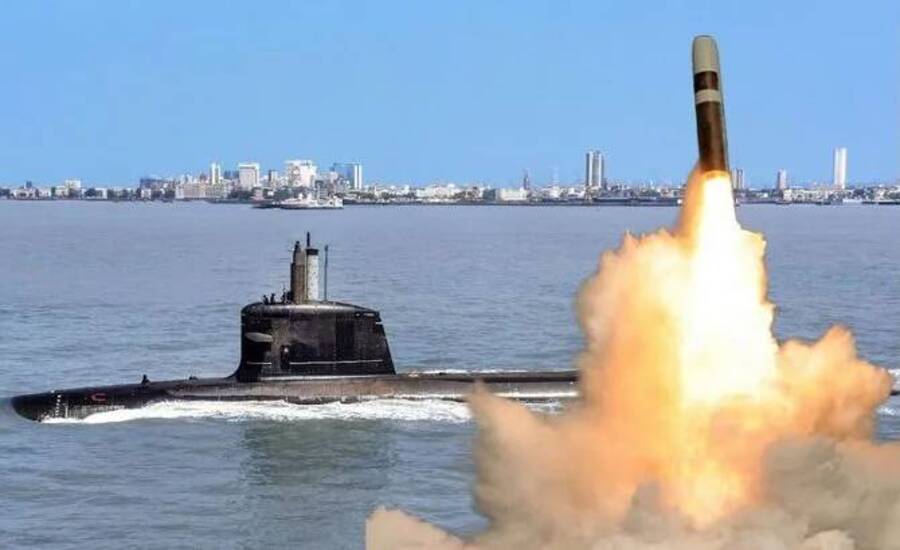
New Delhi: India’s Defence Research and Development Organisation (DRDO) has taken a major leap forward in modernising the nation’s strategic undersea strike arsenal as its cutting-edge K-6 submarine-launched ballistic missile (SLBM) is reported to be nearing its initial testing phase.
This development, poised to significantly extend India’s nuclear deterrent reach, marks a pivotal step in strengthening the Indian Navy’s strategic capabilities against evolving regional threats.
Brief History of SLBM in India
India has pursued a credible minimum deterrence doctrine since the early 2000s, with a focus on developing survivable second-strike capabilities.
The sea leg of India’s nuclear triad has been central to this strategy, ensuring that ballistic missiles can be launched from submerged platforms—making them harder to detect and pre-empt.
The K-6 represents the most advanced SLBM in India’s arsenal to date, building on predecessors like:
- K-15 Sagarika – Short-range SLBM (~750 km)
- K-4 – Intermediate range (~3,500 km)
- K-5 – Extended range (~5,000-6,000 km)
The K-6 is anticipated to significantly expand India’s maritime strike footprint, aligning it closer to established nuclear-armed powers.
Features of K-6 SLBM Missile
Here are the following features of K6 SLBM Missile;
Design and Development
Developer: DRDO’s Advanced Naval Systems Laboratory, Hyderabad
Type: Submarine-Launched Ballistic Missile (SLBM)
Stages: Three-stage, solid-fuelled design
Length: Over 12 metres
Diameter: ~2 metres
Payload: Up to 2–3 tonnes, capable of carrying conventional or nuclear warheads
Speed: Hypersonic (~Mach 7 to 7.5)
Range: Approximately 8,000 km (some estimates extend toward 10,000 km)
Warhead Tech: Multiple Independently Targetable Re-entry Vehicles (MIRVs) capability.
Such specifications place the K-6 among the most advanced submarine-launched strategic weapons, enabling India to reach distant strategic targets from protected patrol zones in the Indian Ocean—extending into Asia, Europe, and Africa.
K6 SLBM Missile MIRV: Multiple Targets, One Missile
One of the most critical advances with K-6 is its MIRV technology—allowing a single missile to carry several independently guided warheads.
MIRVs drastically enhance lethality, overwhelm missile defence systems, and optimize deterrence by covering multiple target areas with one launch.
This feature is currently possessed by only a handful of global nuclear powers, including the United States, Russia, China, France, and the United Kingdom—signifying a major strategic milestone for India.
K6 SLBM Missile Timeline & Development Trajectory
While official timelines for sea or flight testing remain classified, defence sources indicate the K-6 is approaching the testing phase, with initial trials likely to commence in the late 2020s.
Indications suggest full operational capability may coincide with deployment cycles of new submarine platforms in the 2030s.
Integration with India’s S-5 Class SSBNs
The K-6’s size and range demand a next-generation submarine platform larger than the current Arihant-class.
To that end:
- DRDO and the Indian Navy are coordinating development of S-5 class nuclear-powered ballistic missile submarines (SSBNs).
- These vessels are projected to displace ~13,000 tonnes, nearly double their predecessors, and carry 12–16 K-6 missiles.
- Enhanced reactor power, pump-jet propulsion for stealth, and advanced materials are part of the design to support K-6 operations.
This integration will transform India’s undersea striking force into a more durable and survivable deterrent.
Impact and Geopolitical Significance of K6 SLBM Missile
Once operational, the K-6 will not just enhance India’s naval deterrent but also impact broader geopolitical dynamics:
Strengthened Nuclear Triad: Solidifies India’s sea-based deterrence alongside land and air legs.
Extended Strike Reach: From the Indian Ocean, key strategic targets across distant theatres become reachable.
Deterrent Credibility: Enhanced by hypersonic speed and MIRV sophistication.
Power Projection: Signals India’s technological prowess on par with established nuclear weapons states.