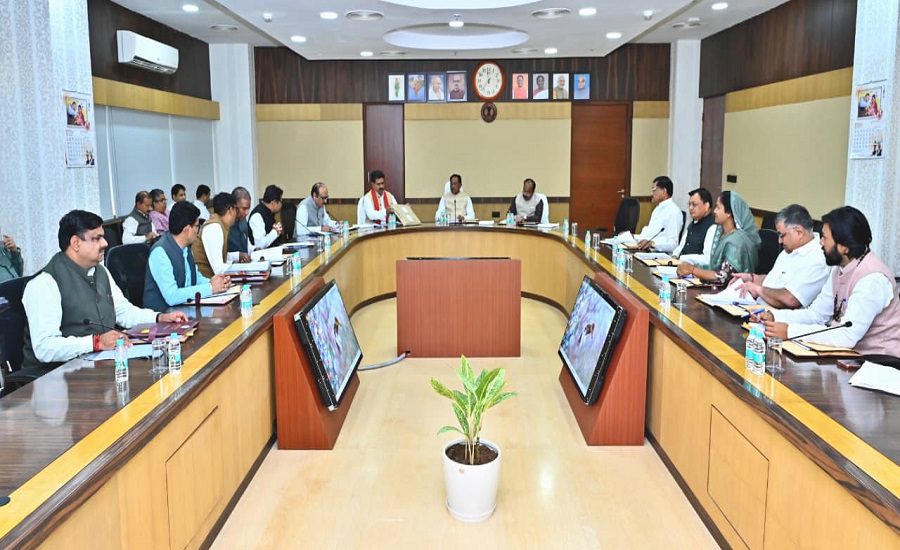
Raipur: The Chhattisgarh Council of Ministers, chaired by Chief Minister Mr. Vishnu Deo Sai, on February 4, 2026, approved several major policy and administrative decisions during a cabinet meeting held at Mantralaya Mahanadi Bhawan.
The decisions aim to strengthen law and order, boost employment, promote innovation, improve urban governance, and expand digital and aviation infrastructure across the state.
Anti-Narcotics Task Force Approved in 10 Districts
In a major step to curb drug abuse, the cabinet approved the creation of district-level Anti-Narcotics Task Forces in 10 districts—Raipur, Mahasamund, Bilaspur, Durg, Bastar, Surguja, Kabirdham, Jashpur, Rajnandgaon, and Korba.
A total of 100 new posts sanctioned under the 2025–26 state budget will be utilized for the initiative.
Read also: Chhattisgarh’s First Space Center Inaugurated; CM Announces Space Sangwari Centers in All Districts
Special Operations Group to Strengthen Security
The cabinet approved 44 new posts for the formation of a Special Operations Group (SOG) under the Police Headquarters’ Special Branch.
The SOG will be a highly trained unit responsible for responding swiftly to major incidents, terror threats, and sudden emergencies, ensuring rapid containment of serious security risks.
Flight Training Organisations to Be Set Up in Chhattisgarh
To meet growing demand in the aviation sector and generate employment, the cabinet approved the establishment of Flight Training Organisations (FTOs) at various airports and airstrips across the state.
The initiative will be implemented through private participation and is expected to promote pilot training, aircraft recycling, helicopter bunking, and aero-sports facilities.
Chhattisgarh Startup and Innovation Policy 2025–26 Approved
The cabinet approved the Chhattisgarh Innovation and Startup Promotion Policy 2025–26, aimed at strengthening the startup ecosystem, incubators, and innovation-driven enterprises.
The policy is expected to improve the state’s ranking in the State Startup Rankings issued by the Department for Promotion of Industry and Internal Trade (DPIIT) and attract greater investment.
35 Completed Housing Colonies to Be Handed Over to Urban Bodies
The cabinet approved the transfer of 35 fully developed residential colonies built by the Chhattisgarh Housing Board and Raipur Development Authority to respective municipal corporations and councils.
The move will enable civic bodies to provide essential services such as water supply, roads, sanitation, and electricity, while relieving residents from double maintenance charges.
Multi-Storey Government Office Complex Planned at Nava Raipur
To ensure optimal land utilization, the cabinet approved the construction of a large multi-storey building at Nava Raipur Atal Nagar for government departments and public sector offices.
Space will be allocated department-wise by the Nava Raipur Atal Nagar Development Authority.
Land Allocation Powers Delegated for Sirpur and Arpa Development
To accelerate planned development in the Sirpur and Arpa riverfront areas, the cabinet delegated the authority to allocate government land to the respective district collectors.
Land will be allotted at a nominal premium of ₹1, considering the financial position of the Special Area Development Authorities.
Chhattisgarh Cloud First Policy Approved
The cabinet approved the implementation of the Chhattisgarh Cloud First Policy, proposed by the Department of Electronics and Information Technology.
Under the policy:
- All departments will use only MeitY-approved cloud service providers
- Low-priority applications will migrate to the cloud by 2027–28
- High-priority services will migrate by 2029–30
- All new applications will be developed as cloud-native
The policy aims to reduce IT costs, enhance cybersecurity, ensure service continuity during disasters, and provide 24×7 digital services to citizens.
Mobile Tower Scheme to Expand Digital Connectivity
The cabinet approved a Mobile Tower Scheme to improve connectivity in remote, geographically difficult, and Left Wing Extremism-affected areas.
The scheme will simplify approvals for telecom service providers and enable tower installation in mobile network–deficient habitations, boosting e-governance, rural economy, healthcare, education, and emergency services such as Dial 112.