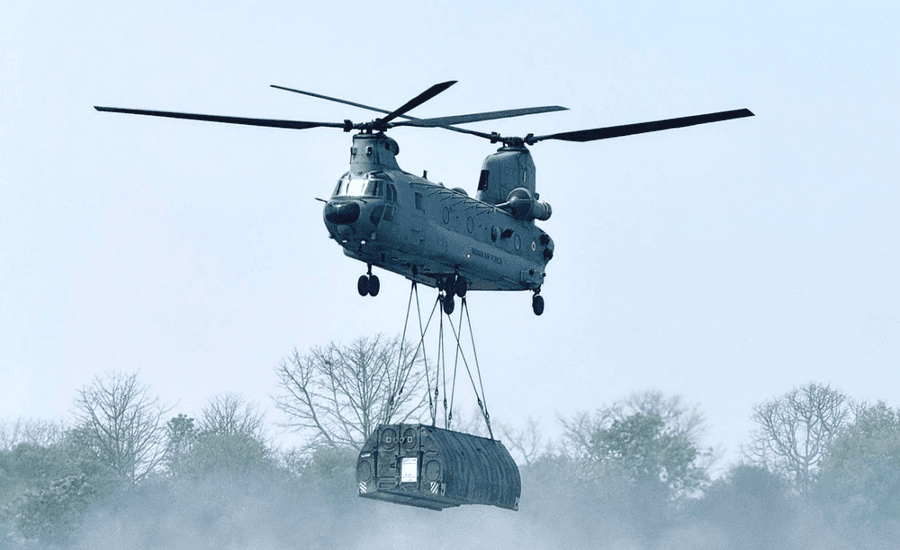
New Delhi: India’s Chinook joint Army-Air Force exercise has showcased a major leap in battlefield mobility and coordination. In this exercise, the Indian Army and Indian Air Force (IAF) successfully demonstrated the rapid air deployment of a heavy assault bridge using a Chinook helicopter. This development highlights India’s growing focus on joint warfare capability, faster troop movement, and improved operational readiness in challenging terrains.
Details of Chinook Joint Army-Air Force Exercise 2026
In a significant military demonstration, the Indian Army’s Kharga Sappers and the Indian Air Force carried out a joint operation involving a Chinook heavy-lift helicopter.
- The Chinook airlifted and deployed a pontoon assault bridge
- The operation was conducted under a joint Army-Air Force exercise
- It validated rapid mobility and battlefield deployment capability
According to official updates from the Army’s Western Command, the exercise showed:
- Seamless coordination between forces
- Efficient joint planning
- High-speed deployment in operational scenarios
This marks a major step towards integrated war-fighting capability.
Why Assault Bridge Deployment is Important
Assault bridges are crucial in modern warfare, especially in terrains with:
- Rivers
- Canals
- Marshlands
These bridges allow heavy military vehicles and troops to cross water obstacles quickly, ensuring uninterrupted movement.
Key benefits:
- Maintains battle momentum
- Prevents delays during combat operations
- Acts as a force multiplier in offensive missions
In regions under the Western Command, such capabilities are critical due to the presence of multiple water bodies.
Role of Chinook Helicopter in the Chinook Joint Army-Air Force Exercise 2026
The Chinook heavy-lift helicopter played a central role in this operation.
What are the Features of Chinook Helicopter
- Can carry up to 11 tonnes of cargo
- Can transport around 45 troops
- Designed for high-altitude operations
- Ideal for rapid logistics and deployment
Its use in this exercise demonstrates how air mobility can directly support ground forces in real-time combat scenarios.
What is the Importance of Chinook Joint Army-Air Force Exercise 2026
The exercise strongly reflects India’s push towards “jointness” — a concept where all three forces (Army, Air Force, Navy) operate in close coordination.
Key outcomes:
- Improved interoperability
- Faster decision-making and execution
- Enhanced combat efficiency
Modern warfare requires multi-domain coordination, and such exercises ensure that India’s forces are prepared for integrated operations.
Strategic Significance for India
This exercise is not just a routine drill — it has major strategic implications:
1. Faster War Response
Rapid deployment means troops and equipment can reach critical locations quickly.
2. Better Border Preparedness
Important for sensitive regions with rivers and rough terrain.
3. Enhanced Offensive Capability
Maintains momentum during attack operations.
4. Strengthening Deterrence
Shows India’s ability to execute complex joint operations efficiently.
Growing Focus on Military Modernisation
India has been actively improving its military readiness through:
- Advanced platforms like Chinook helicopters
- Joint exercises across forces
- Integration of technology and logistics
Recent exercises and drills show a clear shift towards:
- Network-centric warfare
- Rapid deployment capability
- High mobility operations