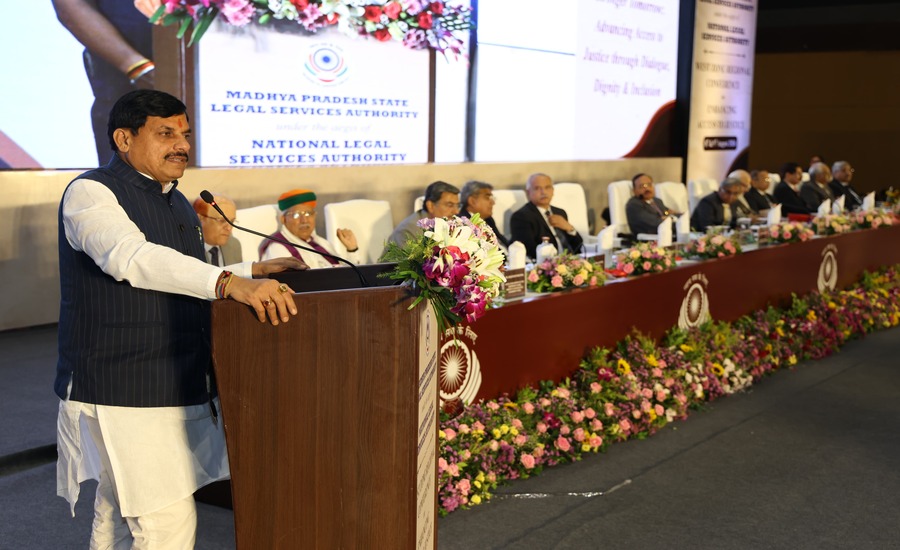
Bhopal/Indore: Madhya Pradesh Chief Minister Dr Mohan Yadav has stressed the need to make justice more accessible, inclusive and citizen-friendly, saying his government remains committed to ensuring that every citizen can seek legal remedies without barriers.
Addressing the West Zone Regional Conference on ‘Enhancing Access to Justice’ at the Brilliant Convention Centre in Indore, Yadav highlighted mediation, technology and legal aid as key tools for reducing delays and taking justice closer to citizens.
The conference brought together judges, judicial officers, legal services authorities and other stakeholders to discuss ways to make the justice system more responsive, inclusive and accessible.
Justice Must Reach Every Citizen
Yadav said justice, liberty and fraternity are among the foundations of democracy and stressed the importance of resolving smaller disputes through mediation.
He pointed to India’s long tradition of settling disputes through dialogue, compromise and community-based mechanisms. Greater use of mediation, he said, can help reduce case pendency while providing quicker and less adversarial solutions to disputes.
“Justice delayed is also justice denied,” Yadav said, adding that the Madhya Pradesh government would extend all possible support to strengthen access to justice.
The conference placed particular emphasis on access, dignity and inclusion in the delivery of legal services.
Technology and Legal Reforms to Improve Access
Yadav said the justice system is undergoing major technological and legal changes aimed at making legal processes faster and more accessible.
Among the measures highlighted at the conference were:
- E-case filing and virtual hearings
- Digital data collection and modern judicial management
- Cybersecurity and automated systems
- E-Zero FIR facilities
Fast-track courts for paper leak and fraud cases
He said four fast-track courts have been established in Indore, Bhopal, Gwalior and Jabalpur with the support of the Madhya Pradesh High Court.
Yadav also referred to the Jan Vishwas Act, saying that removing certain minor violations from the criminal framework can simplify the legal system and make it more citizen-friendly.
The emphasis on technology reflects the broader effort to reduce procedural barriers and improve people’s ability to access legal institutions.
Chief Justice Calls for Citizen-Centred Justice
Chief Justice of India Justice Surya Kant said access to justice requires more than legislation and depends on continuous dialogue with citizens.
He stressed that legal services must understand local needs, languages and concerns, citing tribal communities in Madhya Pradesh, fishing communities in Goa, migrant workers in Gujarat and women in Mumbai.
He said true equality in justice means reaching people who have not yet approached legal institutions.
New Initiatives for Inclusive Legal Services
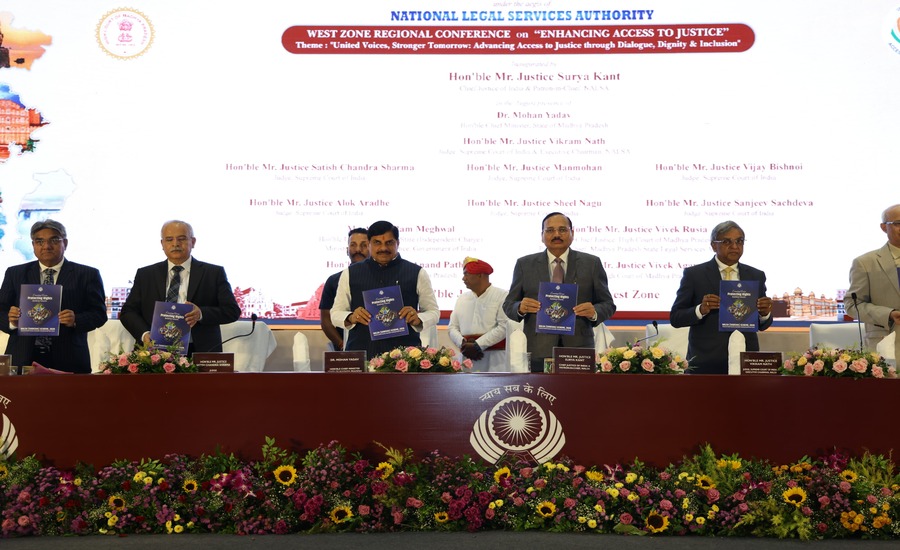
Several initiatives aimed at expanding access to legal services were launched during the conference.
These included:
- Ensuring Access, Protecting Rights, Building Futures
- Preventive and strategic legal services schemes
- Justice for All
- A legal services guide in Braille
- Swar of Justice
- NALSA’s theme song in Indian Sign Language
- The mediation certificate course From Dispute to Consensus
- Justice to Children Litigation Fellowship Programme
Supreme Court Justice Vikram Nath said the Braille guide and Indian Sign Language initiatives would help persons with disabilities access legal services more independently.
He also highlighted the mediation certificate course being launched with the support of National Law University Jabalpur. The programme aims to promote dialogue-based solutions to disputes involving families, neighbours and partnerships.
Mediation Seen as Key to Reducing Disputes
Supreme Court Justice Manmohan said justice should go beyond dispute resolution and help shape the country’s future. He stressed mediation, dialogue and innovative dispute resolution to reduce prolonged litigation and improve access to justice.
Justice as a Foundation of Good Governance
Union Minister Arjun Ram Meghwal said justice must reach every section of society, stressing equal access, free legal aid and AI-based solutions to overcome language barriers.
Madhya Pradesh High Court Acting Chief Justice Vivek Rusia highlighted Lok Adalats, prison reforms, tribal legal services and mediation as key tools for expanding access to justice.
Madhya Pradesh’s Legacy of Justice and Governance
The conference cited Lokmata Ahilyabai Holkar, Emperor Vikramaditya and Raja Bhoj as symbols of justice and good governance in Madhya Pradesh, linking their legacy to responsive, citizen-centric governance.
It brought together judges, legal services authorities, judicial officers and other stakeholders to discuss easier access to justice regardless of social, economic, linguistic or physical barriers.
The focus on mediation, digital tools, legal aid and inclusive services highlighted the shift towards a more accessible justice system that builds public trust and prevents exclusion.