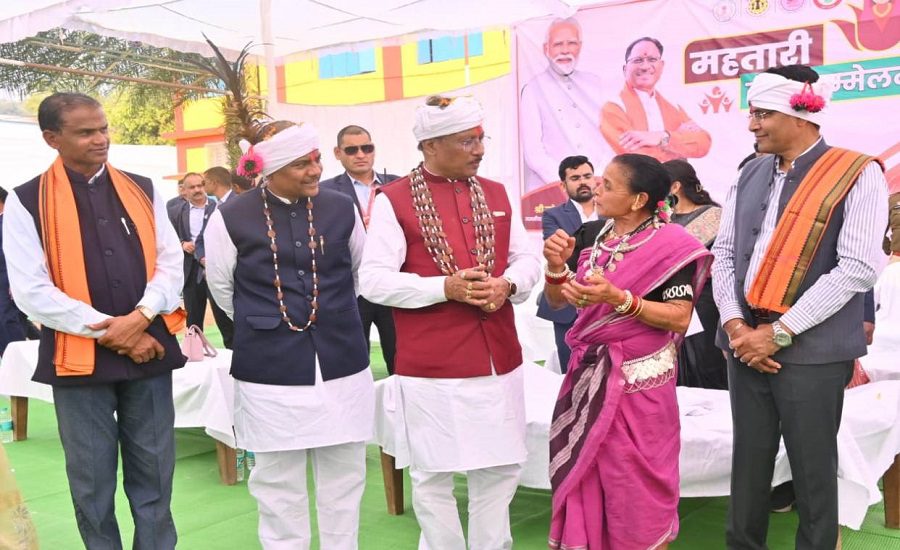
Raipur: Chief Minister Mr. Vishnu Deo Sai reaffirmed the Chhattisgarh Government’s commitment to preserving and promoting Bastar’s tribal heritage during his two-day visit to Narayanpur. A highlight of the visit was his inspection of the newly constructed Garhbengal Ghotul, where he was warmly welcomed by villagers amid the resonant rhythms of traditional Mandar drums.
Immersed in the vibrant folk ambience, the Chief Minister engaged with local cultural figures, praising their efforts in preserving the tribal community’s social system, traditions, and knowledge.
Garhbengal Ghotul: A Modern Hub of Tribal Education and Culture
The Chief Minister closely observed the unique architectural design of the Ghotul and visited spaces dedicated to cultural and educational activities:
- Leyyor and Leyosk Kurma – dedicated spaces for young men and women
- Bidar Kurma – housing traditional attire, ancient musical instruments, and cultural artefacts
- Saga Kurma – a culinary space celebrating Bastar’s traditional cuisine
Sai emphasized that the modern Ghotul will serve as a vital platform to connect the younger generation with their roots and introduce tourists to Bastar’s tribal lifestyle, stating that the Ghotul stands as a symbol of Chhattisgarh’s glorious heritage.
Celebrating Bastar’s Culinary Heritage
During the visit, the Chief Minister partook in a traditional Bastar meal, tasting a variety of dishes that included gato-bhaat, kodo-bhaat, urad dal, hirua dar, jeera bhaji, kanji pej, bhaji ghiroul phool, chati bhaji, kanda bhaji, munga bhaji, imli aamat, madia pej, tamatar chutney, chila roti, ragi kurma, ragi cake, ragi laddu, and ragi jalebi.
He shared the meal with Forest Minister Kedar Kashyap, Revenue Minister Tank Ram Verma, Zilla Panchayat President Narayan Markam, Chairman of the State Minor Forest Produce Federation Roopsai Salam, Padma awardee Pandiram Mandavi, folk artist Butlu Ram, and other senior representatives, reflecting the communal and inclusive spirit of the visit.
Honouring Bastar’s Eminent Personalities
Vishnu Deo Sai’s visit included personal interactions with renowned regional figures, acknowledging their contribution to tribal culture:
- Padma Shri awardee Pandiram Mandavi
- Padma Shri awardee Hemchand Manjhi
- Folk artist Butlu Ram
- Family members of ‘Tiger Boy’ Chendru, a local legend
The Chief Minister commended their dedication to cultural preservation, folk arts, and community education.
Eco-Friendly and Artistic Ghotul Design
Constructed under the guidance of the Forest Department and Padma Shri awardee Pandiram Mandavi, the Ghotul is eco-friendly, made entirely from wood, clay, and bamboo.
Sai praised the intricate carvings on the pillars, personally crafted by Mandavi, noting that the designs reflect cultural continuity, artistic expression, and heritage conservation. He highlighted the Ghotul as a model for preserving tribal architecture and traditional craftsmanship.
Conclusion: A Bridge Between Tradition and Modernity
The Garhbengal Ghotul stands as a symbolic bridge between Bastar’s rich tribal traditions and the new generation, offering education, cultural engagement, and exposure to the unique social system of the tribal community. The Chief Minister reaffirmed the state government’s commitment to protecting, promoting, and celebrating Bastar’s heritage while creating opportunities for cultural tourism and community pride.