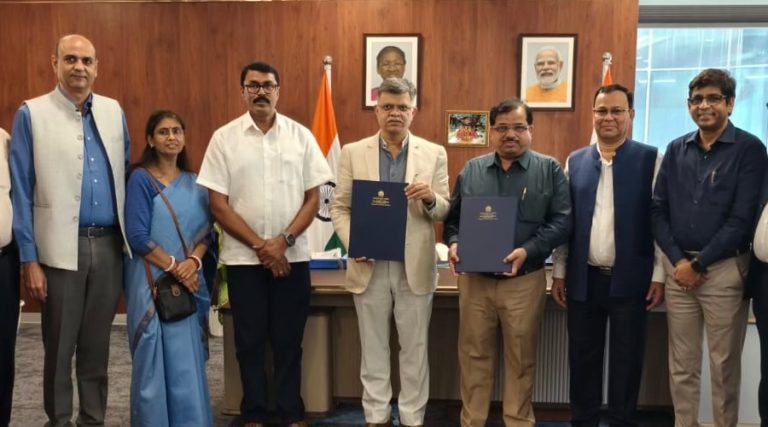
New Delhi: India has taken a significant leap in strengthening its indigenous defence ecosystem with the successful field testing of two high-value unmanned aerial systems— a 150-kg class Loitering Munition UAV (LM-UAV) and solar-powered High Altitude Platforms (HAPs).
Developed by the Council of Scientific and Industrial Research – National Aerospace Laboratories (CSIR-NAL) along with private defence partner Solar Defence & Aerospace Ltd. (SDAL), these systems are poised to transform India’s surveillance, reconnaissance, and precision-strike capabilities.
Both platforms reflect India’s strategic shift toward self-reliance in defence manufacturing, reducing dependency on foreign technologies and accelerating innovation under national initiatives such as Aatmanirbhar Bharat.
Background of CSIR-NAL Loitering Munition UAV
India’s defence sector has been undergoing rapid modernization, emphasizing indigenous development of advanced platforms—from unmanned aerial vehicles to next-generation missile systems.
Government-industry partnerships have created a flourishing ecosystem where defence start-ups, public institutions, and research agencies jointly contribute to critical capabilities.
The collaboration between CSIR-NAL and SDAL is a result of this growing synergy.
Their newly tested LM-UAV and HAP platforms are built to address India’s evolving tactical and strategic requirements, enabling the armed forces to operate effectively across diverse combat environments—especially in GPS-denied, high-altitude, or long-endurance scenarios.
Capabilities of CSIR-NAL Loitering Munition UAV
Indigenous Wankel Engine for High Efficiency and Reliability: The LM-UAV is powered by an indigenous Wankel engine, showcasing domestic innovation in UAV propulsion. This engine design improves fuel efficiency, reliability, and sustained performance—crucial elements for long-endurance missions.
Long-Range & Endurance Performance: The LM-UAV boasts a 900 km operational range with 6–9 hours of endurance, making it exceptionally capable for deep-strike and long-distance surveillance missions. Its ability to operate at service ceilings up to 5 km allows deployment across diverse terrains—from deserts to mountainous regions.
Stealth and GPS-Denied Navigation Capabilities: A major technological advantage is the UAV’s suite of AI-enabled autonomous navigation tools, including:
- GPS-denied operation capabilities
- Low radar cross-section
- AI-assisted target identification
- Enhanced mission autonomy
These features allow it to function in contested airspaces where electronic warfare systems may block or spoof GPS signals.
Operational Use Cases: The LM-UAV’s blend of endurance, precision, and autonomy provides India with advanced capabilities for:
- Precision strikes on enemy installations
- Neutralizing high-value moving or hidden targets
- Border surveillance and intelligence gathering
- Battlefield support in denied environments
This platform represents a strategic asset, strengthening India’s ability to conduct independent, high-precision missions.
Solar-Powered High Altitude Platforms (HAPs): India’s ‘Pseudo-Satellite’ Initiative
Designed for Sustained Flight Above 20 Km Altitude: The HAP systems tested by CSIR-NAL are lightweight, solar-powered aircraft capable of flying above 20 km altitude for extended periods.
They act as pseudo-satellites, offering constant aerial presence for:
- Surveillance
- Communication support
- Reconnaissance
- Disaster management
Key Advantages of CSIR-NAL Loitering Munition UAV Systems
- Zero fuel dependency due to solar power
- Weeks or even months of endurance
- Ideal for military communication networks
- Reduced costs compared to traditional satellites
- Rapid deployment during emergencies
These platforms strengthen India’s space and defence strategy by providing a hybrid alternative between UAVs and satellites.
India’s UAV development successes in recent years include:
- Indigenous octocopter deployment for vaccine delivery during COVID-19
- Advancements in autonomous and semi-autonomous platforms
- Strengthened public-private collaboration in defence technology
These accomplishments reinforce India’s long-term goal of becoming a global defence manufacturing hub.
Strategic Significance: Reduced Imports, Enhanced Capabilities
The LM-UAV and HAP programmes are part of a broader ecosystem aimed at:
- Reducing dependence on foreign defence imports
- Securing robust domestic supply chains
- Promoting indigenous manufacturing
- Enhancing tactical and operational readiness
- Building advanced autonomous warfare systems
Together, these developments signal a shift toward a resilient, self-sustaining defence infrastructure capable of meeting India’s future security challenges.