New Delhi: India has taken a major step toward strengthening its national security with the launch of Defence Forces Vision 2047, a long-term roadmap aimed at transforming the country’s armed forces into a technologically advanced and integrated military. The document was released by Defence Minister Rajnath Singh in New Delhi on March 10, 2026.
The Defence Forces Vision 2047 outlines strategic reforms, capability upgrades, and organisational changes required to prepare the Indian Armed Forces for future warfare. The plan aligns with India’s broader goal of becoming a developed nation, or Viksit Bharat, by 2047 — the centenary year of India’s independence.
Defence Minister Rajnath Singh Releases Defence Forces Vision Document
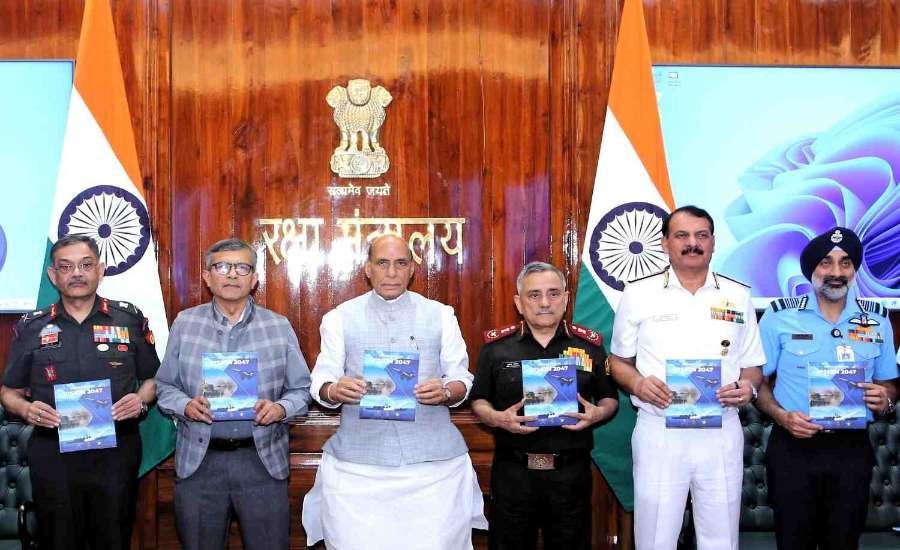
Defence Minister Rajnath Singh released “Defence Forces Vision 2047: A Roadmap for a Future-Ready Indian Military” at South Block in New Delhi.
The blueprint has been prepared by the Headquarters Integrated Defence Staff (HQ IDS). It aims to guide the transformation of the Indian military into a modern, integrated, and technologically advanced force. Senior defence leaders present during the release included:
- Chief of Defence Staff General Anil Chauhan
- Chief of the Naval Staff Admiral Dinesh K Tripathi
- Chief of the Air Staff Air Chief Marshal AP Singh
- Vice Chief of the Army Staff Lieutenant General Pushpendra Singh
- Defence Secretary Rajesh Kumar Singh
The presence of top military leadership highlights the importance of this strategic roadmap.
What is Defence Forces Vision 2047?
Defence Forces Vision 2047 is a long-term strategy designed to prepare India’s armed forces for the changing nature of warfare and security threats.
The document focuses on:
- Building a modern and technologically advanced military
- Improving integration between the Army, Navy and Air Force
- Strengthening national defence capabilities
- Enhancing operational readiness for future conflicts
It also addresses the evolving geostrategic, technological and security environment in the region and globally.
Integrated Multi-Domain Military Strategy
One of the core ideas of the vision document is to transform the Indian Armed Forces into a multi-domain integrated force.
This means the military will be able to operate seamlessly across different domains such as:
- Land
- Air
- Sea
- Space
- Cyber
This integration will improve coordination between the services and help India respond faster and more effectively to emerging threats.
The goal is to create a force capable of:
- Deterring adversaries
- Responding to a wide range of conflicts
- Protecting India’s national interests globally
Focus on Jointness Among Armed Forces
The document highlights the need for greater jointness and synergy among the three services.
This includes:
- Better coordination in planning and operations
- Shared capability development
- Integrated training and command structures
Such reforms are expected to improve efficiency and ensure faster decision-making during military operations.
Role of Innovation and Advanced Technologies
Technology will play a major role in shaping the future of India’s armed forces. The vision document emphasises the adoption of:
- Advanced defence technologies
- Artificial intelligence and digital systems
- Modern warfare platforms
- Advanced training frameworks
These measures will help the Indian military adapt to future warfare challenges, including cyber warfare, autonomous systems and space-based security threats.
Aatmanirbharta in Defence Manufacturing
Another major pillar of Defence Forces Vision 2047 is Aatmanirbharta (self-reliance) in defence. The roadmap encourages the development and adoption of indigenous technologies and defence equipment.
Strengthening domestic defence manufacturing is expected to:
- Reduce dependence on imports
- Boost India’s defence industry
- Create high-skill jobs
- Strengthen the national economy
This aligns with the government’s broader Make in India initiative in the defence sector.
Structured Roadmap for Capability Development
The vision document provides a calibrated roadmap with clear capability goals.
The plan includes:
- Short-term priorities
- Medium-term capability upgrades
- Long-term transformation goals
These timelines will guide the development of critical military capabilities, institutional reforms, and strategic partnerships needed to build a world-class defence force.
Defence Forces Vision: Whole-of-Nation Approach to National Security
The roadmap recognises that future security challenges require a whole-of-nation approach.
This means combining military strength with:
- Diplomatic efforts
- Economic power
- Technological innovation
By integrating these elements, India aims to ensure long-term national security and strategic stability.
Defence Forces Vision for India’s Military by 2047
By the time India celebrates 100 years of independence in 2047, the roadmap aims to establish the Indian Armed Forces as:
- Globally respected
- Technologically advanced
- Combat-ready
- Operationally resilient
Such a transformation will contribute significantly to the vision of a strong and secure Viksit Bharat.