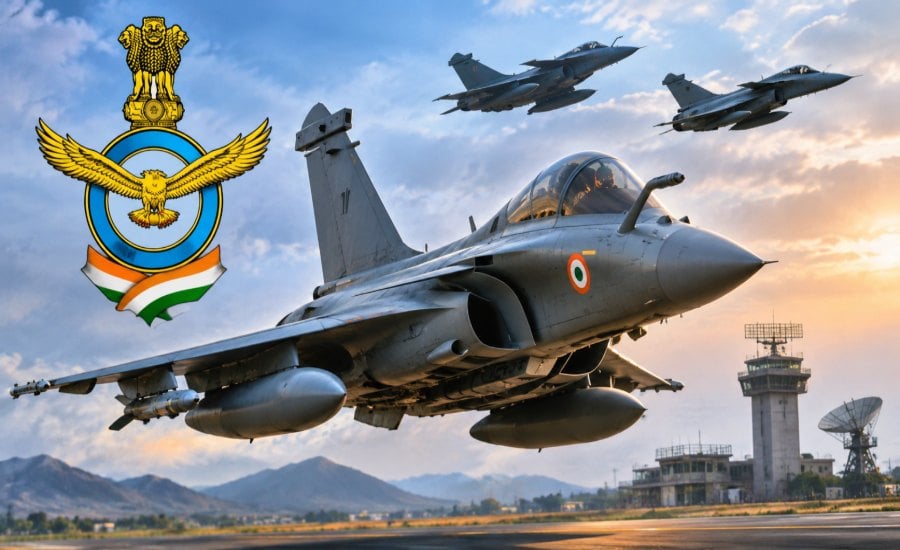
New Delhi: India is preparing its Air Force for future security challenges under a new leadership vision. IAF Chief Ashutosh Dixit has introduced a new strategy called ‘VAYU’ to strengthen operational readiness, improve combat capabilities and make the Indian Air Force (IAF) more self-reliant. He announced these priorities after taking charge as the 29th Chief of the Air Staff on November 1, 2026.
The new vision focuses on four major areas: vigilance and readiness, indigenous defence manufacturing, technological innovation and better coordination between India’s armed forces.
Ashutosh Dixit Takes Charge As 29th IAF Chief
Air Chief Marshal Ashutosh Dixit officially assumed charge as the 29th Chief of the Air Staff on October 31, 2026. He succeeded Air Chief Marshal A.P. Singh, who retired after completing 42 years of distinguished service.
Read also: Why The Indian Air Force Is Already Looking At Tejas Mk-2 Amid Delays In Tejas Mk-1A Deliveries
On November 1, Dixit paid tribute to India’s fallen soldiers at the National War Memorial in New Delhi. He was also given a ceremonial Guard of Honour at Air Force Station New Delhi.
According to the Ministry of Defence, Air Chief Marshal Dixit has more than 3,500 hours of flying experience. He is an experienced fighter pilot, Qualified Flying Instructor and Experimental Test Pilot.
Before becoming the Air Chief, he served in several important positions, including Vice Chief of the Air Staff, Air Officer Commanding-in-Chief of Central Air Command and Chief of Integrated Defence Staff.
What Is The New ‘VAYU’ Vision Of The Indian Air Force
Air Chief Marshal Ashutosh Dixit introduced ‘VAYU’ as the guiding vision for the future development of the Indian Air Force.
Each letter of VAYU represents an important priority. Together, these four areas aim to make the IAF more prepared, technologically advanced and capable of handling future security challenges.
1. V – Vigilance, Victory And Readiness
The first priority is to maintain a high level of operational readiness across the Indian Air Force.
Dixit said that every squadron, radar system, air defence unit and Air Warrior must be prepared to respond whenever required.
He also identified restoring the IAF’s combat strength towards its officially sanctioned level as one of his most important priorities.
2. A – Aatmanirbharta
The second priority focuses on India’s defence self-reliance.
The new IAF chief highlighted the importance of developing and using more Indian-made aircraft, weapons, sensors and other defence technologies. He identified the following programmes as major priorities:
- Tejas Mk1A Fighter Aircraft
- Tejas Mk II Fighter Aircraft
- Advanced Medium Combat Aircraft (AMCA)
- Indigenous Sensors And Weapons
The aim is to reduce dependence on foreign defence systems and strengthen India’s domestic aerospace and defence manufacturing industry.
Dixit also stressed that Indian-made systems must be available in sufficient numbers to meet operational requirements.
3. Y – Yukti
The third priority, Yukti, represents innovation and new thinking.
The Indian Air Force plans to improve its operational methods by using modern technologies and developing better defence solutions. Some important focus areas include:
- Artificial Intelligence (AI)-Enabled Command And Control Systems
- Advanced Counter-Drone Defence
- Improved Aircraft Maintenance Systems
- Better Force Protection And Resilience
- Use Of Near-Space As An Operational Domain
These technologies are becoming increasingly important as modern warfare continues to change.
Drones, artificial intelligence, cyber operations, space-based systems and long-range precision weapons are creating new challenges for military forces.
4. U – Unity Of Effort
The fourth priority focuses on stronger coordination between India’s three armed forces.
Dixit said the Indian Air Force would work closely with the Indian Army, Indian Navy and other national agencies.
He connected this priority with the broader vision of ‘JAI’, which stands for Jointness, Aatmanirbharta and Innovation.
The main objective is to improve cooperation between different military services so they can plan and operate together more effectively.
He also highlighted that air power delivers better results when it is integrated into military planning from the beginning.
Why Is The VAYU Vision Important For India’s Defence
Modern warfare is changing rapidly because of new technologies and emerging security threats.
The use of drones, artificial intelligence, cyber capabilities, space systems and long-range weapons is changing how military operations are planned and conducted.
India needs an Air Force that can respond quickly to these challenges while maintaining strong defensive and offensive capabilities.
The VAYU vision addresses these requirements through better combat readiness, indigenous manufacturing, technological innovation and joint military operations.
It also highlights the importance of developing Indian defence technologies that can support the country’s long-term security requirements.
Focus On Air Warriors And Personnel Welfare
Apart from technology and operational capabilities, the new IAF chief also highlighted the importance of personnel welfare.
He said the training, professional development, safety, welfare and dignity of Air Warriors would receive his personal attention.
His priorities also include Agniveervayu personnel, civilian employees, veterans, Veer Naris and their families.
This approach recognises that trained and motivated personnel are essential for maintaining a strong and effective Air Force.
Read also: Indian Air Force Drone Roadmap: What The 16 Platform Families Mean
FAQs
Air Chief Marshal Ashutosh Dixit is the new Chief of the Indian Air Force. He assumed charge as the 29th Chief of the Air Staff on October 31, 2026, succeeding Air Chief Marshal A.P. Singh.
VAYU is the new guiding vision introduced by Air Chief Marshal Ashutosh Dixit. It represents Vigilance, Victory and Readiness, Aatmanirbharta, Yukti and Unity of Effort.