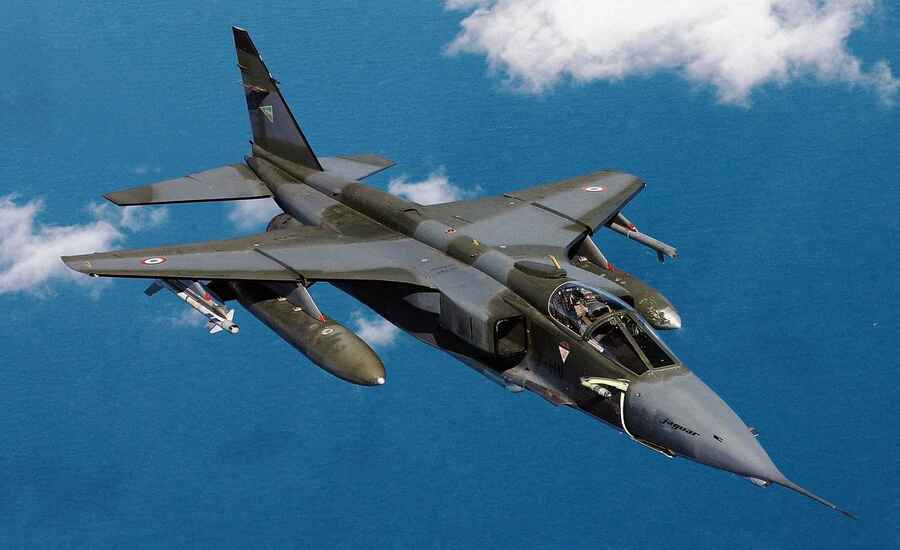
New Delhi: Despite being a Cold War–era platform, the Indian Air Force’s SEPECAT Jaguar Jet — known in service as “Shamsher” — continues to play a vital role in India’s strike capability, particularly as a deep penetration strike aircraft capable of delivering precision weapons deep inside hostile territory. Decades after its induction, the Jaguar remains one of the most rugged and dependable assets in the Indian Air Force (IAF) inventory, maintaining unique capabilities that are not easily replicated by other combat platforms.
Background of Sepecat Jaguar Jet
First inducted into the IAF in 1979, the Jaguar filled a key operational gap in Indian airpower following the 1971 war. Its twin-engine design offered high survivability and versatility, enabling operations from semi-prepared airstrips in harsh environments.
A total of over 160 Jaguars were produced under license by Hindustan Aeronautics Limited (HAL) for India, tailored for both strike and maritime roles.
In a strategic environment where other air forces have retired the type, India remains the only operator of the Jaguar, underlining its continued relevance even as the combat aircraft fleet undergoes modernization.
Combat Legacy: From Kargil to Modern Networked Warfare
Designed as a low-altitude, supersonic strike fighter-bomber, the Jaguar has been a backbone of India’s ground-attack doctrine with advanced radar, navigation systems, and terrain-hugging performance that allow it to evade enemy defenses while executing precision missions in contested airspace.
The Jaguar has built a distinguished operational record over decades:
Kargil Conflict (1999): The aircraft executed deep-penetration attacks using laser-guided bombs, proving its ability to deliver precision strikes against fortified targets.
Balakot Strikes (2019): Jaguars played tactical roles, including acting as decoys to help other aircraft avoid engagement, showcasing adaptive mission employment even in modern networked warfare environments.
These operational deployments have cemented its status as an essential tool in India’s military aviation, especially where low-level penetration and strike precision are required.
Upgrades: DARIN Program and Modernisation Efforts
To keep the Jaguar relevant in contemporary combat scenarios, the IAF and HAL have undertaken multiple avionics and weapons upgrades under the DARIN (Display Attack Ranging and Inertial Navigation) series of enhancements:
DARIN I and II Enhancements
Earlier phases introduced significant improvements including:
- Advanced navigation and attack systems
- Electronic displays
- Laser targeting pods
- Air-to-air and air-to-surface weapons systems
These upgrades improved situational awareness and strike accuracy, contributing significantly to Jaguar’s performance in the 1999 Kargil conflict.
DARIN III: Transformative Modernisation
The most advanced upgrade — DARIN III, initiated in 2008 — integrates cutting-edge systems such as:
- Elta EL/M-2052 AESA radar, making the Jaguar India’s first combat aircraft with advanced active electronically scanned array capability
- Glass cockpit with multiple multifunction displays
- Enhanced navigation, electronic warfare interfaces, and improved weapon integration
These enhancements significantly increase the aircraft’s combat reach, precision strike capabilities, and survivability against modern threats.
Importantly, DARIN III upgrades aim to extend the service life of select Jaguar airframes up to or beyond 2035, giving the aircraft operational relevance even as newer platforms enter service.