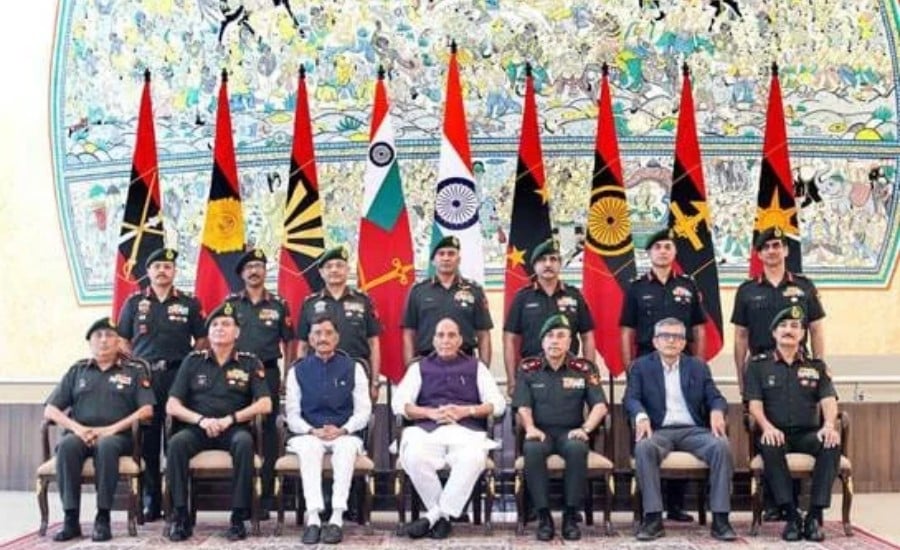
New Delhi: India has taken an important step towards preparing its Army for modern warfare. The Indian Army Land Warfare Doctrine 2026 was released by Defence Minister Rajnath Singh on October 23, 2026, during the Army Commanders’ Conference in New Delhi.
The new doctrine provides a broad framework to prepare the Indian Army for changing warfare, modern technology and emerging security threats. Rajnath Singh also called for a long-term strategic vision covering the next 20–30 years while maintaining readiness for immediate challenges.
Rajnath Singh Releases Land Warfare Doctrine 2026
Defence Minister Rajnath Singh released the Land Warfare Doctrine during the Army Commanders’ Conference held in New Delhi from October 21 to 23, 2026.
Read also: Inside the Indian Army’s ‘Bhairav’ Force: How 100,000 Drone Warriors Are Transforming Modern Warfare
The doctrine aims to help the Indian Army prepare for the changing nature of warfare and future conflicts. It provides an overall framework for developing a modern, flexible and technology-enabled military force.
According to the Ministry of Defence, the conference brought together senior Army leaders to discuss national security, operational preparedness, military modernisation and future capabilities.
The release of the doctrine is an important part of India’s efforts to strengthen its defence preparedness and improve the Army’s ability to respond to changing security conditions.
Indian Army Needs A 20–30-Year Strategic Vision
Rajnath Singh urged Army Commanders to develop a long-term strategic vision covering the next 20–30 years. He said the Army must closely monitor geopolitical developments, regional security conditions and emerging threats.
At the same time, the Defence Minister stressed that the Army should remain ready to respond to immediate challenges. He called for military strategies that can change according to the situation.
The focus is on building a force that can prepare for future conflicts while maintaining strong operational readiness in the present.
Operation Sindoor Highlights The Importance Of Modern Warfare
Rajnath Singh highlighted the lessons learned from Operation Sindoor while addressing the Army Commanders. He said the operation demonstrated the importance of innovative thinking, better coordination, teamwork and advanced weapon systems.
According to the Defence Minister, the Defence Forces successfully adapted to changing operational requirements through improved cooperation and modern military capabilities.
He also said the operation sent a clear message that India would take necessary measures to protect its national interests. The Defence Minister stressed that military strategies must remain flexible and should be adjusted according to changing circumstances.
Land Warfare Doctrine 2026: What are the Main Focus Areas of Indian Army
The Defence Minister appreciated the Indian Army’s restructuring efforts and its growing use of drones and modern technologies.
He said the Army must continuously improve its capabilities and assess its performance to meet future operational requirements. The growing use of technology is changing how military forces collect information, communicate and operate during conflicts.
The government is therefore focusing on improving the Army’s technological strength and preparing it for future battlefield challenges.
Artificial Intelligence And Cybersecurity To Strengthen Army Capabilities
Rajnath Singh highlighted the importance of developing advanced technologies for India’s defence forces. He called for faster progress in several important areas:
- Artificial Intelligence (AI)
- Autonomous systems
- Data analytics
- Cybersecurity
- Secure communication networks
These technologies can help military forces improve information processing, communication and operational coordination.
The Defence Minister stressed that the Army must continue to strengthen these capabilities as warfare becomes more technology-driven.
Multi-Domain Warfare Becomes Important For India’s Defence
Modern warfare is no longer limited to land-based operations. Military forces must also prepare for challenges across the air, maritime, space and cyber domains.
Rajnath Singh said land warfare and ground forces would continue to play an important role in national security. However, he stressed that future military success would depend on an integrated approach involving multiple domains.
The Defence Minister called for better coordination between different military services and improved joint operational capabilities. The aim is to ensure that the Army can work effectively with other defence forces during complex military operations.
What The New Land Warfare Doctrine 2026 Means For India
The release of the Land Warfare Doctrine highlights India’s focus on preparing its Army for future security challenges. The doctrine provides a broad framework for military planning, operational preparedness and future capability development.
Its emphasis on technology, multi-domain operations, flexibility and long-term planning reflects the changing nature of warfare. However, the release of the doctrine does not mean that every proposed capability or reform has already been implemented.
The actual impact will depend on how effectively the Army translates its strategic direction into training, equipment, coordination and operational improvements.
Read also: From Joint Ventures to Make in India: Defence Minister Rajnath Singh Strengthens India–Czech Ties
FAQs
Rajnath Singh released the Land Warfare Doctrine on October 23, 2026, during the Army Commanders’ Conference in New Delhi.
The Indian Army Land Warfare Doctrine is a broad framework released by Defence Minister Rajnath Singh to prepare the Army for changing warfare, future conflicts and emerging security challenges.
India’s long-term strategic vision focuses on preparing the Army for future security challenges while maintaining readiness for immediate threats. It includes military modernisation, advanced technology, multi-domain operations and improved coordination.