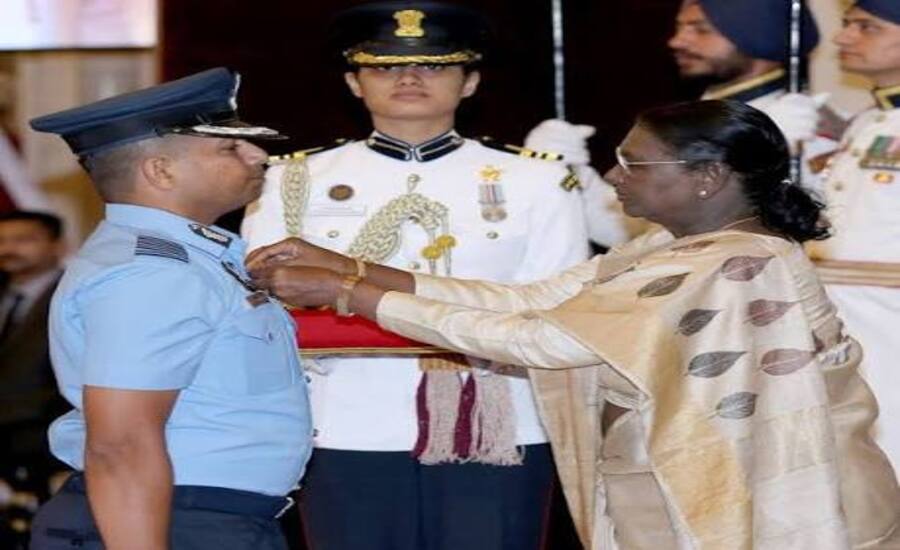
New Delhi: The Indian S-400 Squadron Commander Vir Chakra award has drawn significant attention across India’s defence community. Group Captain Animesh Patni of the Indian Air Force has reportedly been honoured with the Vir Chakra, India’s third-highest wartime gallantry award, for his leadership during Operation Sindoor.
The recognition highlights the growing importance of advanced air defence systems such as the S-400 in modern warfare and India’s evolving military preparedness.
Who Is Group Captain Animesh Patni?
Group Captain Animesh Patni is a distinguished officer of the Indian Air Force (IAF) who has been honored with the Vir Chakra, one of India’s highest military gallantry awards, for his exceptional leadership and bravery during Operation Sindoor.
Read also: Who is Air Marshal Tarun Chaudhry? Indian Air Force Gets New Central Air Command Chief
Early Life and Career
- Early life: He hails from Kunjed village in the Baran district of Rajasthan.
- Commissioning: He was commissioned into the Indian Air Force on December 17, 2005, as part of the 176 Course, joining the Flying (Pilot) branch.
- Fighter Pilot Legacy: He spent much of his early career as a frontline fighter pilot, accumulating over 2,500 flying hours. He specialized in operating advanced aircraft, including the MiG-29, Su-30MKI, and Mirage 2000.
Operational Significance and Operation Sindoor
In 2024, Group Captain Patni transitioned to a strategic role, commanding a regiment of the S-400 Triumf surface-to-air missile system. His command proved vital during Operation Sindoor, an operational response following a terrorist attack in April 2025.
Key highlights of his leadership during this period include:
- Strategic Command: He managed multiple firing units at a forward airfield, maintaining operational readiness under intense enemy pressure.
- Tactical Brilliance: He implemented mobile tactics to deceive the enemy and protect critical strategic assets, ensuring the survivability of his personnel and equipment.
- Historic Engagement: His unit is credited with a historic long-range interception. Using the S-400 system, his team reportedly neutralized a Pakistani Saab 2000 Erieye Airborne Early Warning and Control (AEW&C) aircraft at a range of 314 km, marking what is described as the longest confirmed surface-to-air missile kill in aviation history.
- Vigilance: Beyond his technical duties, his ground-level vigilance led to the apprehension of a suspected enemy spy, demonstrating his comprehensive approach to unit security.
Group Captain Patni’s career, which bridges the gap between traditional fighter pilot expertise and modern, long-range air defense warfare, serves as a significant example of the Indian Air Force’s adaptability and professional excellence.
What Is the Vir Chakra?
The Vir Chakra is India’s third-highest wartime gallantry award, granted for acts of bravery in the presence of the enemy. It recognizes exceptional courage, leadership, and devotion to duty during combat operations.
Why the Award Matters
- Recognizes battlefield courage and operational excellence.
- Reflects the increasing importance of air defence warfare.
- Highlights the contribution of non-fighter combat units in modern conflicts.
- Demonstrates the role of technology-driven military operations.
The Strategic Role of the S-400 During Operation Sindoor
The Russian-origin S-400 Triumf, known in India as part of the “Sudarshan Chakra” air defence network, is among the world’s most advanced long-range surface-to-air missile systems.
India has deployed multiple S-400 squadrons to strengthen protection against aircraft, drones, cruise missiles, and ballistic missile threats.
Capabilities of the S-400
- Engagement ranges up to 400 km.
- Ability to track multiple aerial targets simultaneously.
- Designed to intercept aircraft, UAVs, cruise missiles, and ballistic missiles.
- Integrated multi-layer air defence architecture.
During Operation Sindoor, the S-400 reportedly played a key role in intercepting hostile aerial threats and protecting critical military infrastructure across India. Reports indicate that the system helped neutralize incoming drones and missiles aimed at Indian targets.