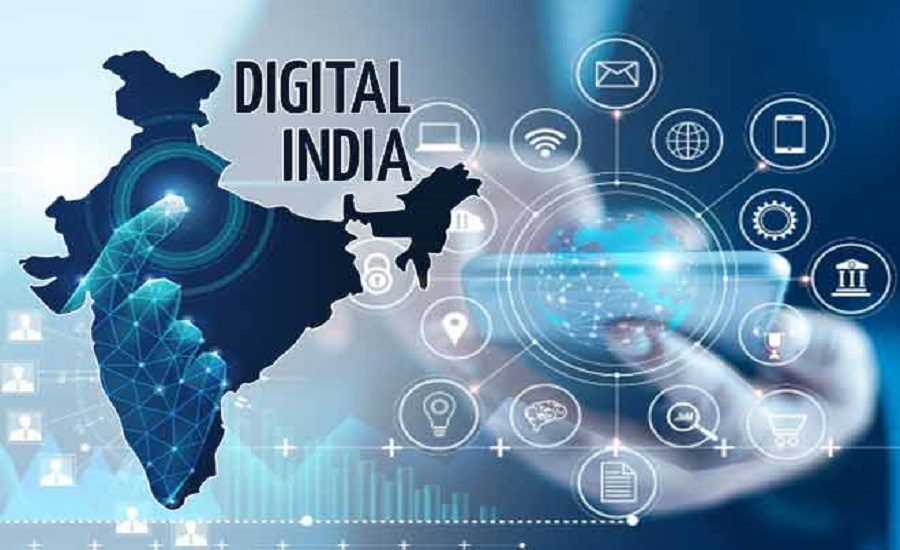
New Delhi: The Government of India’s flagship Digital India programme has significantly advanced digital inclusion across the country, providing citizens with greater access, affordability, and strong digital public infrastructure, Union Minister for Electronics and Information Technology, Ashwini Vaishnaw, informed the Lok Sabha today.
Launched in July 2015 under the vision of Prime Minister Narendra Modi, the programme aims to democratize technology, empower citizens, and bridge the digital divide. Over the past decade, India has witnessed a massive transformation in internet access, digital payments, and public service delivery.
Internet Access Multiplies Across the Nation
According to the Telecom Regulatory Authority of India (TRAI), internet connectivity in India has grown from 25 crore users in 2014 to 103 crore in 2025, reflecting a remarkable expansion over the last decade.
This surge has been driven by the rapid deployment of 4G and 5G networks, a vast network of optical fiber cables, and consistent investments in digital infrastructure. Such growth has positioned India among the few large economies in the world that have successfully implemented digital public infrastructure.
At the recent AI Impact Summit, President Emmanuel Macron of France praised India’s efforts, noting that the country has built a digital ecosystem that no other nation has achieved.
Under the leadership of PM @narendramodi Ji, Digital India is advancing digital inclusion through greater access, affordability & strong Digital Public Infrastructure. pic.twitter.com/zN9VoBLZTl
— Ashwini Vaishnaw (@AshwiniVaishnaw) March 11, 2026
Read also: Govt Strengthens Anganwadi Infrastructure Under Mission Saksham Anganwadi and Poshan 2.0
Making Internet Affordable for Every Citizen
India now offers some of the lowest data tariffs in the world, making digital access highly affordable. The cost of 1 GB of mobile data in India ranges between $0.08 and $0.10, compared to the global average of $2.59. Key comparisons include:
- Bangladesh: $0.23 – $0.34 per GB
- Nepal: $0.27 – $0.43 per GB
- Sri Lanka: $0.25 – $0.35 per GB
- Pakistan: $0.12 – $0.18 per GB
- France: $0.16 – $0.20 per GB
- Germany: $2.14 per GB
This affordability has been made possible through transparent regulatory practices in the telecom sector, ensuring that millions of citizens can access digital services without financial barriers.
Robust Digital Public Infrastructure
India’s unique digital public infrastructure has transformed service delivery across the country, making government services more accessible and efficient.
Aadhaar: A Universal Digital Identity
With over 1.43 billion Aadhaar numbers generated, citizens now have a universal digital identity. This has streamlined access to welfare schemes and enhanced financial inclusion.
Through Aadhaar-linked Direct Benefit Transfers (DBT), cash benefits from 328 schemes across 56 ministries are directly credited to beneficiaries’ bank accounts, reducing fraud and eliminating duplicate claims. To date, over 16,600 crore Aadhaar authentications have been carried out, including 10.67 crore IDs in West Bengal alone.
Unified Payments Interface (UPI): Revolutionizing Digital Payments
The Unified Payments Interface (UPI) has emerged as a game-changer in digital payments, with over 460 million users and billions of transactions monthly. Serving 6.5 crore merchants and connecting 685 banks on a single platform, UPI is the world’s largest digital payment system, accounting for 81% of India’s digital payments and nearly 49% of global real-time digital transactions.
Safeguards for Public Safety
While promoting digital growth, the Government ensures public safety and order. Both the Central and State Governments can temporarily suspend internet services during emergencies under the Telecommunication (Temporary Suspension of Services) Rules, 2024, in accordance with Supreme Court guidelines.