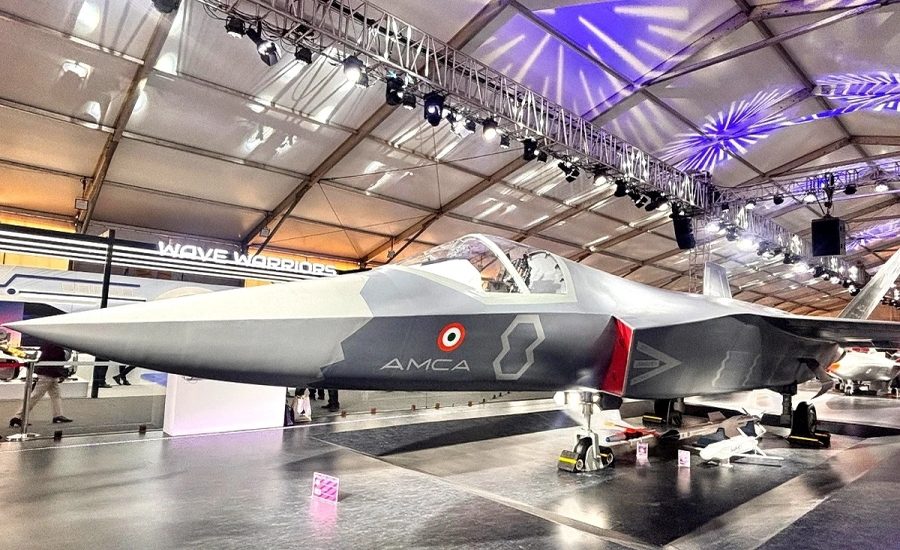
New Delhi: The Defence Metallurgical Research Laboratory (DMRL) — a key research establishment under Defence Research and Development Organisation (DRDO) — has achieved a major milestone for the indigenous 5th-generation fighter programme of India.
On 15 November 2025, DMRL formally handed over the “Rear Fin Root Fitting” (RFRF) — a critical titanium structural component — to Aeronautical Development Agency (ADA) for integration into the Advanced Medium Combat Aircraft (AMCA).
This successful handover marks a significant step forward in India’s efforts for self-reliant aerospace manufacturing, reducing dependence on imports, and underlining the growing maturity of its domestic defence-industrial ecosystem.
Background of 5th-Gen AMCA Fighter
The AMCA is envisioned as India’s first indigenous fifth-generation stealth fighter aircraft — a twin-engine, single-seat jet designed to rival the most advanced combat aircraft in the world.
The programme has been gradually transitioning from paper design to full-scale engineering and manufacturing, with a prototype rollout expected in the coming years.
One of the most challenging aspects of designing such an aircraft lies not only in avionics, stealth coatings, sensors, or weapons, but in structural integrity — especially at points of high stress, thermal load, and fatigue over long service lives.
What is Rear Fin Root Fitting
The Rear Fin Root Fitting (RFRF) is one such critical component: it is the structural “root joint” where the vertical stabiliser (fin) meets the rear fuselage of the aircraft.
This junction endures substantial bending, torsional and fatigue loads throughout aircraft operations, especially given its proximity to engine nozzles and exhaust zones, where temperature and stress can be extreme.
Until now, such large, complex, high-strength aerospace-grade titanium castings or forgings were largely imported — often because they require advanced metallurgical know-how, precise manufacturing, and rigorous quality control.
Details of the Make in India RFRF
According to official reports, DMRL accomplished this feat by developing two independent indigenous manufacturing technologies for producing the RFRF:
- Investment Casting — carried out by PTC Industries Limited, Lucknow.
- Closed-Die Hot Hammer Forging — executed by Steel and Industrial Forgings Limited (SIFL), Thrissur.
The RFRF is not a simple part — in its raw machined state, it reportedly weighs over 80 kilograms and features deep pockets, thin walls, and intricate internal passages, making its fabrication particularly challenging.
Both the cast and forged variants underwent extensive testing — including destructive and non-destructive tests, dimensional inspections, metallurgical evaluations, and mechanical property assessments — to ensure they meet the stringent airworthiness standards mandated for modern combat aircraft.
Following this rigorous validation, the components were accepted without any deviation or concession, clearing them for integration into AMCA’s structural test assemblies and, eventually, flying prototypes.
Key Significance of 5th-Gen AMCA Fighter
A Major Boost to Indigenization & “Aatmanirbhar Bharat”.
This milestone underscores that India is not just designing fighter jets, but is now capable of manufacturing critical structural components — in aerospace-grade titanium — entirely through domestic industry.
It reduces reliance on foreign suppliers and strengthens strategic autonomy in defence manufacturing.
Strengthening India’s Defence Supply Chain
The collaboration between DMRL (DRDO lab) and private/public sector firms like PTC Industries and SIFL demonstrates a maturing defence-industrial base capable of meeting complex aerospace requirements.
This sets a precedent for future parts and components required for AMCA and other indigenous platforms (engines, airframes, avionics, etc.).
Technical Validation of Domestic Capabilities
Producing an 80 kg+ titanium fitting with complex geometry and ensuring it meets airworthiness standards is no small feat.
This shows that Indian metallurgical and manufacturing capabilities have reached a level of sophistication required for next-generation combat aircraft — a domain previously dominated by a few global aerospace powers.
Momentum for AMCA Programme
Having validated structural components increases confidence in the overall AMCA development timeline. As of 2025, the government approved an “Execution Model” for the AMCA programme under which private-sector firms will help build the aircraft. With components like the RFRF ready, the path toward prototype assembly and eventual flight tests becomes more tangible.
What Happens Next — Road Ahead for AMCA
With the Rear Fin Root Fitting now cleared for integration, the next steps in the AMCA programme likely include:
- Assembly of full-scale structural test airframes (or prototypes) using the new indigenous components.
- Flight-worthiness testing, structural and fatigue testing over time.
- Concurrent development of other critical subsystems — engines, avionics, stealth coatings, weapons integration — many of which are also being pursued via indigenous or joint-development routes.
- Scaling up manufacturing capabilities and supply chains to support serial production when AMCA enters the production phase.
- If everything proceeds smoothly, this achievement could speed up the timeline for AMCA induction — enabling India to realize its ambition of a fully indigenous fifth-generation stealth fighter.
Broader Context of RFRF in Global Aerospace & Security Landscape
Globally, only a handful of countries have the capability to design, develop, and manufacture fifth-generation fighter aircraft — not just at design level, but also at the supply-chain, metallurgical and production levels. By mastering the manufacturing of a critical structural titanium fitting, India moves closer to joining that club.
In the context of increasing geopolitical competition in the Indo-Pacific region, having indigenous high-end aerospace manufacturing reduces strategic dependency, strengthens national security, and gives India greater flexibility in defence planning. It also paves the way for future export potential and collaboration with friendly countries.
Moreover — beyond just AMCA — the expertise gained can be leveraged for other aerospace programmes: engines, UAVs, drones, naval aviation, and even civilian aerospace applications.