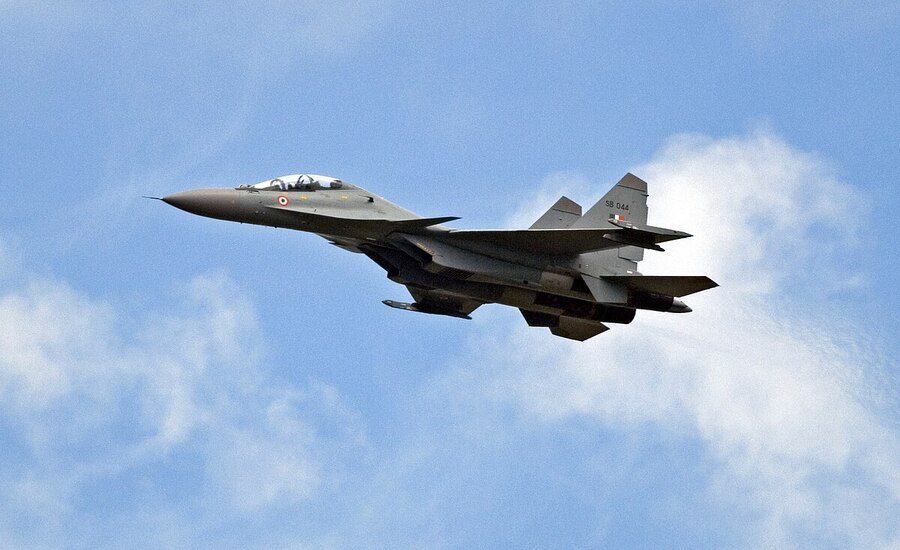
New Delhi: India’s Long Range Land Attack Cruise Missile (LRLACM) program has received a major boost as the Defence Research and Development Organisation (DRDO) accelerates its integration with the Sukhoi Su-30MKI.
LRLACM integration on Su-30MKI highlights how DRDO is leveraging the already proven BrahMos-A pylon architecture to fast-track deployment. This move is expected to significantly enhance India’s long-range precision strike capability, allowing the Indian Air Force (IAF) to hit high-value targets from safer stand-off distances.
What is LRLACM
The LRLACM is an advanced air-launched cruise missile being developed indigenously to strengthen India’s deep-strike capability.
- Designed for long-range precision strikes
- Can target strategic land-based assets
- Expected to operate from frontline fighter jets like Su-30MKI
Read also: DRDO Lock-Confirm-Kill Missile Brings ‘Think Before Strike’ Technology to Indian Arsenal
Reports indicate that integration efforts are nearing testing phases, marking a crucial step toward operational deployment.
This missile is part of India’s broader push for self-reliant (Atmanirbhar) defence systems.
Su-30MKI: Backbone of India’s Strike Power
The Sukhoi Su-30MKI is the backbone of the IAF’s combat fleet.
- Long range and heavy payload capacity
- Capable of carrying advanced missiles
- Already integrated with multiple indigenous weapons
Its ability to carry heavy stand-off weapons makes it the ideal platform for LRLACM deployment.
Leveraging BrahMos-A Pylon: A Smart Strategy
Instead of building a new integration system from scratch, DRDO is using the existing pylon developed for BrahMos-A.
Why this matters:
- Saves time and cost
- Uses already tested and validated structure
- Reduces technical risks
The BrahMos-A integration required major structural modifications like reinforced undercarriage and specialized hardpoints.
By reusing this architecture, DRDO is accelerating LRLACM’s path to deployment.
Strategic Impact of Su-30MKI LRLACM Integration
The Su-30MKI LRLACM integration will significantly enhance India’s military capabilities:
1. Extended Strike Range
Aircraft can strike targets deep inside enemy territory without entering hostile air defence zones.
2. Improved Survivability
Stand-off capability ensures reduced risk to pilots and aircraft.
3. Multi-Platform Flexibility
Future integration with aircraft like Rafale is also expected.
4. Boost to Indigenous Defence
Strengthens India’s Make in India defence ecosystem.
How It Compares to BrahMos-A
| Feature | BrahMos-A | LRLACM (Expected) |
| Type | Supersonic cruise missile | Likely long-range cruise missile |
| Launch Platform | Su-30MKI | Su-30MKI (initial) |
| Role | Anti-ship & land attack | Deep land strike |
| Integration | Completed | In advanced stage |
BrahMos-A already gives India strong strike capability, but LRLACM aims to expand range and flexibility further.
Future Outlook
India is rapidly upgrading its aerial strike capabilities with systems like:
- Rudram anti-radiation missiles
- Astra air-to-air missiles
- LRLACM for deep strike
This layered approach will transform the IAF into a highly networked and long-range strike force.
Read also: What is DRDO’s LRASSCM Missile? Features, Range, and Su-30MKI Integration Explained