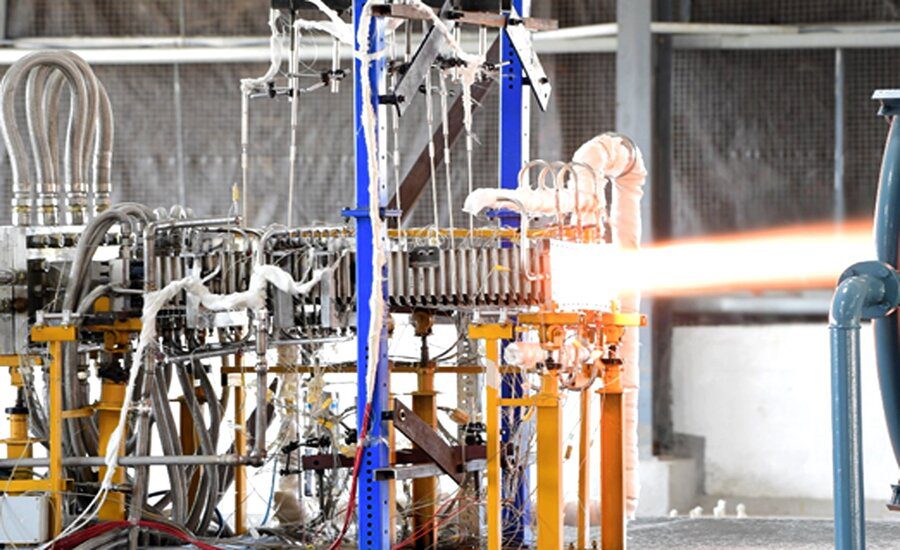
New Delhi: In a landmark achievement for India’s aerospace and defence capabilities, the Defence Research and Development Organisation (DRDO) has successfully conducted a long-duration ground test of a full-scale, actively cooled scramjet engine, marking a critical milestone in the nation’s hypersonic missile development.
The trial, carried out on January 9, 2026, demonstrated continuous operation for over 12 minutes at the DRDO’s Scramjet Connect Pipe Test (SCPT) Facility in Hyderabad.
What is Scramjet Engine
Scramjet (Supersonic Combustion Ramjet) engines represent one of the most technically challenging propulsion systems in modern aerospace engineering. Unlike traditional jet engines, scramjets operate efficiently at hypersonic speeds by compressing incoming air at supersonic velocities and sustaining combustion without moving parts.
Read also: Project Dhvani Explained: Inside DRDO’s Project Dhvani and Its Mach-7+ Strike Capability
This sophisticated technology is essential for hypersonic cruise missiles, which rely on air-breathing engines to maintain supersonic combustion over extended durations.
With this capability, such missiles can travel at speeds above 6,100 km/h, making them significantly harder to intercept with conventional defence systems.
Details of Scramjet Engine Trial
The DRDO’s Defence Research & Development Laboratory (DRDL) in Hyderabad conducted the test using an actively cooled full-scale scramjet combustor, designed and developed in collaboration with industry partners.
The active cooling system manages the extreme thermal loads produced during high-speed combustion—one of the major engineering challenges in hypersonic propulsion.
During the trial, the engine sustained combustion for over 12 minutes, a runtime significantly longer than previous tests. This performance builds on earlier milestones including a subscale scramjet test that ran for extended durations in April 2025, confirming the reliability and effectiveness of design and materials used in the system.
Importance of the Scramjet Engine Trial
This successful test also validates:
- Engine design and combustion stability
- Thermal management and active cooling systems
- State-of-the-art test infrastructure at SCPT
- All of which are crucial before progressing to flight-worthy engine testing.
India’s Strategic Edge in Hypersonic Capabilities
This milestone highlights India’s advancing prowess in hypersonic propulsion—a realm traditionally dominated by a few global powers.
India achieves a major hypersonic milestone |
— Ministry of Defence, Government of India (@SpokespersonMoD) January 9, 2026
Hyderabad-based DRDL, @DRDO_India, successfully conducted a 12+ minute long-duration ground test of a full-scale actively cooled scramjet combustor at its SCPT facility, strengthening India’s Hypersonic Cruise Missile programme.… pic.twitter.com/yQ4IN2B0SS
Hypersonic weapons and propulsion systems offer strategic advantages due to their speed, maneuverability, and survivability against modern defence shields.
India’s progress with scramjet technology signifies a shift in the nation’s defence posture, enabling development of next-generation weapons systems that can bolster deterrence and defence readiness in an increasingly competitive global security landscape.
Read also: India’s Most Powerful Nuclear Submarine: What Is the K-6 SLBM? Timeline, Speed & Range Explained