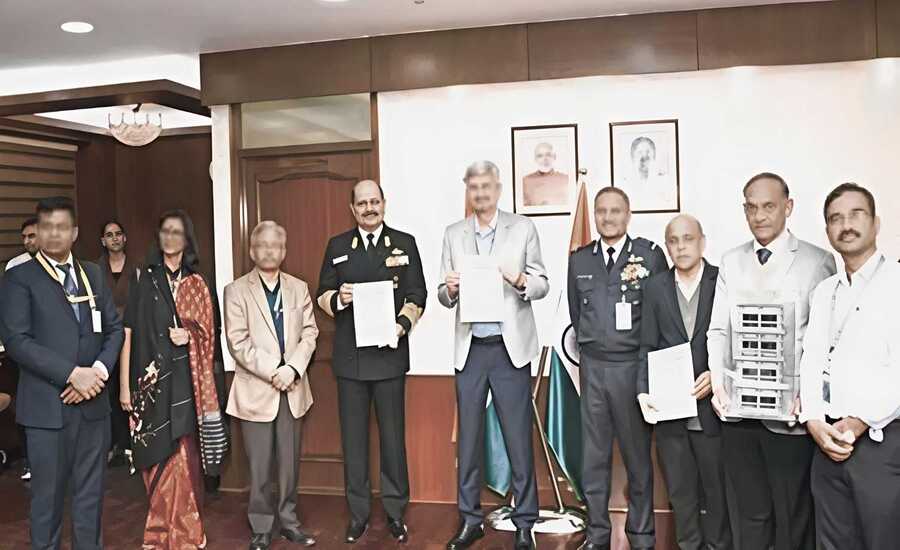
New Delhi: In a significant milestone for India’s defence-technology sector, the DRDO recently handed over seven cutting-edge indigenous technologies to the three services of the Indian Armed Forces under its Technology Development Fund (TDF) scheme. The move underscores New Delhi’s deepening push for self-reliance (or ātmānirbharta) in critical defence systems — spanning airborne electronic warfare, naval logistics, underwater operations, propulsion systems and battery technologies for next-generation platforms.
The handover was formalised during a high-level meeting of the DRDO Empowered Committee held at DRDO Bhawan in New Delhi on December 02, 2025, presided over by Secretary, Department of Defence R&D and DRDO Chairman Samir V. Kamat. Senior representatives from the Armed Forces, Department of Defence Production, and DRDO participated.
The Committee approved 12 new projects which included strategic, aerospace, naval and electronic warfare technologies during the meeting. These approvals were seen as a government sign which had a strong reliance on technology in the critical defense areas.
With this transfer, India takes another leap toward reducing import dependence for core defence technologies — a strategic objective aligned with national initiatives such as “Make in India.”
Background of DRDO TDF Scheme
The TDF scheme is one of the flagship initiatives of DRDO to catalyse development of “defence and dual-use systems, subsystems, components or technologies” through domestic industry, including MSMEs and startups.
Read also: Big Boost to Make in India: DRDO Integrates Next-Gen GaN AESA Long Range Radar System
Under this scheme, DRDO collaborates with Indian industry — offering technical guidance, test facilities, and transfer-of-technology (ToT) frameworks — to ensure that indigenous designs are matured into deployable products.
Over the past three years, the Ministry of Defence (MoD) has sanctioned a large number of R&D projects under various schemes (including TDF), approving 148 new projects. This reflects a strategic shift toward boosting domestic capacity for defence production.
Thus, the latest handover of seven new technologies can be seen as part of a sustained and expanding push by DRDO and the MoD to build a robust home-grown defence-industrial ecosystem.
What Technologies Were Transferred Under DRDO TDF Scheme — A Breakdown
DRDO has transferred seven indigenous technologies to the Indian Armed Forces under the Technology Development Fund (TDF) scheme.
The technologies strengthen India’s defence capabilities across airborne EW, naval operations, underwater communication, propulsion systems, energy storage, and resource sustainability.
High-Voltage Power Supply for Airborne Jammers
- Powers self-protection jammers on military aircraft.
- Enhances survivability in contested airspace by boosting electronic warfare capabilities.
Tide-Efficient Gangway for Naval Jetties
- Ensures safe movement of naval personnel between ships and shore.
- Functions effectively despite tidal variations, improving naval logistics.
Advanced VLF–HF Switching Matrix Systems
- Allows fast, secure switching between communication frequencies.
- Critical for reliable signalling in electronic warfare environments.
VLF Loop Aerials for Underwater Platforms
- Enables long-range underwater communication.
- Essential for submarines and submerged vessels operating at depth.
Indigenous Waterjet Propulsion System for Fast Interceptor Craft
- Increases speed, manoeuvrability, and stealth of small naval craft.
- Enhances coastal security and rapid-response operations.
Process for Recovery of Lithium Precursors from Used Batteries
- Recovers valuable lithium materials from spent Li-ion batteries.
- Reduces import dependence and supports battery lifecycle management.
Long-Life Seawater Battery System
- Provides long-endurance power for underwater sensors and surveillance.
- Improves maritime domain awareness with minimal maintenance needs.
Key Significance of DRDO TDF scheme for India’s Defence & Strategic Autonomy
Boost to Indigenous Capability & Import Substitution: By transferring homegrown technologies to the Tri-Services, DRDO is advancing India’s strategic goal of reducing reliance on foreign suppliers for critical defence systems. This is in line with governmental emphasis on indigenisation.
The fact that these technologies have been “designed, developed and extensively tested by Indian industry with close collaboration of DRDO experts and the Services” demonstrates maturity of domestic R&D and manufacturing capacities.
Wider Industrial Participation & Encouraging Startups, MSMEs: TDF is specifically designed to allow participation of small and medium enterprises and startups in defence R&D — offering them a pathway to contribute to critical national capabilities.
This transfer serves as a strong signal to Indian industry; that novel defence technologies can realistically transition from lab to field, encouraging further investment, innovation, and risk-taking from private and small-scale players.
Strategic Flexibility — Multi-Domain Relevance
The seven technologies span airborne, naval, and underwater domains (and even resource/material recovery), suggesting that India is not just focusing on one segment of defence. Rather, it is building complementary capabilities across multiple theaters — from airspace to maritime and underwater. This offers enhanced strategic flexibility and operational readiness.
Accelerated Induction — From Lab to Field
At the same committee meeting, DRDO approved an additional 12 new projects spanning strategic, aerospace, naval, and electronic-warfare technologies. This underscores that the TDF pipeline remains active and expanding.
Moreover, the Committee urged for expedited, end-to-end processing and smoother acquisition mechanisms to ensure that developed technologies are inducted into service quickly, aligning with evolving operational requirements.
Key Challenges and the Road Ahead
While the handover reflects success, there remain broader challenges. Historically, many defence R&D projects worldwide — including some under DRDO — have faced delays in testing, certification, production scaling and induction.
For the transferred technologies to make a real impact, they must undergo rigorous user trials, obtain certifications (especially for airborne or naval systems), and then be produced at scale. The success of TDF-based transfers will hinge not only on technical maturity but also on efficient procurement and manufacturing pipelines.
Furthermore, integration into existing platforms — for example, retrofitting a new power supply or jamming system on an aircraft, or deploying seawater battery-powered sensors — may present logistical, infrastructural and compatibility challenges.
Hence, consistent follow-through, policy support, continued budget allocations, and synergy between DRDO, industry and the Services will be critical.