New Delhi: The Economic Survey 2025–26 underscores the pivotal role of manufacturing and exports in securing India’s long-term growth prospects amid a fragmented and uncertain global economic environment, Chief Economic Advisor (CEA) V. Anantha Nageswaran said on Monday.
Speaking on the Survey, Nageswaran said the document lays out a clear policy direction for India to remain resilient against global headwinds, even as the country continues to outperform most major economies.
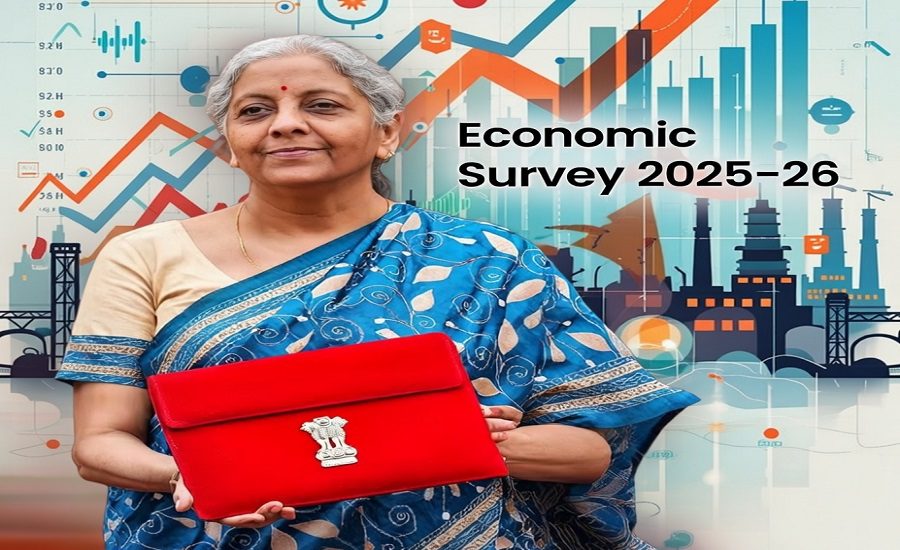
Survey Cover Reflects Core Policy Message
Highlighting the symbolism behind the Survey’s cover, the CEA said it reflects the central theme of the government’s growth strategy.
“The cover of this Economic Survey symbolises our key message, the importance of manufacturing and exports for India’s future growth in a highly fragmented and fractious global environment,” Nageswaran said.
According to him, strengthening manufacturing capacity and export competitiveness is essential for India to navigate rising global uncertainties and geopolitical fragmentation.
Read also: India’s AI Strategy Focuses on Inclusion, Jobs, and Open-Source Innovation: Economic Survey
Five-Part Survey Reviews Performance, Maps Future Priorities
The Economic Survey 2025–26 is structured into five parts, reviewing India’s current economic performance while outlining priorities for the future. It also highlights the preparation required by the country and society to meet growth ambitions in a challenging global context.
The Survey examines how India can sustain high growth while building resilience against external shocks.
IMF Sees India Growing at 7.3% in FY26
Nageswaran said India continues to be among the fastest-growing major economies globally, with strong growth projections for the current and coming years.
“The IMF predicts growth of 7.3 per cent for the year ending March 2026, while MOSPI estimates it at 7.4 per cent,” he said.
The IMF has also projected 6.4 per cent growth for the next two financial years, 2026–27 and 2027–28, reflecting confidence in India’s medium-term outlook.
India an ‘Oasis of Economic Performance’
Emphasising India’s relative strength, the CEA said the country’s growth trajectory stands out against the backdrop of slowing global growth.
“Whether for the current financial year or the future, India’s growth numbers stand out in comparison with the rest of the world. That is why we describe India as an oasis of economic performance in the global scenario,” Nageswaran noted.
GDP Growth Surpasses Pre-COVID Trend
The Survey highlights that India’s economic momentum has not only recovered after the pandemic but has also surpassed the pre-COVID growth trend.
“Real GDP growth before COVID was 6.4 per cent, it was 6.5 per cent in FY25, and this year it is projected at 7.4 per cent,” Nageswaran said.
This marks a clear acceleration in growth compared to the pre-pandemic average.
Strong Private Consumption Supporting Growth
Private consumption continues to be a key driver of India’s economic expansion.
According to the CEA, private final consumption expenditure is estimated to grow by 7 per cent in the current year, following 7.2 per cent growth in the previous year. Strong household demand has provided stability to the growth cycle amid external uncertainties.
Investment Cycle Shows Clear Revival
The Economic Survey flags a significant improvement in investment activity, with capital formation expected to outperform both recent years and the earlier decade marked by stress in banking and corporate balance sheets.
“In real terms, gross fixed capital formation is expected to perform significantly better than in FY25 and far better than during the 2012–2020 period, when growth averaged just 6.3 per cent per annum due to banking and corporate balance sheet stress,” Nageswaran said.
This revival in investment signals growing confidence in India’s economic fundamentals.
Moderate Inflation Creating Favourable Conditions
The CEA said India has managed to combine high growth with a benign inflation environment, supporting both consumption and investment.
“We are achieving this high growth rates, consumption and investment spending amidst very moderate inflation environment,” he said.
Inflation is projected at around 1.7 per cent on average for the first nine months of the year, largely due to a deflationary trend in the food price index.
Underlying inflation pressures remain contained as well.
“If you take out gold and silver, core inflation is 2.9, well below the 4 per cent threshold with which the headline inflation is pursued by the central bank,” Nageswaran said, adding that benign inflation trends are likely to continue into the next financial year.
Fiscal Deficit Reduction on Track
On public finances, the Economic Survey indicates steady progress in fiscal consolidation following the pandemic.
“In 2021–22, the government said we would bring down the COVID-year fiscal deficit to less than half, and we are about to deliver on that this year, with an estimated 4.4 per cent of GDP as the Union government’s fiscal deficit,” the CEA said.
He also highlighted a sharp improvement in the primary deficit.
“The primary deficit has come down from 5.7 per cent and is expected to be 0.8 per cent this year,” Nageswaran noted.
Capital Expenditure Share Rises
Improved tax buoyancy and better expenditure prioritisation have helped enhance the quality of government spending.
Nageswaran pointed out that the government’s push for infrastructure has strengthened capital expenditure.
“The effective capex rate has gone up from 2.7 per cent pre-COVID-19 to 3.9 per cent post-COVID as a percentage of GDP,” he said.
Credit Rating Upgrades Reflect Growing Confidence
India’s improving macroeconomic stability and investment-led growth have translated into external recognition, including multiple credit rating upgrades.
“That is the reason why last year we received three credit rating upgrades beginning with Morningstar DBRS in May, Standard & Poor’s in August, and R&I Investment Ratings from Japan in September,” the CEA said.
Manufacturing and Exports in Focus
The Survey’s emphasis on manufacturing and exports signals the government’s intent to deepen India’s integration into global value chains, reduce vulnerability to external disruptions, and enhance competitiveness.
While domestic demand remains a key pillar of growth, the Survey stresses that productivity-led manufacturing expansion and export growth will be essential to sustain high growth over the long term.
India Positioned as a Global Bright Spot
With GDP growth projected to remain robust, inflation under control, and fiscal consolidation progressing steadily, the Economic Survey 2025–26 positions India as a rare bright spot in the global economy.
However, it also underscores the need for continued reforms, investment, and export-led expansion to maintain momentum and build resilience in an increasingly uncertain global landscape.