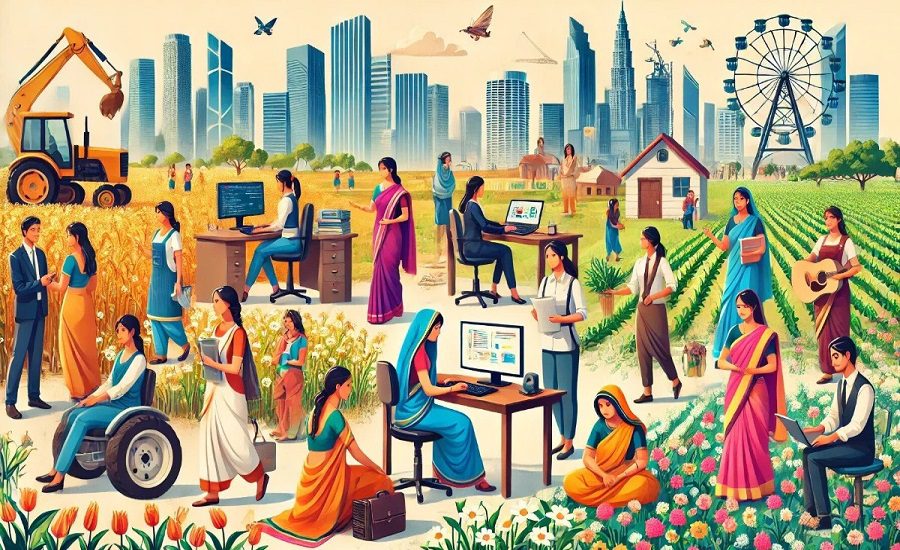
New Delhi: India’s workforce of over 56 crore people is emerging as a significant engine of economic growth, with women increasingly taking centre stage as both workers and entrepreneurs. The latest Economic Survey 2025–26 notes that rising labour force participation, falling unemployment, and steady job creation across organised and unorganised sectors reflect India’s progress towards a more inclusive growth model.
To fully realise the demographic dividend, the Survey stresses the need to move beyond mere job quantity, focusing instead on quality employment and sustainable livelihoods, particularly for women. Structural reforms, targeted policy interventions, and recently enacted Labour Codes are designed to balance labour market flexibility with worker welfare, while boosting industry competitiveness.
Rising Female Workforce Participation
India has seen a remarkable improvement in the Female Labour Force Participation Rate (FLFPR), rising from 23.3% in 2017–18 to 41.7% in 2023–24. Over the same period, the unemployment rate declined sharply from 5.6% to 3.2%, indicating growing economic inclusion and empowerment of women.
The number of women-led enterprises is also increasing. According to Women and Men in India 2024, the share of female-headed proprietary establishments grew from 24.2% in 2021–22 to 26.2% in 2023–24, with the manufacturing sector accounting for the highest share at 58.4%. States like West Bengal, Karnataka, Gujarat, and Andhra Pradesh, which report a higher presence of women-led establishments, also record higher FLFPR.
Women Entrepreneurs as Drivers of Economic Growth
The Survey highlights the role of women entrepreneurs in India’s transition towards higher-value economic activity. Key enablers include:
- Integrating self-help groups (SHGs) into the MSME ecosystem
- Expanding credit access and procurement opportunities
- Providing mentorship and business support
State-led initiatives are setting benchmarks:
Telangana’s WE-Hub connects women-led startups with investors and innovation ecosystems.
Kerala’s Kudumbashree and Maharashtra’s Mahila Arthik Vikas Mahamandal link microfinance, enterprise development, and formal credit, enabling women to enter non-traditional sectors such as logistics, construction, and facility management.
Persistent Barriers to Women’s Participation
Despite progress, women face structural barriers including:
- Limited mobility and unsafe transport options
- Lack of affordable housing
- Inflexible work arrangements that clash with caregiving responsibilities
Highly educated women often remain concentrated in low-productivity or part-time roles. PLFS 2023–24 data shows women aged 25+ with advanced degrees account for just 2.9% of the employed female workforce.
Women’s participation in STEM disciplines also remains limited, with 43% of enrolments in 2021–22, constrained by social norms, care responsibilities, early marriage, and higher education costs. Expanding STEM access and future-oriented skills is essential to bridging gaps and enabling women to enter white-collar services and modern manufacturing.
Policy Focus: Mobility, Housing, Care, and Skills
The Survey calls for a multipronged policy approach to enhance women’s participation:
- Urban mobility: safer, affordable transport
- Housing solutions: working women’s hostels and rental housing; examples include Sakhi Niwas and Tamil Nadu’s Thozhi Hostels
- Women-centric industrial clusters to improve access to urban jobs
- Reducing unpaid care burden: expanded Anganwadi networks, community crèches, and employer-linked childcare
- Skills development: aligning training with industry demand in manufacturing, renewable energy, digital services, and agro-processing
- Returnship/back-to-work programs: enabling women to re-enter the workforce after career breaks
Flexible Work and Labour Reforms
The new Labour Codes have opened opportunities for women by enabling work-from-home and hybrid arrangements, alongside provisions for maternity benefits, equal pay, and workplace safety. Expanding social security, income protection, and grievance redressal for gig and platform workers is also a priority.
Towards Viksit Bharat 2047
The Survey concludes that increasing women’s workforce participation and entrepreneurship is not just a social goal but a strategic economic imperative. Higher female employment:
Supports household welfare
Strengthens labour market outcomes
Enhances productivity
These measures are central to India’s vision of a more inclusive, resilient, and prosperous economy, moving towards Viksit Bharat by 2047.
Key Takeaways
- FLFPR increased from 23.3% (2017–18) to 41.7% (2023–24)
- Unemployment fell from 5.6% to 3.2%, reflecting economic inclusion
- Women-led enterprises rose to 26.2% of proprietary establishments
- Policy interventions: Labour Codes, SHG integration, mobility, housing, care economy, skills training
- Focus on high-value sectors: manufacturing, STEM, digital services, renewable energy
- Women’s participation is a strategic driver of India’s inclusive economic growth