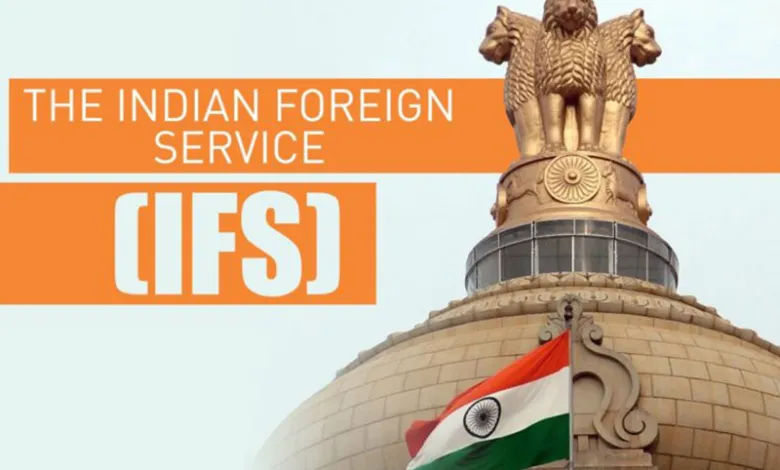
New Delhi: The Indian Foreign Service (IFS) is witnessing a gradual generational transition at its highest levels, with diplomats from the 1992–1994 batches increasingly moving into positions traditionally occupied by officers from the 1988–1990 cohorts.
The change comes as a number of senior IFS officers from the older batches approach superannuation or reach the permissible limits of tenure extensions. As vacancies emerge at some of India’s most important diplomatic missions, the next generation of mid-senior diplomats is increasingly being considered for assignments at strategically significant capitals.
The transition is particularly notable because the 1992–1994 cohort is now at a stage in its career where many officers have accumulated decades of experience across bilateral diplomacy, multilateral negotiations, headquarters assignments and ambassadorial missions.
Among the most visible examples of this transition is Vikram K. Doraiswami, a 1992-batch IFS officer, who was appointed India’s next Ambassador to China in March 2026 after serving as High Commissioner to the United Kingdom. The Ministry of External Affairs officially announced his appointment on March 19, 2026.
From the 1988–1990 Cohort to the 1992–1994 Generation
For several years, diplomats belonging to the 1988–1990 batches have occupied some of the most consequential positions in India’s external affairs establishment.
Their generation has handled diplomatic assignments during major shifts in India’s foreign policy, including the post-Cold War restructuring of global relations, the expansion of India’s strategic partnerships, the rise of China, changes in the global security architecture and the emergence of new multilateral groupings.
However, the career cycle of this cohort is now creating space for the officers who entered the IFS a few years later.
Read Also: Who Is Hansraj Singh Verma? 2008-Batch IFS Officer Appointed India’s Ambassador to Cuba
The 1992–1994 batches are consequently emerging as an important pool for high-level ambassadorial and high commissioner appointments. Their rise is expected to become increasingly visible over the coming year as more senior positions become available.
The development is not simply a matter of replacing one set of officers with another. It reflects the normal progression of a diplomatic service in which officers move through increasingly senior assignments as their predecessors retire or complete their permissible tenures.
1992 Batch Already Holding Key Assignments
The movement of the 1992 batch into strategically important missions is already visible.
Vikram K. Doraiswami, who joined the IFS in 1992, has been appointed Ambassador of India to China after serving as India’s High Commissioner to the UK. The Embassy of India in Beijing records that Doraiswami joined the IFS in 1992 and had earlier served at the Indian mission in Beijing, where he worked for nearly four years in the late 1990s.
His appointment is significant in the context of the wider generational transition because Beijing is one of India’s most strategically sensitive diplomatic stations.
The appointment also illustrates how officers from the 1992 cohort are moving into missions requiring extensive experience in bilateral relations, geopolitical negotiations and crisis diplomacy.
London Also Moves Into the Newer Cohort
The transition is similarly visible in London.
Kumaran Periasamy, a 1992-batch IFS officer, took charge as India’s High Commissioner to the United Kingdom on May 13, 2026, after previously serving as Secretary (East) in the Ministry of External Affairs. The High Commission of India in London identifies him as a 1992-batch officer and records his previous assignments in Cairo, Tripoli, Brussels, Islamabad, Washington, Colombo, Doha and Singapore, among others.
His appointment means that two of the most closely watched diplomatic capitals for India — London and Beijing — are now headed by diplomats belonging to the 1992 batch.
This provides a concrete indication of how the next generation is already moving into positions traditionally associated with the most senior serving diplomats.
The 1994 Batch Is Also Moving Up
The generational transition is not confined to the 1992 cohort. Officers from the 1994 batch are also occupying increasingly important positions within the diplomatic establishment.
One example is Rudrendra Tandon, a 1994-batch IFS officer who assumed charge as Secretary (East) in the Ministry of External Affairs on May 11, 2026. Before taking up the position, he served as India’s Ambassador to Greece. His career has included postings in Paris, Algiers, Kabul and Moscow, as well as assignments dealing with Pakistan, the Prime Minister’s Office, UN affairs and regional organisations.
The appointment demonstrates that the 1994 cohort is also entering the upper levels of the foreign-policy establishment, both at missions abroad and within South Block.
Another prominent 1994-batch officer, Pranay Verma, has also moved into another significant diplomatic assignment. The Ministry of External Affairs announced in April 2026 that Verma, then High Commissioner of India to Bangladesh, had been appointed Ambassador of India to Belgium and the European Union.
Similarly, Neeta Bhushan, another 1994-batch officer, was appointed Ambassador of India to Poland in February 2026 after serving as High Commissioner to New Zealand.
Together, these appointments indicate the increasing presence of the 1994 cohort across important bilateral and multilateral assignments.
Why the Transition Matters
The timing of this generational change is particularly important because the international environment in which these officers will operate is markedly different from the one their predecessors encountered at the beginning of their careers.
India’s diplomacy today involves simultaneous engagement with the United States, Russia, China, Europe and the Global South, alongside expanding relationships in the Indo-Pacific, West Asia, Africa and Latin America.
The diplomatic establishment is also dealing with a more fragmented international order, competing strategic partnerships, trade and technology negotiations, supply-chain realignments, geopolitical conflicts and increasingly complex multilateral negotiations.
As officers from the 1992–1994 cohorts move into the most important missions, they bring with them experience accumulated over roughly three decades of service.
Their careers have generally spanned the period from the post-Cold War years to the emergence of a more multipolar international system. Many have served both at headquarters and abroad, giving them exposure to different dimensions of foreign-policy formulation and implementation.
Washington, Moscow, Beijing and London in Focus
The most closely watched part of this transition will be the composition of leadership at Tier-I diplomatic missions, particularly in capitals such as Washington, Moscow, Beijing and London.
These missions have traditionally been among the most important postings in the IFS because of their direct connection with India’s strategic, economic, security and political interests.
The movement of 1992–1994 batch officers into such assignments therefore represents more than a routine reshuffle of diplomatic personnel. It marks the gradual arrival of a cohort that is now reaching the senior-most stage of its professional career.
At the same time, it would be premature to assume that every Tier-I posting will necessarily be filled exclusively by officers from these three batches. Ambassadorial appointments depend on the Government’s requirements, individual experience, vacancies and the broader diplomatic context.
What is increasingly evident, however, is that the 1992–1994 cohort has become an important pool for senior diplomatic assignments.
A New Generation for a Changing Global Order
The transition also highlights how the IFS itself evolves through successive cohorts.
Officers from the 1988–1990 batches built their careers during one phase of India’s emergence as a major diplomatic actor. The 1992–1994 generation, meanwhile, entered the service during the early post-Cold War period and has subsequently worked through India’s expanding engagement with major powers, regional organisations and multilateral institutions.
Their experience now places them in a position to take charge of missions at a time when India’s foreign-policy priorities are becoming increasingly diverse.
The generational change, therefore, is best understood as an institutional progression within the IFS, rather than an abrupt change in diplomatic direction. As the older cohort reaches retirement and tenure limits, the officers immediately behind them are moving into the positions that form the upper tier of India’s diplomatic network.
With appointments such as Doraiswami in Beijing, Periasamy in London and senior roles for officers such as Tandon and Verma, the transition is already visible. The coming year is likely to make the changing age and batch profile of India’s senior diplomatic leadership even more apparent.