New Delhi: External Affairs Minister Dr. S. Jaishankar has officially launched the BRICS 2026 logo, official website, and theme for BRICS 2026—marking a strategic milestone as India assumes the rotating chairmanship of the influential multilateral forum this year.
The unveiling event, held in New Delhi on January 13, signifies the beginning of a year-long diplomatic effort where India will steer BRICS—a bloc representing nearly half of the world’s population and a sizable share of global economic output—through evolving geopolitical and economic challenges.
India Begins Its BRICS 2026 Chairmanship
India officially took over the BRICS presidency at the start of 2026, succeeding Brazil and underscoring its growing leadership role among emerging economies.
BRICS (an acronym for Brazil, Russia, India, China, and South Africa) has expanded in recent years to include Egypt, Ethiopia, Iran, the UAE, and Indonesia as full members, reflecting its expanding global footprint.
Collectively, these member nations represent approximately 49.5% of the global population, around 40% of global GDP, and nearly 26% of worldwide trade — highlighting the bloc’s strategic significance.
Symbolism and Significance: The BRICS 2026 Logo
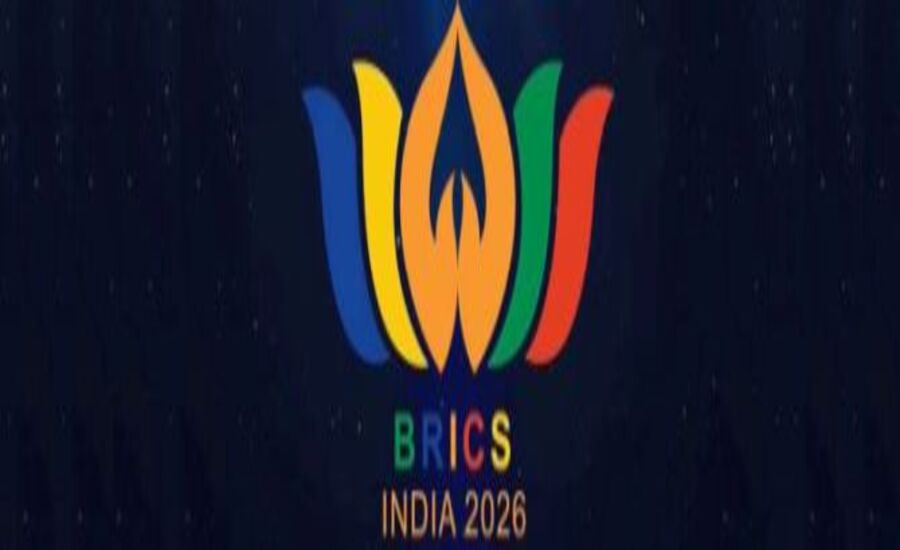
At the center of the BRICS India 2026 visual identity is a new lotus-inspired logo, carefully crafted to blend cultural symbolism with global partnership motifs:
Lotus Motif: A reflection of India’s cultural heritage and resilience.
Petal Colors: Each petal incorporates hues representing BRICS member nations, symbolizing unity in diversity.
Namaste Symbol: The center of the logo features the traditional Namaste gesture, embodying cooperation, respect, and mutual dialogue.
Tagline: “Building for Resilience, Innovation, Cooperation and Sustainability”—capturing the thematic focus of India’s chairmanship.
Officials describe the BRICS 2026 logo as emphasizing a people-centric and collaborative vision, resonating with India’s broader diplomatic outlook.
Official BRICS 2026 Website: A Centralized Digital Portal
Alongside the logo launch, the External Affairs Minister inaugurated the official BRICS 2026 website—designed as a central hub for all information regarding the forum, including:
- Upcoming meetings and locations
- Official declarations and communiqués
- Project initiatives and thematic updates
- Resources for academia, media, and public engagement
The platform is poised to enhance transparency and accessibility for stakeholders across member nations as well as international observers.
Strategic Priorities of BRICS 2026 Under India’s Leadership
Speaking at the launch event, EAM Dr. S. Jaishankar articulated India’s vision for the BRICS 2026 chairmanship.
While reaffirming the bloc’s collaborative roots, he outlined four key strategic priorities that will guide India’s stewardship of the forum:
1. Resilience: Strengthening systems and institutional capacity to address global shocks (economic, health, climate, and energy disruptions).
2. Innovation: Promoting technological cooperation and forward-looking solutions across digital, green energy, and scientific sectors.
3. Cooperation: Enhancing diplomatic relations and inclusive development strategies among member states.
4. Sustainability: Prioritizing equitable and environmentally sound development objectives.
According to Jaishankar, these priorities will form the backbone of policies and dialogues across political, economic, and cultural avenues throughout the year.
BRICS at a Crossroads: Multilateral Reform and Global Impact
India’s chairmanship arrives at a moment when global institutions face calls for reform to better reflect contemporary geopolitical and economic realities. In his address, Jaishankar emphasized BRICS’ potential to function as a constructive platform complementing the broader multilateral system while advocating for reforms in institutions like the United Nations, World Trade Organization, World Bank, and IMF.
India aims to position BRICS as an arena for dialogue that elevates emerging economies and promotes inclusive global governance models.
Celebrating Two Decades of BRICS Cooperation
2026 also marks the 20th anniversary of BRICS, which originated from the initial BRIC grouping conceptualized by Goldman Sachs as a way to project long-term economic growth potential for Brazil, Russia, India, and China.
Formal diplomatic structuring began in 2006, and South Africa joined soon after, creating the “S” in BRICS.
Since its inception, BRICS has become a key forum for emerging market cooperation on issues ranging from trade and investment to sustainable development and global equity.
Looking Ahead: India’s Global Diplomacy in 2026
Under India’s leadership, BRICS nations are expected to deepen cooperation in key sectors such as:
- Digital public infrastructure and payment systems
- Climate change adaptation and clean energy transitions
- Technological innovation including AI and space partnerships
- Trade diversification and reduced dependency on traditional financial architectures
Diplomats and think-tanks alike are watching closely as India leverages its strategic autonomy and constructive engagement to foster cohesion across members—even as geopolitical tensions persist.
Read also: S. Jaishankar Recalls His 1977 UPSC Interview on the Day Emergency Was Lifted: ‘That Got Me Through’