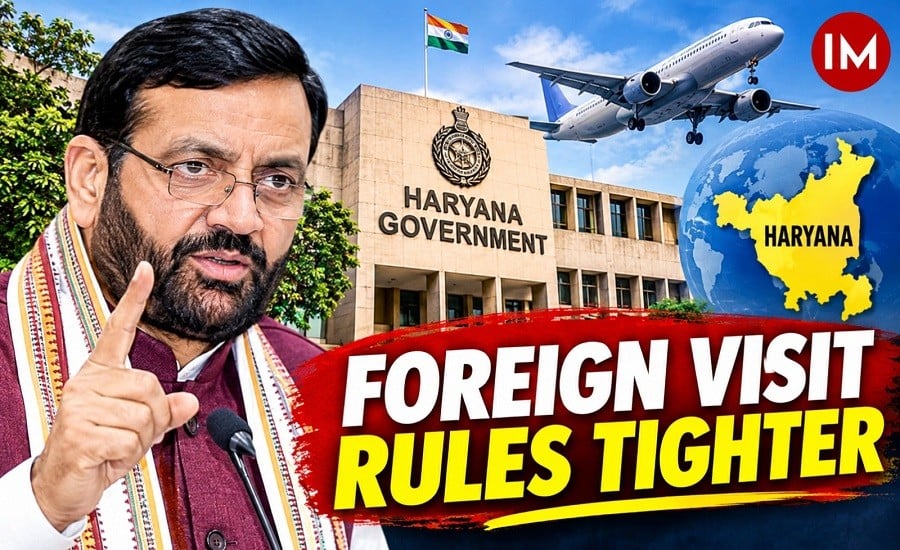
Chandigarh: The Haryana government has introduced significant changes to the rules governing official foreign visits by government officers and employees, making scrutiny by the Chief Secretary’s office mandatory before any proposal can be forwarded to the Chief Minister’s Office (CMO) for final approval.
Under the revised procedure, no government department, officer, board or corporation will be permitted to send proposals for official foreign tours directly to the CMO. Instead, all such files must first be routed through the Chief Secretary’s office for examination and clearance.
The decision follows concerns within the state government that proposals for foreign delegations and official visits were being forwarded directly to the Chief Minister’s Office without adequate scrutiny of administrative requirements, eligibility conditions and financial implications.
The Department of Personnel has issued instructions to ensure compliance with the revised procedure across government departments and associated organisations.
Chief Secretary’s Clearance Now Mandatory for Foreign Tour Proposals
The most significant change is the introduction of a mandatory approval stage at the level of the Chief Secretary.
Previously, several government departments, boards and corporations had been forwarding foreign visit proposals directly to the Chief Minister’s Office for approval.
Under the new arrangement, such direct submissions will no longer be permitted.
All proposals must first reach the Chief Secretary’s office, where they will be examined in accordance with applicable administrative rules and financial requirements.
Only after receiving clearance from the Chief Secretary’s office will the files be forwarded to the CMO for final approval.
The revised process establishes a uniform administrative route for considering foreign travel proposals and introduces an additional level of scrutiny before they reach the Chief Minister.
Read also: No Direct Proposals to CM: Haryana Adds Chief Secretary’s Office to Foreign Travel Approval Process
Rules Applicable to IAS, IPS and All Categories of State Employees
The new instructions cover a wide range of government officers and employees.
They apply to officers belonging to the All India Services (AIS), including the Indian Administrative Service (IAS), Indian Police Service (IPS) and Indian Forest Service (IFoS).
The revised procedure will also apply to Group A, Group B, Group C and Group D employees working under the Haryana government.
In addition, officers and employees of state boards, corporations and statutory bodies will come under the same approval mechanism.
The government has therefore extended the revised procedure beyond senior bureaucrats to cover official foreign travel proposals across different levels of the state administration.
Study Tours, Training Programmes and International Conferences Covered
The revised instructions are not limited to conventional official foreign tours.
They also cover study visits, overseas training programmes, international meetings, conferences and seminars attended by government officers and employees in their official capacity.
Foreign delegations involving officers from government departments, boards, corporations and other statutory organisations will also be required to follow the prescribed route.
This means that proposals for participation in international administrative programmes, professional training sessions and official conferences will have to undergo scrutiny at the Chief Secretary’s office before being considered for final approval.
The objective is to ensure that different categories of official foreign travel are examined through a common administrative process.
What Will the Chief Secretary’s Office Examine?
Under the new arrangement, the Chief Secretary’s office will scrutinise foreign visit proposals on several important parameters before granting clearance.
One of the primary considerations will be the eligibility of the officer or employee proposed for the foreign visit.
The office will also examine the frequency of foreign visits undertaken by the concerned officer to determine whether the proposed travel is justified.
Another important factor will be the necessity of the visit, including its relevance to official duties and administrative requirements.
Budgetary provisions will also form part of the scrutiny. The Chief Secretary’s office will examine whether adequate financial provisions are available for the proposed visit and whether the expenditure complies with applicable requirements.
These checks are intended to ensure that foreign visits are undertaken for legitimate official purposes and receive appropriate administrative and financial examination.
Foreign Cooperation Department Also Directed to Follow New Procedure
The Haryana Department of Personnel has issued specific instructions to the Commissioner and Secretary of the Department of Foreign Cooperation regarding the revised approval mechanism.
According to the directions, proposals for foreign visits processed by the Department of Foreign Cooperation must also be routed through the Chief Secretary’s office.
The department will therefore not be permitted to forward such proposals directly to the Chief Minister’s Office without the mandatory scrutiny.
The instructions bring proposals handled by the Foreign Cooperation Department within the same approval framework applicable to other government departments.
This is particularly significant because the department deals with matters involving international engagement and cooperation.
Why Did the Haryana Government Change the Rules?
The changes were introduced after the state government became aware that several departments, boards and corporations were sending proposals for foreign delegations and official visits directly to the Chief Minister’s Office.
The government found that this practice could result in important administrative and financial aspects not receiving adequate examination before the proposals reached the final approving authority.
Concerns were raised about whether eligibility conditions, the necessity of travel, applicable rules and budgetary provisions were being properly scrutinised.
The absence of a mandatory examination at the Chief Secretary’s level was seen as a gap in the existing procedure.
The revised system seeks to address this issue by ensuring that every proposal passes through a central administrative authority before being placed before the Chief Minister.
Chief Minister Retains Final Approval Authority
Although the government has introduced an additional scrutiny stage, the Chief Minister’s Office will continue to be the final approving authority under the procedure described in the instructions.
The Chief Secretary’s office will examine proposals and provide clearance before they are forwarded for the Chief Minister’s consideration.
The revised arrangement therefore changes the route through which foreign travel proposals are processed rather than transferring final approval powers from the Chief Minister.
For government departments and officers, the change means that proposals will need to be prepared with sufficient justification, relevant administrative details and budgetary information before being submitted for scrutiny.
Focus on Administrative Oversight and Financial Accountability
The revised foreign travel approval mechanism reflects the Haryana government’s decision to strengthen administrative oversight over overseas visits undertaken in an official capacity.
By requiring all proposals to pass through the Chief Secretary’s office, the government aims to ensure greater consistency in the examination of foreign tours, training programmes, study visits and international engagements.
The changes are also expected to bring greater attention to the necessity and frequency of such visits, along with the availability of funds and compliance with applicable rules.
For IAS, IPS and IFoS officers, state government employees and personnel of boards and corporations, the mandatory routing requirement will now be an important part of the official foreign travel approval process.