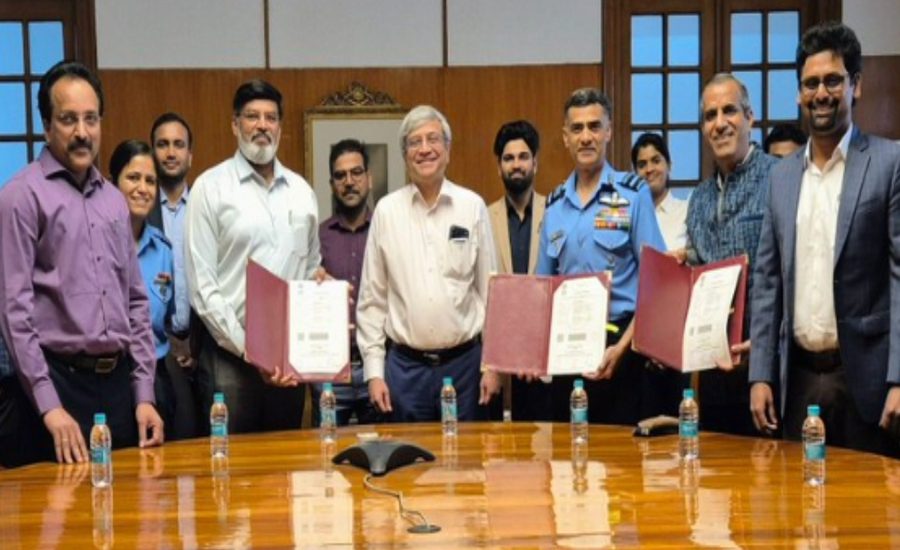
New Delhi: The Indian Air Force (IAF) has signed a strategic Memorandum of Agreement (MoA) with the Foundation for Science Innovation and Development (FSID) at the prestigious Indian Institute of Science (IISc) in Bengaluru to jointly develop a homegrown hypersonic propulsion system.
This landmark collaboration marks a major push towards defence self-reliance, with advanced air-breathing engine technology aimed at powering future high-speed defence platforms for India’s aerial and strike capabilities.
Details of IAF IISC Hypersonic Propulsion System Deal
On January 29, 2026, the Indian Air Force formalised an MoA with FSID and IISc to focus on the indigenous development of an advanced air-breathing propulsion system, designed for hypersonic flight — speeds exceeding Mach 5 (five times the speed of sound).
Unlike rocket engines that carry both fuel and oxidiser, air-breathing propulsion systems draw oxygen directly from the atmosphere, making them lighter, more fuel-efficient, and capable of sustained high-speed operation. This system is expected to use advanced technologies such as scramjet or dual-mode ramjet engines to reach hypersonic performance.
What is the Importance of IAF IISC Hypersonic Propulsion System Deal
The IAF IISC hypersonic propulsion system deal represents a key milestone under India’s Atmanirbhar Bharat mission, aimed at reducing the country’s reliance on foreign aerospace technology. By nurturing domestic R&D and aerospace manufacturing, the IAF hopes to build propulsion systems that can be integrated into future missiles, drones, and aircraft.
Application in Defence Systems
With this technology, India could field next-generation hypersonic cruise missiles, long-range stand-off weapons, or high-speed unmanned aerial vehicles (UAVs) capable of penetrating advanced air defence systems. These capabilities would significantly enhance India’s aerial strike and deterrence posture.
Role of IISc and FSID
The Indian Institute of Science (IISc), based in Bengaluru, brings deep expertise in aerospace engineering, particularly in hypersonics and propulsion. Its Combustion, Gasification and Propulsion Laboratory has been at the forefront of engine research to simulate and test extreme flight conditions.
The Foundation for Science Innovation and Development (FSID) — a not-for-profit innovation bridge — will facilitate technology transfer and manage collaboration between the academic and defence sectors. Together, these institutions form a scientific backbone for achieving cutting-edge propulsion breakthroughs.
Where India Stands in the Global Hypersonics Race
Hypersonic propulsion and flight systems represent a frontier technology largely dominated by global powers like the United States, Russia, and China. India has already demonstrated its own capabilities — notably the Hypersonic Technology Demonstrator Vehicle (HSTDV) trials by DRDO and recent scramjet tests — but integrating this into fully functional systems requires sustained investment and cross-sector collaboration.
Strategic Implications and Future Prospects
Against the backdrop of rising regional tensions and defence modernization, hypersonic systems offer dramatic advantages: rapid strike capability, reduced response times, and increased survivability against modern air defences. This new pact is likely to accelerate India’s progress towards operational hypersonic platforms.
Boost to Research Ecosystem
The partnership will also promote educational and R&D linkages, enabling IAF personnel to work alongside academics, and push future innovations in propulsion technologies. This could spawn a new defence-technology ecosystem involving startups and industry partners.
Read also: Indian Army Joins Hands with IISc Bengaluru and Indy Astra to Develop Fully Indigenous AI System